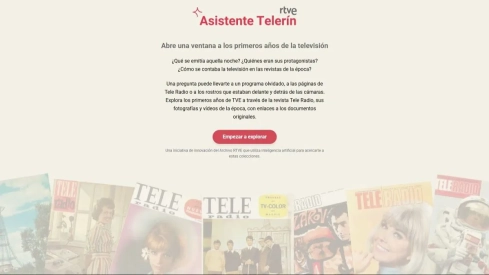
RTVE has presented Telerín, a new tool based on artificial intelligence that allows exploring the first years of Spanish Television's history through questions formulated with the user's own words. Available since this Tuesday, October 27, coinciding with TVE's 70th anniversary, the assistant offers free access without registration to historical documents, images, and videos from the corporation's archive. Its objective is to facilitate the consultation of an audiovisual heritage that until now required a better understanding of how its collections were organized.
What children's programs were broadcast on TVE in 1968? What did the magazine Tele Radio advertise for Christmas 1965? Who appeared on its covers during those years? These are some of the queries that can be made through this platform, which allows locating historical materials based on dates, program names, or protagonists. Users can access the assistant from the website telerin.rtve.es/telerin, without having to create an account or use technical terms to formulate their searches.
📺 RTVE presenta 'Telerín', una nueva forma de descubrir la historia de TVE con inteligencia artificial. Una iniciativa de innovación del @ArchivoRTVE.
— RTVE Comunicación y Participación (@RTVE_Com) October 27, 2026
📺 Disponible de forma gratuita a través de https://t.co/nglmYxOLoS, coincidiendo con el #70AñosTVE.https://t.co/6ZeyMw0rP9 pic.twitter.com/1BJDMESJLx
One of the main collections incorporated into Telerín is the magazine Tele Radio, whose issues span from late 1957 to December 1969. Its pages gather information on TVE and Radio Nacional de España programming, interviews, reports, opinion articles, and advertising, material that allows reconstructing both the evolution of Spanish radio and television and the social and cultural changes of the era. The tool also includes issues of 'TVE es noticia', a publication aimed at media outlets between 1967 and 1969, in addition to more than 2,000 digitized photographs from the 'Tele Radio' archive and a selection of preserved videos from those years.
The initiative is not limited to locating documents: it also allows consulting the original sources to verify information and continue researching independently. The answers include links to the materials used, while the digitized broadcast records from the Archivo General de la Administración help to cross-reference the announced programming with the broadcasts that were finally made. RTVE warns, however, that the results may be conditioned by the quality of the digitization and the automatic text recognition, so it recommends consulting the original documents to expand or verify the data.
Telerín is part of an innovation project of the RTVE–Universidad de Zaragoza Chair, promoted by the RTVE Archive and developed by the corporation's Systems and Innovation Directorate. The tool explores how artificial intelligence can facilitate access to documentary and audiovisual heritage, both for the general public and for researchers interested in the history of Spanish television