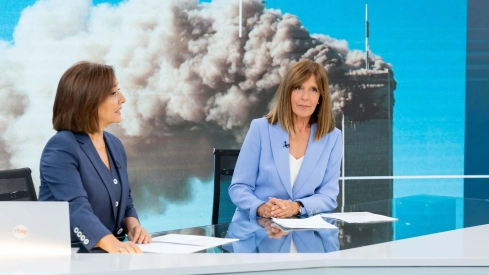
RTVE has looked to its past to celebrate its 70 years of history. The public corporation broadcast this October 19 in prime time El Telediario de nuestras vidas, a special edition that brought back some of the most recognized journalists from its news programs to recall the events that have defined recent history. A reunion with television memory that brought back to the set faces that for decades have accompanied viewers from their homes.
With original idea and direction by Carlos del Amor and production by Antonio Casado Ruiz, the program brought together professionals such as Iñaki Gabilondo, Matías Prats, Ana Blanco, Pedro Piqueras, Pepa Bueno, Olga Viza, María Escario, Manuel Campo Vidal, Lorenzo Milá and Carlos Franganillo. Paco Montesdeoca and Mónica López, linked to weather information, also participated. The broadcast also featured the presence of Eduardo Sancho, considered the first presenter in the history of Telediario, who reappeared before the cameras at 100 years old.
Empieza el #ElTDdenuestrasvidas con Eduardo Sancho,el primer presentador de la historia del Telediario junto a David Cubedo y Jesús Álvarez.
— Telediarios de TVE (@telediario_tve) October 19, 2026
A sus 100 años, se pone al frente del informativo para comenzar una edición muy especial por los #70AñosTVE. https://t.co/QLLFK4XVB2 pic.twitter.com/VXF47shWKb
A journey through the news that has marked history
The special has maintained the usual structure of a Telediario (news program), albeit with a fundamental difference: instead of focusing on the day's current events, it has revisited events that are part of collective memory. The COVID-19 pandemic, the attempted coup d'état on 23F, the September 11 attacks, and various political, war, and sports episodes have been featured in a review where each journalist has once again lent their voice to some of the most significant moments of their career, as well as the inclusion of a fragment of Queen Letizia, when she was a presenter, saying good night.
#ElTDdenuestrasvidas | En estos 70 años, muchos periodistas han saludado a los telespectadores con un «buenas tardes» o un «buenas noches» antes de comenzar el informativo.
— Telediarios de TVE (@telediario_tve) October 19, 2026
Y sí: como vemos en este repaso, también lo hizo una reina… #70AñosTVE pic.twitter.com/Lmvy54mgwu
The selection of news has been one of the great challenges of the production. "70 years have to fit into 45 minutes and a lot had to be discarded," explains Del Amor, who also highlights the difficulty of bringing professionals together and getting them to present a news program again without knowing beforehand what news item they would cover.
The reunions have been one of the great attractions of the broadcast. Carlos Franganillo recalled his time at the helm of Telediario during the pandemic; Iñaki Gabilondo reviewed 23F and the political evolution of Spain; Ana Blanco revisited the 9/11 attacks; and Pedro Piqueras addressed the coverage of international conflicts. For their part, Matías Prats and Olga Viza rekindled their connection with Olympic information, while María Escario reviewed some of the great milestones in Spanish sports.
The tribute has also reserved space for professionals who have told history from the scene of events. Correspondents and reporters such as Rosa María Calaf, Almudena Ariza, Anna Bosch, and José Antonio Guardiola have been part of an edition that wanted to go beyond the best-known presenters to recognize the work of those who have brought information to viewers. The participation of Beatriz Pérez-Aranda, with one of her characteristic sports blunders, also added a touch of humor to the closing, as the news program went "like a cucumber."
#ElTDdenuestrasvidas | Nunca un Telediario había tenido un privilegio como el de esta noche: reunir a los mejores periodistas y comunicadores del país.
— Telediarios de TVE (@telediario_tve) October 19, 2026
Un informativo que ha ido «como un pepino», que diría —y dice— la gran Beatriz Pérez-Aranda.#70AñosTVE pic.twitter.com/iRmCIjGCpo
The challenge of bringing together Telediario legends
The preparation of El Telediario de nuestras vidas has required selecting the most representative events of seven decades and coordinating the participation of journalists who have developed a good part of their careers in different stages of RTVE. The special has sought to combine the documentary value of archive images with the emotion of seeing together again those who have narrated some of the most important episodes of our history.
The broadcast has also wanted to address the errors of public television, in an exercise of memory that is not limited to celebrating its achievements. The review has included a reflection on the occasions when the news programs were not up to par, vindicating self-criticism as part of journalistic commitment. In her farewell, Pepa Bueno also wanted to focus on the professionals who work behind each edition and on the sense of public service that defines Telediario.
The director of News, Jon Ariztimuño, highlights the collaboration of Atresmedia and Mediaset to make possible the participation of professionals who today work in other channels. The special concludes with a vindication of public service and the thousands of workers who make each news program possible. "Stopping telling the world, and stopping telling life, is not in our plans," recalls the historic correspondent Rosa María Calaf in a closing that recovers RTVE's motto: "We will always be everyone's television."
With this special, RTVE has turned the anniversary of television into a tribute to the voices that have reported the news for 70 years. A celebration of shared memory and journalism that concludes with an idea that runs through the entire broadcast: public television will continue to make sense as long as it continues to report what is happening and give space to the lives of citizens.