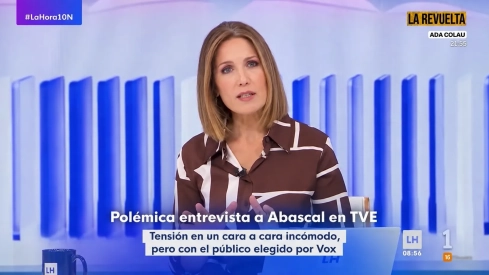
The TVE journalist and presenter Silvia Intxaurrondo has analyzed the interview that David Broncano conducted on Monday night, November 9, with the far-right leader of Vox, Santiago Abascal. In this context, the presenter of 'La hora de la 1' has expressed her three reflections after the public channel gave a voice to Abascal's far-right speeches.
“Should the far-right have a place on public television?” Silvia Intxaurrondo asked this Tuesday. The journalist then raised whether RTVE can be neutral when it has a duty to defend fundamental rights and equality. Her third question focused on the limit between guaranteeing pluralism and normalizing discriminatory discourses.
Intxaurrondo invited a debate on these issues and linked them to the discomfort the interview generated in part of the audience. Explaining the criterion she has followed in her own program, she pointed out that “in the last three years, no one who goes against human rights has been interviewed on this program.” She added two caveats: that she was not present or that the interview was in response to an order from the Central Electoral Board. She also expressed her support for Broncano and considered it unfair to criticize him.
From gender violence to the expulsions proposed by Vox
During the interview on 'La Revuelta', Broncano defended that laws against gender violence have given more women the support to report and reproached Vox for its absences in the minutes of silence for the victims. Abascal asked to review the law and, when asked about these absences, replied: "What I usually do when a person dies is pray."
Regarding housing, the leader of Vox linked the price increase to immigration and proposed abolishing taxes associated with the purchase of a first home. He also defended the expulsion of people in irregular situations and foreigners who commit crimes, regardless of their administrative status. On climate change, he questioned the scientific conclusions about the causes of current warming.
Gaza and attacks on Sánchez mark two other clashes
Broncano also reproached him for not using his contacts with Israeli authorities to denounce to Benjamin Netanyahu's Government what the presenter called "genocide" in Gaza. Abascal defended Israel as an ally and criticized him for not having mentioned the Israeli victims or condemned Hamas's crimes during that exchange. At another point in the interview, Broncano warned him that calling Pedro Sánchez a "dictator" "implies heating up the atmosphere in a very brutal way." The Vox leader reaffirmed his stance and called him an "apprentice tyrant and autocrat."
Broncano reproaches Abascal for calling Sánchez a "dictator"
David Broncano has questioned in La Revuelta why Vox repeatedly uses the word "dictator" to refer to Pedro Sánchez. The presenter warned that using that epithet against the President of the Government in a democracy "implies heating up the atmosphere in a very brutal way."
Santiago Abascal reaffirmed his stance and called Sánchez an "apprentice tyrant and autocrat." To justify his words, he accused him of "assaulting all institutions" and cited the Court of Auditors and RTVE itself. He also attributed alleged instructions to him to remove Vox interventions from the Congress's Official Journal.
Contact
We are listening. Get in touch.
