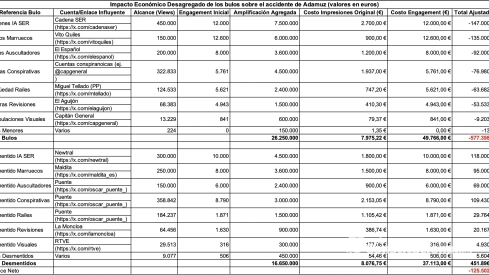
The tragic train accident in Adamuz, Córdoba, where two high-speed trains collided causing 45 deaths and over a hundred injuries, has triggered an avalanche of misinformation on social networks like X. With a total amplified reach of 26.2 million impressions –adding direct reach, direct amplification (RT + mentions), indirect (RT/likes of replies, secondary replies, and post clones), the cost of the organic spread of hoaxes has generated reputational damage equivalent to 577,398.70 euros in marketing terms to date.
However, the denials driven by the Minister of Transport, Óscar Puente, and fact-checkers like Maldita.es and Newtral have neutralized 451,896.50 euros, 78% of this impact. **This figure illustrates the capacity of official responses to mitigate, though not eliminate, toxic virality, a characteristic of the infodemic or information pandemic generated by disinformation. Hence the negative reputational balance of this hoax campaign, which amounts to a net -125,502.20 euros.**
The difference between the more than 26 million people impacted by hoaxes and the more than 16 million reached by rectifications is almost 10 million impressions and shows that debunking is not enough to cure the infodemic due to a lack of infovaccines such as digital literacy in polarized environments like Spanish society.
Main hoaxes about Adamuz: the virality of disinformation
The derailment of the Iryo train followed by the collision with Renfe's Alvia occurred on a conventional track, with investigations pointing to a track failure. From the early hours, hoaxes and fake news exploited the uncertainty.
Among the key hoaxes, conspiracy theories about satanic rituals or alleged foreign sabotage stand out, speculations without evidence that were debunked by Maldita.es and Óscar Puente. It is the only one of the main hoaxes (it caused damage of almost 77,000 euros) with a net positive balance (the debunkings exceeded 109,000 euros)
Likewise, speculation about the age of the track section where the accident occurred stands out, based on half-truths to insinuate negligence, which Puente refuted by providing Adif's technical documentation proving that the point on the track where the derailment occurred is part of the tracks built in 2023 and installed between May and July 2025. This is a half-truth amplified by the media (particularly El Mundo) and politicians like Miguel Tellado (PP), as it is true that the renewed tracks were welded in some sections to the old ones, but the derailment of the Iryo train occurred on one of the renewed ones, not at the welding point, which is also the subject of the current investigation.
A piece of disinformation from El Español also originated the hoax about ADIF's diagnostic trains being abandoned in depots, and even vandalized. ADIF has a fleet of six diagnostic trains in active service (three German Stadler trains, all three running and receiving data, with one working on the Madrid-Barcelona line; 2 BT trains in service, and the Seneca, about to be repaired to become operational) and, indeed, a Talgo series 106 "Doctor Avril" with the essential safety homologation underway and a new CAF pending receipt. The dissemination of this hoax aimed to sow the idea that inspections were not being carried out due to a lack of resources, but it was denied by Puente himself and by ADIF, who confirmed the seven inspections carried out on the accident section (two geometric diagnostics, and five dynamic, in addition to the ultrasonic inspection), and managed to neutralize 69,000 euros of the original persistent damage of 92,000 euros.
The tragedy, in fact, gave rise to several lies and misinformation about track inspection protocols, including the geometric and dynamic auscultations by Adif mentioned, to which is added the daily passage of trains to check the safety of the routes. It was denied by Puente himself, clarifying the protocols and the publication of guides by La Moncloa
In this context, there have also been *deepfakes* or AI-manipulated images of the accident, presented as real by the media and re-shared online. **The case of SER is a good practice, as after falling into the error of disseminating an image they received generated by Google's AI, Gemini, which even featured its watermark, they corrected themselves and apologized for sharing it, following denials from Newtral and Maldita.es.**Disinformation using images has also gone the other way around, as altered videos and photos suggesting negligence on the part of RTVE have been labeled as possible hoaxes, which RTVE denied by proving the authenticity of the material disseminated by the public entity.
Another of the most widely disseminated hoaxes concerned the manipulation of the tender specifications for a concession to Morocco for the manufacture of trains in the country, which was originally presented by the ultra-agitator Vito Quiles as a "gift" of millions of euros to Morocco for trains while Spanish ones were being "neglected." The debunking, verified by EFE Agency and Maldita.es, proved that the concession was actually for repayable credits (with interest) conditioned on the manufacture of those trains and infrastructure by Spanish companies, and not a "gift" of funds that would detract from investment in the maintenance or expansion of the Spanish network. It represents the hoax with the worst balance (40,000 euros of reputational damage) after its partial neutralization.
Disaggregated Economic Impact
The following table summarizes the impact on direct and amplified impressions of the main hoaxes about the Adamuz accident, as well as the adjusted total in euros that reflects the reputational damage and its partial mitigation with the debunking.
Scientific methodology
Applying an original econometric model based on "equivalent marketing" – developed within the framework of my ongoing doctoral thesis in Journalism at the Complutense University, "An econometric model of reputation applied to political disinformation: Infodemic and analysis of infoviruses in Spain, 2025–2026," **supervised by Dr. Fernando Peinado** and focused on the econometric quantification of hoaxes, disinformation, and misinformation and the role of journalism in their propagation or mitigation – the adjusted net balance reveals the aforementioned residual damage of 125,502.20 euros
This model transforms the impressions and interactions of hoaxes and fake news on X, as well as their debunking, into what they would cost in euros if the aim were to achieve the same impact through paid advertising on the social network. The model applies a CPM (cost per thousand impressions) of 6 euros (based on Spanish benchmarks such as those from Brafton and Improvado, which conservatively place the average price between 5-10 euros for local campaigns in 2026) and a CPE (cost per engagement) of 1 euro (slightly higher than the global median price of 0.18-0.58 euros according to Quantum IT and SQMagazine, to reflect the high competition on polarized topics in Spain). That is, it models the reputational impact in euros, taking into account the investment a brand would have needed to produce those same impacts through advertising.
The model incorporates an amplification adjustment to the total price to capture the effective cost of secondary interactions and organic spread of these hoaxes. And it does the same with debunking, so that it can present a reputational balance (losses and gains) that is persistent over time applied to disinformation, where hoaxes would be the losses and debunking the gains.
Conclusion: Disinformation Is Costly
The Adamuz case demonstrates that disinformation generates persistent net damage, initially €577,512, partially neutralized to €125,502 equivalent solely on the X social network, even with effective debunking on the same channel. Minister Puente and verification bodies have managed to mitigate 78% of the damage, but the organic amplification of hoaxes demands urgent regulation on X, beyond context notes, and media literacy for society. At El Constitucional, we defend the central idea of our doctoral thesis that truth must be quantified to combat the digital chaos of the infodemic.
Add ElConstitucional.es as a preferred Google source for free.
Stay informed about all the latest breaking news with the best information. Against disinformation, for democracy and social rights.