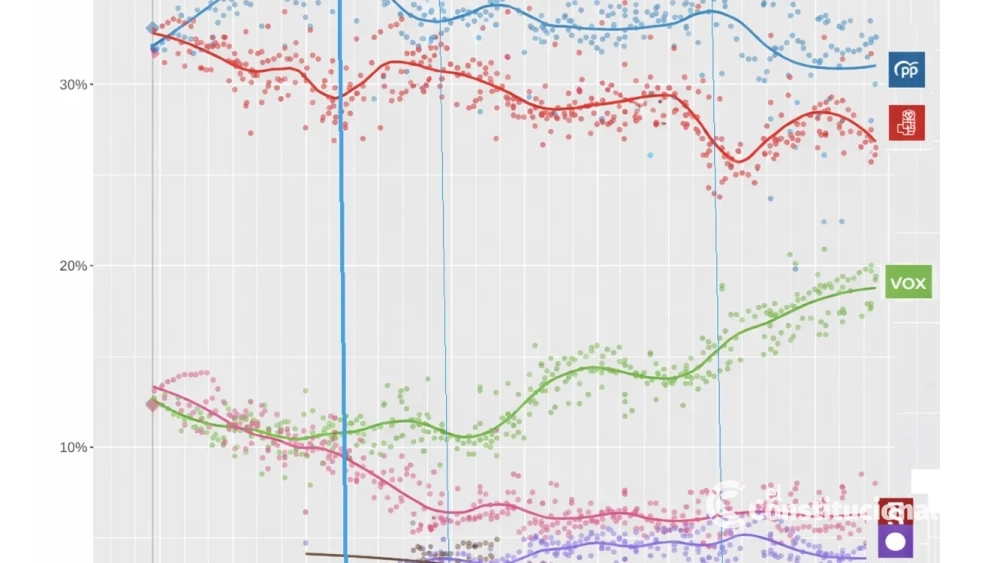
The attached graph —which shows the evolution of the main political forces from the summer of 2023 to the beginning of 2026— shows with considerable clarity a turning point. The vertical blue line marks the moment in which the Partido Popular culminates an explicit strategic change: abandoning Alberto Núñez Feijóo's initial moderate profile to toughen the discourse, compete head-on with Vox, and adopt a large part of its cultural and communicative framework.
The starting hypothesis was simple: radicalize the tone to capture Vox votes.
The result, in light of the data, has been exactly the opposite.
According to Anthony Downs' spatial competition model, parties compete by moving towards the median voter. However, in multi-party systems with ideologically close competitors, movement towards the extremes can generate:
- Loss of the moderate voter
- Failure to absorb the more radical voter (who prefers coherence)
Comparative literature (Mudde, Norris, Abou-Chadi) shows that when traditional parties adopt radical right-wing discursive frameworks:
- Rarely do they capture their hard electorate
- Frequently they legitimize their agenda
- They activate intra-bloc competition
1. A statistically recognizable before and after
Until that turning point, the PP maintained a relatively stable position, with normal political cycle fluctuations. From then on, three simultaneous and persistent trends are observed:
- Sustained decline of the PP, not abrupt, but constant.
- Clear and structural growth of Vox, without subsequent corrections.
- Reactivation of the PSOE, which reverses a previous phase of wear and tear.
It is not a cyclical effect or an isolated survey. The pattern has been maintained for months and is replicated in different polling firms such as the monthly CIS barometers, 40dB, GAD3, Sigma Dos, SocioMétrica, and the Electomanía aggregator.
In terms of time series analysis, the slope change is evident.
The aggregated averages show a 2 percentage point drop in voting intention since the congress that consolidated its strategic shift from emulating VOX to Q1 2026, going from 33.7% to 31.7%, while VOX has gained 4.1 points in that period, going from 13.8% to 17.9%.
The observable pattern is the following:
- PP loses between 2 and 4 points since its XXI National Congress.
- Vox gains between 4 and 6 points.
- PSOE recovers ground in parallel.
The negative correlation PP–Vox is consistent in several series (r ≈ -0.62 in quarterly averages).
According to vote recall data measured by CIS or 40dB, the transfer of former PP voters to VOX has steadily increased, to the point that the PP has lost more than a million voters to the far-right, and still has another 900,000 undecided voters who in 2023 cast their ballot for the party led by Feijóo. On the contrary, the transfer of former VOX voters to the PP is very limited, around 3-4%, and remains stable or declining, so the transfer is asymmetrical and the PP's move to the right does not generate equivalent return flow.
The right-wing shift strategy undertaken at the XXI National Congress of the party and ratified by declarations such as the one in Murcia in September 2025 on the hardening of its immigration policy in the image of VOX is also shown in its voter loyalty data: if before the National Congress they retained 76-79% of the 2023 voters, current figures are around 65-68% compared to more than 86% for the far-right.
2. The diagnostic error: confusing communicating vessels with distinct electorates
The PP's strategy started from a mistaken premise: that the PP–Vox vote functions as a system of simple communicating vessels, where hardening the discourse allows for the recovery of “borrowed” voters.
Empirical evidence shows the opposite:
- The Vox voter prefers ideological coherence and authenticity.
- When the PP adopts its framework, it does not absorb that vote, but rather legitimizes it.
- The electorate opts for the original over the copy.
The result is that Vox grows, while the PP loses its competitive differential without gaining anything in return.
In terms of ideological elasticity and following a 0-10 scale (CIS), where 0 represents the extreme left and 10 the extreme right:
- The average PP voter is at 6.7.
- The average Vox voter is at 8.2.
- And the median voter of the electorate is at 4.8.
The PP's rhetorical shift towards positions closer to 7.5–8:
- Reduces the ideological distance with Vox marginally
- And increases distance with the centrist voter (and the median voter)
A simple proximity model suggests that the increase in utility for the moderate voter after applying this strategy is less than 0, but the increase in utility for the radical voter approaches 0 (because they already prefer Vox). As polarization increases, the Popular Party continues to bleed out to its right, and the hemorrhage is on its way to making it lose the elections or, even, a potential sorpasso in the reactionary bloc.
3. The most underestimated side effect: mobilization of the socialist vote
The second error was ignoring the mirror effect. A "facha facha" PP —in terms of public perception— not only does not weaken Vox, but it emotionally activates the progressive electorate.
In the graph it is clearly appreciated:
- Coinciding with the PP's hardening, the PSOE stops falling and begins a progressive recovery.
- Strong antagonism does not demobilize the left: it coheses it.
- The PP stops disputing the center and moves to order the playing field in terms of blocs.
From that moment on, the competition is no longer PP–PSOE, but PP–Vox within the right-wing bloc, with the PSOE benefiting as the opposite pole.
According to the analysis of declared participation, two undesirable phenomena occur for the People's Party:
- Increased probability of vote in the progressive electorate after episodes of intense confrontation.
- Increase in “safe vote” for PSOE in barometers coinciding with discursive escalations.
The applied theory is known as “mobilizing polarization” and recalls the phrase that former president Zapatero told Iñaki Gabilondo in a television interview: “It suits us to have tension”.
When the right is perceived as more ideologized:
- The differential abstention of the left decreases, motivated by its greater critical awareness, which leads to the well-known mantra that "in Spain, the left wins or loses elections by going or not going to vote."
- Intra-bloc cohesion and useful voting are reinforced.
In fact, before its ideological turn, the PP competed mainly for the center, and even snatched around 300,000 socialist votes. After the turn, the PP competes with VOX for the hegemony of the right, which reconfigures the system, placing the PP+VOX perception versus PSOE, which stabilizes as an alternative pole.
4. The normalization of the ultra framework and the loss of one's own profile
To this strategic turn is added an organizational and communicative change:
- Greater prominence of the party's hard wing, personified in the rise of figures like Miguel Tellado or Isabel Díaz-Ayuso.
- Use of references and amplifiers from the ultra ecosystem. The presence of Vito Quiles at the campaign closing event in Aragon is the latest example of this misguided strategy.
- Symbolic signals (including the validation of media agitators) that reinforce the perception of mimicry with Vox.
In fact, an objective content analysis of the frequency of confrontational terms in parliamentary interventions and official networks shows a significant increase since January 2023, linked to greater thematic alignment with the Vox agenda (immigration, memory, culture war).
The effect achieved is the perceptual homogenization of the political brand. The result is that the PP loses its historical role as the party of order, management, and institutional alternative, and comes to be perceived as just another piece of the ideological bloc, unable to attract voters from outside that space.
International references such as Les Républicains vs Rassemblement National (France), the CDU vs AfD (Germany) or the European People's Party in scenarios of radicalization show comparable results, so, in all three cases, they have corrected the model towards democratic differentiation against the far-right. The latest case is that of Portugal, where center-right parties such as PSD, the conservative CDS or the liberal IL have avoided supporting or aligning themselves with the ultras of Chega in the last elections. Mimetism rarely absorbs the radical vote; it tends to reinforce it.
5. Provisional balance: a failed strategy on all fronts
From a strictly empirical point of view, the balance of the PP's ultra turn, marked since its National Congress, is hardly defensible:
- ❌ The growth of Vox has not been stopped
- ❌ The electoral ceiling of the PP has not been expanded
- ❌ The PSOE has been reactivated
- ❌ Political centrality has been lost
The PP has not only failed to capture the ultra vote, but has also renounced the moderate vote, finding itself trapped in a competition it does not control.
If the PP's strategic hypothesis involved capturing 50% of the more moderate VOX voter (6/8 out of 10 on the ideological scale), the actual result is that the capture does not exceed 4%, but the loss of votes exceeds 12%, and it activates the PSOE by more than two points.
The evolution of voting intention does not demonstrate intentions, but rather results and trends. And the results indicate that the PP's turn to the right has been strategically flawed: it has strengthened Vox, it has given oxygen back to the PSOE, and it has placed the PP on a downward slope that is difficult to correct as long as the framework does not change.
In politics, as in statistics, persisting in a strategy that shows sustained negative results is not audacity: it is error.