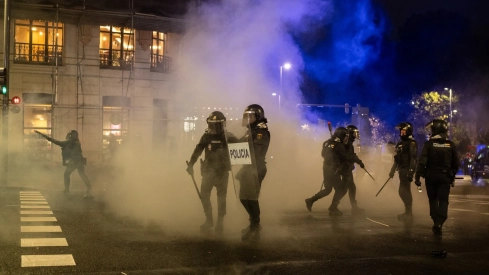
The PSOE considers the police charges that occurred on Wednesday at the end of the demonstration for the general strike on 11-N in Madrid to be "deplorable," according to socialist sources consulted by 'ElConstitucional.es'. The same sources advocate for a clarification of what happened, through an investigation, and maintain their support for the Minister of the Interior, Fernando Grande-Marlaska, in the face of calls for his resignation from Sumar, Podemos, and ERC. In the opinion of the socialists, "very serious accusations" have been made against the minister.
The PSOE's position coincides with the decision announced this Thursday by Marlaska, who has instructed the General Directorate of the Police to investigate the charges and incidents of the day. According to the Interior Ministry, the investigation will be carried out independently of the internal review to which the National Police subjects its actions. The minister has also ordered that tear gas not be used in future demonstrations.
The demonstration started at 6:00 p.m. and gathered 120,000 people, according to the Government Delegation, and 400,000, according to the Tenants' Union. The march proceeded peacefully until the vicinity of Plaza de España, where it was scheduled to end. Tension increased when the Police cut off access to the square. A small group burned several wastebaskets and agents charged against some of the demonstrators on Gran Vía.
The demonstrators reported the use of pepper spray and tear gas. Samur treated several people with eye irritation and respiratory problems. Graciela García, an RNE journalist who covered the protest, recounted what she witnessed this Thursday on Juan Ramón Lucas's program: "At 8:50 p.m., after feigning withdrawal, the Police started firing rubber bullets and swept everything away."
The Police affirm the "proportionality" of the charges and support the intervention
Police sources consulted by this newspaper maintain that the Police must intervene when violent acts or coercion occur against those who want to work during the strike. "Therefore, there must be a proportionate police response," they affirm. According to their version, some agents tried to clear the area by pushing, without using their batons.
When evaluating the images of the intervention that are being disseminated through social networks, the sources have indicated that whoever believes they were unduly beaten "has the right to go to a judge". They have also encouraged those who believe they suffered injuries or that their rights were violated to report it. Likewise, they consider it "absurd" that Thursday's debate focuses on a few police actions and relegates the demands of the mobilization.
For its part, sources from the police union JUPOL maintain that the charges constitute an authorized use of force in the face of public order disturbances and citizen security problems. It defends that pickets must be informative and that agents have an obligation to intervene in situations of disorder. According to the union, the Police graduate their response based on the violence they perceive and consider pepper spray and tear gas less harmful means than other options.
Regarding rubber bullets, JUPOL says it does not know if they were used on Gran Vía. The union maintains that they are an authorized means and that their use can prevent hand-to-hand confrontation. Its position adds to the testimony of the RNE journalist and the investigation ordered by the Interior Ministry to clarify the police action.
Frente Amplio asks Sánchez for Marlaska's dismissal
The candidate of Frente Amplio for Madrid, Emilio Delgado, has demanded that the President of the Government, Pedro Sánchez, dismiss the Minister of the Interior, Fernando Grande-Marlaska, after the police charges recorded during the general strike day of November 11 for housing.
In an interview on Cadena Ser, Delgado has maintained that "it no longer makes much sense to appeal to the minister," and added that, "the longer the PSOE supports Marlaska, the more responsibility is transferred to the President of the Government."
For the Frente Amplio candidate, even the PSOE electorate "feels uncomfortable" because, as he has stated, "it is neither the first time, nor the second, nor the third" that the police have harshly charged against demonstrators in progressive protests. In that context, he compared the police action in the housing protest with the escort that, in his opinion, the far-right received when it cut off Gran Vía three years ago.
Delgado has also criticized the use of pepper spray against participants in the mobilization and has reproached that "you cannot offer a hand to citizens when they mobilize for their rights" and, at the same time, respond in the streets with "savage police charges" like those that, he said, were seen in the general strike.
The political leader has also pointed out that fundamental rights such as assembly or expression "are being violated" and has indicated that there is a specific problem with the riot police. "In this country, the Police are very well valued, I believe that many people appreciate the protection and work of the police in their daily lives, but there is a specific problem with police unions and with the riot police," he stressed.
According to his denunciation, "it is not normal for there to be concentrations of neo-Nazis and for police to be seen calmly talking with them," and he also criticized that, in the housing protest in Madrid, the police gassed "a homeless person who was on Gran Vía."
"This is inadmissible," concluded Emilio Delgado, who insisted on demanding "political responsibilities" to "guarantee fundamental rights in Spain," while also calling for "a thorough review of the police model."
Contact
We are listening. Get in touch.
