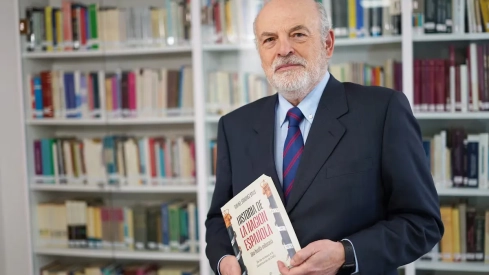
The far-right Vox party has appointed an former leader of Falange Española as number two in one of the main ministries of the Junta de Andalucía. Rafael Sánchez Saus, the new Deputy Minister of Tourism, Justice, Deregulation, and Local Administration, was a national councilor for the Falangist formation and even competed for its leadership in 1987.
The appointment was approved this week by the Governing Council as part of the team chosen by Manuel Gavira, Second Vice President of the Junta and Andalusian leader of Vox. The official biography released by the autonomous administration highlighted Sánchez Saus's extensive academic career but omitted his membership in Falange and his publications favorable to the far-right.
The new deputy minister assures that that period belongs to the past and that he currently does not consider himself a Falangist. He also admits that he "has never disavowed" that militancy and that he can still admire José Antonio Primo de Rivera, founder of Falange and one of the main ideological references of Spanish fascism.
The controversy has grown because his most recent positions maintain many of the elements that characterize Vox's discourse. Sánchez Saus questions the State of Autonomies, combats democratic memory policies, rejects the right to abortion, and warns of an alleged "Islamization" of Andalusia.
Candidate to lead Falange in 1987
Sánchez Saus's relationship with Falange went beyond a fleeting youth affiliation. He formally joined the party in 1981 and was appointed head of Youth and provincial deputy chief in Seville. Years later, he reached the organization's National Council.
On July 4, 1987, he presented his candidacy for the National Leadership of Falange Española de las JONS. He obtained 44 votes against 145 for the Falangist leader Diego Márquez Horrillo, re-elected during an assembly that concluded with the singing of 'Cara al Sol' and the evocation of José Antonio Primo de Rivera.
Sánchez Saus now maintains that that candidacy was testimonial and that it aimed to update the party to respect civil liberties. According to his version, he left the organization after losing that vote.
Two years later, however, he gave a lecture at the Complutense University of Madrid in which he still defined himself as a Falangist. In that speech, he lamented the political decline of the organization and defended the need to recover a way of thinking that, in his opinion, had attracted generations of Spanish university students.
The text also presented the Falangist movement as an attempt to regenerate Spain and criticized its leaders for having led it to a situation of ideological, economic, and organizational bankruptcy. The discrepancy he expressed was directed against the functioning of Falange and its loss of relevance, while retaining a good part of its political references.
An official curriculum without the political part
The Junta presented Sánchez Saus as an academic of recognized prestige. Born in Albacete in 1956, he holds a doctorate in History from the Complutense University, is a professor of Medieval History at the University of Cádiz, and was rector of the CEU San Pablo University between 2009 and 2011.
He is also a member of several academies and the author of more than twenty books and a hundred scientific publications. The official profile did not include his former position in Falange or his book 'Por qué Vox. El despertar de la derecha social en España', a compilation of articles in which he defends Santiago Abascal's party.
His professional experience has mainly developed in the university, historical research, and Catholic organizations. He lacks a previous management career in Tourism, Justice, or Local Administration, the areas he will now have to coordinate as deputy minister.
The contrast within the ministry itself is visible. The technical general secretary, Inés María Cruz Lora, has more than two decades in the Superior Corps of General Administrators of the Junta. Sánchez Saus arrives as the political and ideological profile chosen by Vox, while administrative management falls to a civil servant with experience within the Andalusian Administration.
Against autonomies from an autonomous government
One of the main clashes between his ideas and the position he has just assumed lies in the territorial model. Sánchez Saus has presented the State of Autonomies as a threat to national unity and accuses certain institutions and intellectuals of participating in a "historical deconstruction" of Spain.
Now he will be part of the Government of an autonomous community and will have direct powers over Local Administration. The ministry managed by Vox will control relations with city councils and provincial councils from an institutional structure that its new deputy minister has questioned in his publications.
His work also contains a complacent reading of the Franco dictatorship. In several articles, he has described those years as a period that transformed Spain offering "bread and dignity" and has linked the regime's actions with the subsequent development of the parliamentary monarchy.
Sánchez Saus has described historical memory legislation as an initiative of "revanchists" and has praised authors linked to Falange. He has also used derogatory expressions against members of Pedro Sánchez's Government and has defended deeply restrictive positions on abortion.
The legacy of Al-Andalus under Vox's management
The new deputy minister's theses also clash with a fundamental part of Andalusia's tourist and cultural heritage. Sánchez Saus rejects the idea of a fruitful coexistence between Muslims, Christians, and Jews during the Andalusian period and presents that narrative as a historical falsification.
In his book 'Al-Ándalus y la cruz' (Al-Andalus and the Cross), he describes that period as a system of political, religious, and legal subjugation of Christians. His interpretation combats the vision of the three cultures that Andalusia has been using for decades as an element of cultural, tourist, and diplomatic promotion.
The Ministry of Tourism itself promotes routes dedicated to the Caliphate, the Umayyads, the Nasrids, the Almoravids, and the Almohads. The community also houses the Three Cultures of the Mediterranean Foundation, created by the Andalusian Government and Morocco to foster dialogue, coexistence, and mutual understanding.
Vox has made the supposed "Islamization" of Andalusia one of its main political fronts. Manuel Gavira has announced actions to stop the planned Islamic Cultural Center in Seville, and the government pact includes the elimination of Arabic Language and Moroccan Culture classes in Andalusian schools.
Sánchez Saus will now have responsibilities over a tourism sector that obtains a good part of its international projection from that legacy. The Alhambra, the Mosque of Cordoba, Medina Azahara, and the Andalusian routes are an essential part of Andalusia's image in the world.
Women as a supposed "problem"
The general secretary of the Andalusian PSOE, María Jesús Montero, has also asked for explanations for statements in which Sánchez Saus brought back as a matter for discussion "the massive access of women to work" and the use of contraceptive methods.
The new deputy minister presented both issues by recalling the debates raised by Catholic sectors during the eighties and asked if they could be discussed again today. Montero believes that these words imply defending the exclusion of women from the labor market.
"It is not acceptable for a high-ranking official to be linked to Falangist positions," denounced the socialist leader, who also warned that "democratic values and equality do not admit setbacks."
María Márquez, deputy general secretary of the PSOE-A, has wondered "from what cave" the new Vox team has come out and has accused the ultra formation of transferring ideas contrary to political pluralism, trade unions, and women's equality to the Junta.
The opposition demands his dismissal
Adelante Andalucía has demanded the immediate resignation or dismissal of Sánchez Saus. Its spokesperson, José Ignacio García, has defined him as "a fascist with a fascist card" and considers that political past incompatible with the exercise of responsibilities in a democratic institution.
García has compared the appointment to the possibility of Germany incorporating a former leader of a Nazi party or Italy doing the same with a member of a fascist organization. "People who are not democrats should not occupy democratic institutions," he stated.
Por Andalucía has also denounced the choice. Its parliamentarian Ernesto Alba maintains that Vox has used its entry into the Executive to "place" a former aspirant to lead Falange at the second level of a ministry with powers over Tourism and Justice.
From the regional government, they have explained that the ministers have the capacity to choose their teams and have supported Sánchez Saus's academic career. Sources close to the Presidency assure that they were unaware of his Falangist past before the appointment, although they maintain their endorsement of his professional curriculum.
The first vice-president, Antonio Sanz, has avoided commenting on the controversy and has responded that he only gives his opinion on the people who are part of his department. Rafael Sánchez Saus remains in office while PSOE, Adelante Andalucía and Por Andalucía maintain their request for explanations and dismissal.
