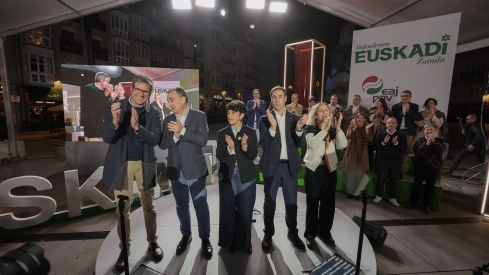
The PNV arrives at 29N with a battle that directly affects its position in Madrid. Several polls place it below the five deputies it obtained in 2023, the minimum it needs to form a parliamentary group with its own representatives. While EH Bildu aims to expand its presence and the PSE-EE disputes the first position in Euskadi, the nationalists are trying to regain ground by claiming the agreements achieved and increasing their criticism of Pedro Sánchez.
The message was heard again this morning in Madrid. Aitor Esteban has asked for strength to face a potential PP and Vox government, but he has also warned that the PNV "does not have much desire to repeat the experience of this legislature in the same terms" if Sánchez continues in La Moncloa. The party president maintains his rejection of a majority dependent on Vox and demands other conditions to negotiate again with the socialists.
Estamos en un momento crucial para Euskadi.
— AITOR ESTEBAN (@AITOR_ESTEBAN) November 19, 2026
Hay muchos temas que interesan a nuestro País y que no van ser una prioridad en un futuro gobierno ni del PSOE ni del PP. Por eso es necesario un PNV fuerte en Madrid para conseguir que Euskadi tenga voz propia y sea protagonista.… pic.twitter.com/MY8Bd3ad82
That position responds to a specific political difficulty. The PNV shares governments with the PSE-EE in the main Basque institutions and has been necessary to sustain Sánchez's majorities, but it needs to explain why it is worth voting for them separately. Their margin narrows when the campaign focuses on choosing between the president and Feijóo, especially on a day like today, marked by the televised face-to-face between both candidates.
The wear and tear comes from before. In the 2023 general elections, the PNV was behind the socialists in Euskadi and retained five deputies. In the 2024 regional elections, it maintained the first position in votes, although EH Bildu tied with it at 27 seats. These are different elections, but they show an increasingly open competition for Basque political leadership.
The fifth deputy decides much more than one seat
The comparison of polls offers a worrying diagnosis for the jeltzales, although with differences that should be preserved. The most recent estimates from several firms leave them with three or four deputies; others keep open the possibility of reaching five. There are also more favorable previous measurements, such as Sigma Dos's on November 9, which granted them between four and six representatives.
These are the main data published until this Thursday:
- 40dB., November 19. Their latest report places the PNV at three deputies, two less than in 2023. The fieldwork covers November 14 to 18.
- SW Demoscopia, November 18. Projects three seats and 0.7% of the state vote. Their monitoring accumulates interviews from October 26 to November 17.
- Sigma Dos, November 18. Maintains a range of four to five deputies, which allows the PNV to retain the group at the upper end of the estimate.
- IMOP Insights, November 16. Grants them four representatives, compared to the current five, while EH Bildu would reach eight in the entire State.
- SocioMétrica, November 15. Estimates four PNV deputies in Euskadi, behind EH Bildu, with seven, and the PSE-EE, with five.
- CIS, November 12. Its pre-election macro-survey calculates a range of two to four seats for the jeltzales, also below their current representation.
To these six measurements is added the Basque Sociometer published on October 30, which placed the PNV as the third force in Euskadi, with 21.9% and four deputies. EH Bildu appeared first, with 29.1% and seven seats, followed by the PSE-EE, with 24.7% and five. This survey has a Basque scope, so its figures for Bildu should not be confused with state estimates that include Navarra.
Dates also matter. A follow-up that incorporates interviews from this week and a survey conducted in October portray different moments. Furthermore, state samples and their distribution models do not have the same capacity to describe each province as a territorial survey. The coincidence among several houses sustains the alert for the PNV; the variation between their results leaves open the dimension of the loss.
The five-deputy threshold has practical consequences. A dedicated group provides spokespersonship, resources, and differentiated presence in parliamentary activity. With three or four seats, the PNV would not meet the required minimum on its own and would have to explore formulas with other representatives to avoid the Mixed Group. The reform of the Regulations that will be applied in the next legislature maintains that floor of five deputies.
The party defends two seats in Bizkaia, two in Gipuzkoa, and one in Álava. Losing the second Gipuzkoan or the Álava representative would be enough to leave it below that threshold. Recovering a third deputy in Bizkaia would compensate for one of those losses, but would require substantially improving the expectations drawn by the polls.
There is also a risk in the Senate, although its election requires another analysis. In the Basque provinces, four senators are elected, and each voter can mark up to three names. A third position can leave a formation without direct representation, but the result depends on the votes of each candidate and agreements between parties.
Sánchez and EH Bildu narrow the PNV's space
Given this scenario, the jeltzales are defending their negotiating capacity with concrete examples. Last night, in Laudio-Llodio, Maribel Vaquero claimed credit for the negotiations on Talgo, the electrical capacity for industry, and the prevalence of Basque collective agreements. "We are the insurance policy for Aiaraldea and Euskadi," affirmed the candidate for Gipuzkoa.
Vaquero directed his reproaches at both sides. He accused Sánchez of visiting Euskadi without addressing their concerns and described the support for PP and Vox as "the vote against Euskadi". The party's president in Álava, Jone Berriozabal, completed the message with a warning to future partners. "There will be no blank checks, there will be no free adhesions, there will be no agreements at any price".
☝️ Habrá más representantes vascos en Madrid, pero los únicos que defendemos a Euskadi somos los de EAJ-PNV.⁰⁰@MaribelVaquero_, Kongresurako Gipuzkoako zerrendaburua: “Vamos a Madrid con la agenda vasca, el cumplimiento del Estatuto de Gernika, el desarrollo de nuestro… pic.twitter.com/KdNTOdW6ow
— EAJ-PNV (@eajpnv) November 19, 2026
The PNV thus tries to recover one of its traditional hallmarks, the negotiation of support in exchange for concrete commitments for Euskadi. During the campaign, it also recalled its agreements with the Government of Mariano Rajoy on pensions in 2018. This precedent serves to claim autonomy from the PSOE, although the PP's dependence on Vox today limits the options of reproducing that relationship.
EH Bildu competes with another proposal of utility. Oskar Matute has defended that the coalition would support Sánchez "for free" if necessary to prevent a PP and Vox Government. With this, it seeks to mobilize the left and dispute with the PNV the representation of Basque interests. For the jeltzales, the problem consists in demonstrating that conditioning support produces results that the electorate values more than identification with a bloc.
This morning, Esteban insisted precisely on the need for an autonomous voice in Madrid. He also acknowledged that a part of the PNV electorate "unplugged" after the pandemic. The leader was optimistic about the preservation of the group and questioned a face-to-face that concentrates attention on Sánchez and Feijóo, leaving out the forces that can decide their majorities.
The general elections are also the party's first electoral test since Esteban replaced Andoni Ortuzar in 2025. Maribel Vaquero heads the candidacy for Gipuzkoa, accompanied on that list by the former mayor of San Sebastián, Eneko Goia; Idoia Sagastizabal leads that of Bizkaia and Gorka Urtaran, former mayor of Vitoria, that of Álava. After November 29, the next appointment will arrive, the municipal and provincial elections of May 2027, where the PNV will defend a large part of its institutional power.
The latest Sociometer retains a favorable data for the party. 29% of Basques consider it the best defender of Euskadi's interests in Congress, compared to 25% who choose EH Bildu. The difference changes with age, the PNV is the most indicated option among those over 45 years old and Bildu among those who have not reached that age.
Contact
We are listening. Get in touch.
