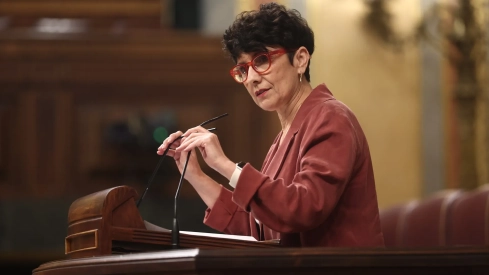
The head of the PNV list for Congress for Gipuzkoa, Maribel Vaquero, has assured that her party will demand in Madrid the fulfillment of the Gernika Statute of Autonomy and has proposed moving towards a new political status based on the “national recognition” of Euskadi.
In an interview on Televisión Española (TVE), reported by Europa Press, Maribel Vaquero insisted that the main objective of the PNV is to continue defending Euskadi in Madrid, with the intention of continuing to act as the voice of the Basques in the Cortes Generales and to demand a greater level of self-government.
As she explained, the jeltzale party wants to continue promoting the so-called “Basque House”, with an agenda focused on everyday problems, including housing, pensions, industry, and the economy.
Vaquero summarized her approach as follows: “continue demanding that the Gernika Statute of Autonomy be fulfilled and, from national recognition, advance towards a proper status”, in addition to a bilateral relationship with the State.
Industry, energy and transport infrastructures
The PNV candidate cited the case of Talgo as an example, which she mentioned as a sample of the jeltzales' work in Madrid, arguing that it was a plant that “was going to close down” and that, finally, managed to maintain employment and “create roots” in Euskadi.
She also highlighted that they have achieved “more energy and more plugs” for Basque industry, an activity that, she pointed out, largely depends on electrical energy to continue operating and generating new jobs.
More railway competencies and connection with Europe
Maribel Vaquero demanded “more self-government, especially in railway matters and transport infrastructures”, considering that these matters are essential because they “structure a country”, favor mobility and contribute to strengthening territorial competitiveness.
In this area, she asked for the completion of the Basque Y and for it to be connected with Europe and with the plateau. Likewise, she demanded more decision-making power to manage Basque airports and for the ports of Bilbao and Pasaia to have a good railway connection to move goods from road to rail.
Housing, salaries and protection for small owners
Regarding housing, the PNV leader defended both regulation and construction. After noting that more residential supply is needed, she stressed that in Euskadi housing is in the hands of small owners, so she asked for “collaboration and more carrot and less stick”.
Her objective, she explained, is for housing to remain on the market while the construction of more properties is accelerated, while speculation is limited and the access of vulture funds to the purchase of homes is made difficult, in order to protect the vulnerable without criminalizing the small owner.
Vaquero also defended better salaries and that companies have security to grow and adapt to new market needs. In her opinion, this evolution should translate into “better wages”, because without decent remuneration, she said, an imbalance is generated. In this framework, she stressed that young people need higher salaries to be able to develop their life project and emancipate themselves.
Pensions and own minimum wage for Euskadi
Regarding pensions, Maribel Vaquero recalled that, during the negotiation of the 2018 Budgets, the PNV extracted from the then President of the Government, Mariano Rajoy, the commitment to revalue pensions.
The candidate reiterated that her party's objective is to guarantee older people a decent pension in line with the rising cost of living. Therefore, she maintained that they want to continue ensuring that pensions are revalued according to the Consumer Price Index (CPI) and remarked: “with us, that commitment is secure”.
Vaquero also defended that pensions must be public and guaranteed, something that, she pointed out, is already included in the Pact of Toledo and will continue to be so with the support of the PNV.
In the same vein, she advocated for an own SMI for Euskadi (Interprofessional Minimum Wage), adjusted to the cost of living in the Basque Autonomous Community. In her opinion, salary increases should arise from an agreement between unions, employers, and public institutions, and she warned that she is concerned that they do not even occur with the consensus of social agents.
Contact