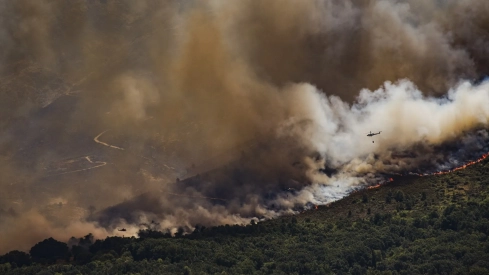
The Burgohondo forest fire has worsened during Thursday afternoon and has forced the confinement of the inhabitants of Burgohondo, Navaluenga, and El Tiemblo. The enormous concentration of smoke has led the Junta de Castilla y León to send an ES-Alert notification to all connected phones in the area, while evacuations have extended towards the surroundings of the El Burguillo reservoir.
⚠️Desde el Centro Coordinador de Emergencias de Junta de Castilla y León se ha enviado un #EsAlert a las zonas afectadas.
— 112 Castilla y León (@112cyl) July 23, 2026
Si te llega el mensaje, no llames al 1-1-2, sigue las indicaciones de las autoridades.@naturalezacyl https://t.co/oHcSiTRQ3Y pic.twitter.com/TjMGwJzmR2
Authorities have ordered the evacuation of the El Burguillo campsite, the rural houses of Las Cruceras, and the town of La Rinconada. The evacuees are being transferred to the El Barraco sports center, set up to accommodate them while the fire continues to advance through a region of rugged terrain and very dry vegetation.
The fire started around 1:00 PM on Wednesday in the municipality of Burgohondo and reached level 2 of the Potential Severity Index during the night. The speed of its spread, its proximity to inhabited areas, and the risk to large forest masses have placed this emergency among the most serious of those currently active in Spain.
The affected area has not yet been precisely calculated. Smoke prevents reliable measurement from the air, and the perimeter continues to change, although authorities are already speaking of a considerable extension between Burgohondo, Navaluenga, and the area closest to Piedralaves.
Three municipalities confined under smoke
The Emergency Coordination Center has asked residents of the three municipalities to remain inside their homes, keep doors and windows closed, and follow the instructions of the Civil Guard. The alert has been sent due to the density of the smoke and the risk of inhaling it, even in places where the flames are still at a certain distance.
The Junta has requested that people who receive the message not call 112 unless they need help or are in danger. The purpose is to prevent the emergency phone from becoming saturated during hours when evacuations, medical assistance, and movements of extinguishing resources are being coordinated.
23/07/26 18h Debido al #IFBurgohondo se procede al
— 112 Castilla y León (@112cyl) July 23, 2026
𝐜𝐨𝐧𝐟𝐢𝐧𝐚𝐦𝐢𝐞𝐧𝐭𝐨 de
▶️El Tiemblo
▶️Navaluenga
▶️Burgohondo
y la 𝐞𝐯𝐚𝐜𝐮𝐚𝐜𝐢𝐨́𝐧 de
▶️Camping del Burguillo
▶️Casas rurales de Las Cruceras y La Rinconada@naturalezacyl pic.twitter.com/rzvamrefhE
In Navaluenga, the City Council has advised avoiding any outdoor activity and using an FFP2 mask when it is essential to go out. The smoke plume has spread throughout the Alberche Valley and can be observed from tens of kilometers away, including several municipalities in the Community of Madrid.
The situation has been changing rapidly throughout the afternoon. The main front was about 1,500 meters from the urban area of Navaluenga around three o'clock, a distance that has forced a large part of the deployment to be concentrated there.
The Military Emergency Unit is opening a defense line with heavy machinery to prevent the flames from reaching the first homes. The absolute priority is to protect Navaluenga and the scattered residential areas of Burgohondo, without neglecting the flanks advancing through the mountains.
🟧| Protección Civil Castilla y León |
— 112 Castilla y León (@112cyl) July 23, 2026
🔥Insistimos, en caso de estar cerca de una zona en la que hay un incendio forestal ten en cuenta las recomendaciones para evitar incidentes.
⚠️Y sigue en todo momento las instrucciones de las autoridades y los servicios de emergencia pic.twitter.com/xwR9KALI7E
More evacuations and a night away from home
About a hundred people had already been evacuated during Wednesday night from Puente Nueva and Matalaceña, two areas of Burgohondo with scattered homes. Nearly half have spent the night in the municipal sports center and the rest have found accommodation on their own.
Cruz Roja has installed beds, a field hospital, and a psychosocial care device. Residents still cannot return to their homes because the operation needs to consolidate the area and verify that there are no reproduction points near the homes.
About 200 minors who were in the Venero Claro children's camp in Navaluenga were preventively moved by their organizers to facilities in El Oso. The move was made before the situation worsened and did not respond to a forced evacuation order.
The extension of the evacuations to the campsite and rural houses around El Burguillo shows how far the emergency has advanced. People who were in La Rinconada have also had to leave the place during the afternoon due to the risk of being isolated.
⏰18:10h. 🔥 #IFBurgohondo
— MeteoÁvila (@Meteoavila2) July 23, 2026
😔 Imágenes desde dentro del infierno.
📍La Rinconada. pic.twitter.com/FX2KMawvuM
Changing wind and very complicated orography
More than a hundred professionals and numerous aerial and terrestrial resources participate in the operation, along with the UME, brigades from the Ministry for Ecological Transition, personnel from the Junta, Civil Protection, Civil Guard, and resources from the Provincial Council of Ávila.
The work is being carried out under wind gusts that have reached between 40 and 50 kilometers per hour, with changes in direction that can open new fronts in a few minutes. High temperatures and low vegetation humidity worsen a situation that the technical director of extinction has defined as "very active and complex".
Large convective smoke clouds have at times prevented aerial resources from working normally. In high areas, the rocky terrain and lack of roads also hinder the arrival of ground brigades.
Bulldozers are opening accesses and firebreaks so that teams can get closer to the flames. Coordination between aerial resources and heavy machinery will be crucial during the night, when helicopters and planes have to withdraw and the weight of the operation falls on the ground teams.
A member of the team suffered second-degree burns on a leg during the extinction work. She was treated at the Burgohondo health center and is recovering favorably.
The threat to the Iruelas Valley
One of the main fears is that the fire will reach the Iruelas Valley Natural Reserve, a protected area with pine forests, oak groves, and a significant population of black vultures. The operation is working to block the advance of the flames before they penetrate the forest areas of greatest ecological value.
The evacuations carried out in La Rinconada, Las Cruceras, and the El Burguillo campsite already affect the immediate surroundings of the reserve, although authorities have not confirmed that the main front has entered it.
The area advancing towards Piedralaves has allowed for a more effective intervention by aerial means. The Junta considers that the Tiétar Valley is not currently under immediate threat, but the wind can alter that forecast.
The mayor of Navaluenga, Armando García Cuenca, has described the fire as the worst the region has suffered in the last 50 years. The population of the municipality increases considerably during the summer, which multiplies protection needs and complicates a possible mass evacuation.
A machinery spark, the main hypothesis
The causes are still under investigation and must be determined by environmental agents and security forces. The first indications suggest that a machine could have produced a spark at the place where the fire started, as explained by the territorial delegate of the Junta in Ávila.
This hypothesis does not yet allow for a confirmed cause or to determine if there was negligence. Investigators will have to identify the machinery, reconstruct the work that was being carried out, and check if the restrictions in force during a day of extreme risk were respected.
The human factor is behind a good part of forest fires, whether due to negligence, accidents, or intentional actions. An apparently minor spark can cause an explosive spread when high temperatures, dry fuel, and strong wind coincide, as has happened in Burgohondo.
Spain exceeds 108,000 burned hectares
The Ávila fire has joined an especially serious week across the country. Spain has already accumulated some 108,000 burned hectares during 2026, four times more than on the same dates last year, according to data provided this Thursday by the third vice president, Sara Aagesen.
So far this year, around 1,900 incidents have been registered and 24 have exceeded 500 hectares. Among the most serious fires are those of La Mierla, in Guadalajara; Almorox and Villa del Prado, between Toledo and Madrid; Castropodame, in León; and Burgohondo.
The emergency is forcing the simultaneous mobilization of state and regional resources in several provinces. The extent of the fires reduces the capacity to deploy reinforcements and demonstrates the difficulty of responding when several large outbreaks coincide under the same heatwave.
Climate change is lengthening risk seasons and favoring fires capable of exceeding ordinary extinction capacity. Added to this are the abandonment of rural land, the continuity of vegetation, the lack of management of some forest masses, and the depopulation of large areas of the interior.
A pact that must begin before summer
Pedro Sánchez has once again this week called for a state pact against the climate emergency that guarantees laws, financing, and coordination between administrations. Aagesen has announced a new convention with parties and social agents after the summer, while the Junta de Castilla y León has shown itself willing to participate in this agreement.
The experience of recent years has shown that extinction alone cannot contain increasingly fast and extensive fires. Prevention requires silvicultural work, grazing, cleaning of strategic points, maintenance of roads and firebreaks, protection of inhabited areas, and stable forest employment throughout the year.
The Ministry for Ecological Transition itself warns in its planning against desertification that extinction capacity is approaching its limit and that the margin for improvement increasingly depends on prevention. Mountains need management also in autumn, winter, and spring, when fire does not yet occupy the headlines.
Negotiations for the pact will resume after the summer. Before that, the Burgohondo operation faces a decisive night to close the advance towards Navaluenga, contain the flanks close to the Iruelas Valley, and keep the confined populations protected.
