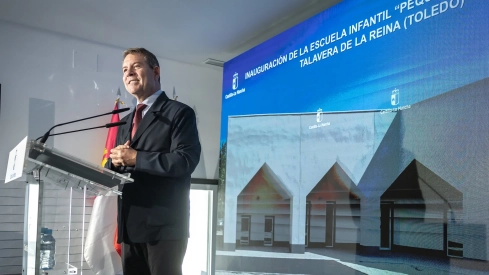
The president of Castilla-La Mancha, Emiliano García-Page, on Monday blamed certain political leaders for fueling rejection of immigration to gain electoral advantage. The socialist baron maintains that a good part of the current tension responds to "a designed frontism, elaborated from above" and that daily coexistence is very far from the climate projected by the parties.
Page made these statements in Talavera de la Reina, during the inauguration of the 'Pequeños Exploradores' children's school, after being asked about the victory of the far-right Alternative for Germany (AfD) in the Saxony-Anhalt elections and about the latest polls that reflect an increase in rejection of immigration in Spain.
The socialist leader avoided pointing to specific acronyms, although he spoke of those who intend to win elections using immigration and those who stimulate confrontation between two blocs. "There are people who, to get ahead in politics, to endure in politics, need hatred and confrontation between one another," he lamented.
A frontism built from politics
García-Page contrasted the noise of public debate with the reality that, he claims, he perceives among citizens. "At street level, there is much more normality than in the political atmosphere," he assured before attributing to political power "the worst feelings, the most hateful feelings that exist in Spain."
The Castilian-Manchegan president considers that Spain continues to be an open and tolerant society that recognizes the need for foreign workers due to the lack of labor. He also admitted that coexistence can be more difficult in areas where there is a high concentration of migrant population, although he rejects that these particular situations define the country as a whole.
His criticism also extends to foreign policy, a field that for decades was marked by basic agreements between government and opposition and that now, in his opinion, has been incorporated into internal confrontation. Page believes that this climate revives "the mental scheme of the two Spains" in a much more plural and diverse society.
In response, he has called for "recovering spaces of coexistence," tearing down political walls, and returning Spain to a space of centrality. "I will always be in favor of fostering understanding, consensus, and reason above the populism that always nests at the extremes," he defended.
The struggle for funding and the next PISA report
Page took advantage of the event to predict that Castilla-La Mancha will be above the national average in the next report from the Program for International Student Assessment (PISA). The forecast is based, as he explained, on ten years of educational investments and an 80% increase in spending per student compared to 2015.
During that period, the community has incorporated 6,310 teachers, nearly 900 of them during the current academic year, and has doubled the staff of professionals dedicated to specialized care. The regional president has championed public education as a tool to reduce social differences and recalled that 90% of regional spending is allocated to health, education, and social services.
Amidst the debate on the reform of the regional financing system, García-Page has rejected any formula that establishes differences based on the income of each territory. "As if those who already have better pockets had more right to better education, better healthcare, or better social benefits," he criticized before calling that approach "absolutely inconceivable."
The Governing Council of Castilla-La Mancha will also approve an investment of 23 million euros to air-condition educational centers owned by the autonomous community. Page has asked the municipalities to join these plans and highlighted the agreement reached with Talavera de la Reina, which will allow 1.3 million to be allocated to improving the facilities of thirteen municipal schools.
