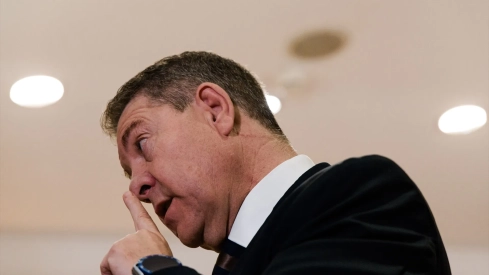
Emiliano García-Page has turned the reform of regional funding into a new challenge against Pedro Sánchez. The president of Castilla-La Mancha has hardened his discourse against the Government this Friday and has described the proposal as "the most unsupportive, most unjust and most unequal model of Spanish democracy", a few hours before his Executive voted against it in the Fiscal and Financial Policy Council (CPFF).
The Treasury's proposal has gone ahead with the votes of the General State Administration, Catalonia and the Canary Islands. The other thirteen common regime communities have opposed it, including the two governed by the PSOE, Castilla-La Mancha and Asturias. The Community of Madrid was the only one that left its seat empty after its attempt to extend the boycott to the other PP governments failed.
The regional opposition has an undeniable political weight, although it was not enough to stop the proposal. The State controls half of the CPFF votes and needed the support of only one community. The agreement now begins a much more uncertain journey through the Council of Ministers and the Congress of Deputies, where the Treasury will have to gather a parliamentary majority that it still does not have guaranteed.
Page has shown himself to be "hurt" and "outraged" during an interview on 'Espejo Público'. In his opinion, the Executive has accepted a system that treats "those who have more and better, and those who have less much worse". His Government maintains that Castilla-La Mancha would receive more money, but would fall to the last place in relative funding per adjusted inhabitant.
Another challenge from Page to Ferraz
The Castilla-La Mancha leader has taken a good part of his offensive to the internal PSOE arena. He has called for the convening of a Territorial Policy Council before the reform reaches the Council of Ministers and has challenged the socialist leadership to submit the model to the grassroots.
"I would like to see if they dare to consult this model with all the party members," Page launched, who considers "the core" of what it means to be a social democrat to be at stake. He has also compared the process with the reform approved during the Government of José Luis Rodríguez Zapatero, preceded, as he recalled, by months of conversations with the socialist federations.
The move allows Page to once again reinforce his profile as an internal opposition to Sánchez. However, his rejection remains limited for now to public statements and his Government's vote in the territorial body. The Castilian-Manchegan president has not announced that he will ask the eight socialist deputies elected in his community to break group discipline when the reform reaches Congress, as the regional PP is already demanding.
Page has also attributed the content of the proposal to the demands of Esquerra Republicana de Catalunya (ERC) and Junts. He has accused the independence movement of acting out of "selfishness" and has described the negotiation as "blackmail." His criticism is especially directed against ordinality, the criterion that seeks to prevent a community with greater fiscal capacity from ending up below others after contributing to the common system.
The regional president has reduced this principle to the idea that those who have more will always retain more resources. The debate is considerably more complex. The model incorporates leveling mechanisms and an additional contribution from the State, although Castilla-La Mancha considers that these instruments still do not adequately compensate for factors such as geographical dispersion, aging, or the cost of providing services in small municipalities.
Page has also criticized the support from the Canary Islands. According to his version, Hacienda would have negotiated a bilateral agreement with the archipelago to make a result initially supported by Catalonia "more decorous." The Canary Islands Government has offered a very different explanation and has defended its vote due to the improvements obtained during the negotiation. The islands estimate that they will receive an additional 1,337 million euros, will be above the average, and will keep their Economic and Fiscal Regime outside the system.
The clash between money and relative position
The proposal promoted by Hacienda contemplates an additional 20,975 million euros for the communities in 2027. The increase comes, among other measures, from raising regional participation in personal income tax to 55% and in value-added tax to 56.5%, compared to the current 50%.
The Government also guarantees that no community will lose resources compared to the current system. According to its calculations, the difference between the best and worst financed territory would be reduced from about 1,500 to approximately 700 euros per inhabitant. The system is proposed as common, although its adoption will be voluntary for each autonomous community if it passes parliamentary processing.
That point marks the difference between Page's narrative and the figures defended by the Treasury. Castilla-La Mancha could receive more money and, at the same time, worsen its relative position if other communities obtain greater increases. The real disagreement lies in how the increase is distributed, what territorial needs are weighted, and how much each community should retain after contributing to equalization.
The meeting has also incorporated new mechanisms to bring the worst-financed territories closer to the average and address factors such as depopulation, tourism, reindustrialization, or forest area. Part of these instruments will have to be specified through subsequent legislative developments, and some of their amounts are still open.
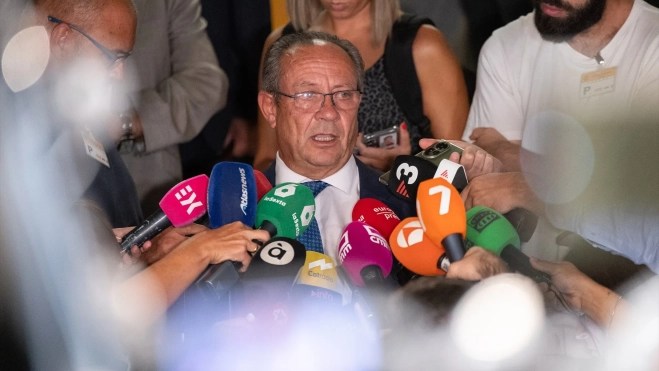
The Castilian-Manchegan Minister of Finance, Juan Alfonso Ruiz Molina, has also warned that Junts could demand changes during parliamentary processing. Minister Arcadi España has confirmed that groups will be able to present amendments and negotiate the text when it reaches Congress. The Executive wants the new system to come into force on January 1, 2027.
