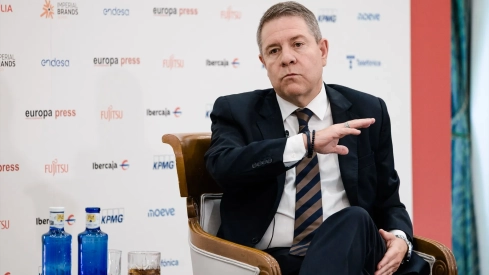
Emiliano García-Page has once again placed Pedro Sánchez before an uncomfortable rift within the PSOE. The president of Castilla-La Mancha this Thursday rejected the regional funding proposal that the Government wants to take to the Fiscal and Financial Policy Council on July 29 and has warned that his community will not accept a model that he directly links to ERC.
From Jadraque, in Guadalajara, Page has again called for a Conference of Presidents to address the reform before the Treasury advances in the calendar. In his opinion, the Government cannot dispatch a matter of this size in a CPFF meeting, where the central Executive retains a decisive position by regulation. “We are not going to swallow Junqueras' model in any way”, he affirmed.
The Castilian-Manchegan leader has accused Moncloa of trying to impose on all autonomies a scheme of “fiscal separatism” agreed with the independence movement. He has also rejected that the negotiation of funding advances at the same time as the General State Budgets, because this coincidence fuels the idea that the territorial distribution is linked to the parliamentary arithmetic of the Government.
Page asks to separate Budgets and funding
Regional funding has been pending reform for more than a decade and affects the money with which communities pay for health, education, dependency and public services. The Government defends that its proposal would provide 20,975 million more in 2027 compared to the current model, would raise the total resources of the system to 224,507 million and would maintain a guarantee that no community receives less than now.
The Treasury maintains that the new model seeks more fiscal autonomy, more co-responsibility and a distribution adjusted to demographic, social and territorial criteria. Among its bases appear a new adjusted population, greater transfer of personal income tax and VAT, a leveling mechanism and an additional contribution from the State to reduce differences between communities.
Page does not dispute that the system needs to be reformed. But he again rejects the political origin of the text and the way it is processed. The Castilian-Manchegan president fears that the agreement with ERC will tilt the model towards Catalonia and reduce the weight of variables that Castilla-La Mancha considers essential, such as dispersion, aging, depopulation or the real cost of providing services in rural areas.
At that point, the chosen scenario for his statements fits. Page spoke from an event recognizing the fight against depopulation in Castilla-La Mancha, where he defended that the financing of public services cannot depend on a formula that, according to him, rewards those who have more. His thesis is simple to understand in territorial terms: healthcare or school cost more when they have to be maintained in small towns, with an aging population and a great distance between municipalities.
The PP joins the rejection and prepares a block no
Page's clash coincides, not surprisingly, with the rejection of the autonomous communities governed by the PP. The Balearic Islands, Murcia, and Castilla y León have already announced their opposition to the model. The Balearic vice-president Antoni Costa has said that his Government will vote against a financing that he considers "imposed" by the Executive and ERC. The Murcian spokeswoman, Marisa López Aragón, has rejected that the solution for underfunded communities is to get into more debt.
Castilla y León has also questioned the legal and political viability of the proposal. Its spokesman, Carlos Fernández Carriedo, has presented it as a conjunctural concession to a parliamentary partner of Sánchez and has warned that the Junta will use the legal mechanisms at its disposal if the model ends up going ahead.
The national PP has turned the debate into a banner against the Government. Miguel Tellado has accused Sánchez of agreeing on a "harmful" financing with ERC and has promised that Alberto Núñez Feijóo will promote another system if he reaches La Moncloa. The Valencian Community, however, introduces its own nuance. Juanfran Pérez Llorca has demanded a "Valencian exceptionality" due to the DANA and has shown himself willing to renegotiate, albeit from a rejection of the general approach of the Treasury.
Barbón accepts the CPFF and Junts cools the path in Congress
The socialist position is not homogeneous either. Adrián Barbón, president of Asturias, shares criticisms of the model, but does not agree with Page in demanding a Conference of Presidents as a prior step. Barbón defends that the debate should take place in the Fiscal and Financial Policy Council because it is the body legally responsible for addressing autonomous financing.
Catalonia, for its part, is the clearest support for the Government in this phase. The counselor Alícia Romero has asked the PP for a more constructive attitude and has urged Junts to facilitate the processing of the model in Congress. There lies one of the real keys to the calendar. Although the Treasury can take the text to the CPFF, the reform will later need an absolute majority in the Cortes.
Junts maintains its doubts because it considers that the agreement does not equate to the economic agreement it defended and because its calculations greatly reduce the net benefit for Catalonia. The position of Carles Puigdemont's party leaves the negotiation in a complicated terrain for Sánchez, who needs to sustain the pact with ERC without closing the door to other essential partners in Congress.
The next step is set for July 29, when Arcadi España gathers the communities in the CPFF. Castilla-La Mancha will arrive with the rejection announced by Page and with a prior request that Moncloa, for now, has not attended to: a Conference of Presidents to discuss financing with all regional presidents sitting at the same table.
