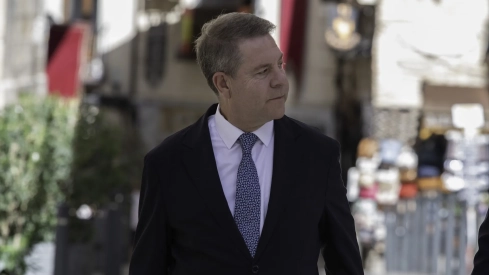
The president of Castilla-La Mancha, Emiliano García-Page, this Thursday escalated his confrontation with Pedro Sánchez to the maximum by describing the management of the Ceuta crisis as "one of the great disasters" of recent years and warning that it could end up becoming "the first or second great lie of democracy".
In an interview granted to the program 'Más de uno', on 'Onda Cero', the socialist leader resorted to the false attribution of the 11-M attacks to ETA to criticize the response offered by Moncloa after the declassification of intelligence reports. "It could end up being the great lie of democracy, like the authorship of 11-M," he assured.
Page questions Moncloa's version
The socialist baron believes that the Government must "hurry up" and "get a move on" to clarify what it did with the information it received before the massive entry of more than 70,000 people into Ceuta on July 30 and 31. Otherwise, he warned, the crisis could become "a huge bargain for the far-right".
"We are in the phase where all of Spain believes that the lie has been elevated to the category of dogma, in the before, the moment, and the after," said Page, who also ironized about the Executive's ability to interpret the documents. "Almost none of those who have had to read the reports from the National Intelligence Center have reading comprehension," he launched.
The documents published by the Government include communications about the increase in arrivals by swimming and about the calls disseminated on social networks to cross the border. The day before the massive entry, the National Intelligence Center (CNI) communicated via WhatsApp to the Government Delegation and the Civil Guard that an attempt could be prepared for July 30. The warnings, however, did not calculate a mobilization of the magnitude that finally occurred.
Moncloa maintains that that informal exchange cannot be equated to an official alert from the intelligence service and defends that none of the agencies anticipated the dimension of the crisis. Page has rejected that this argument closes the debate. "There were reports, but let's say they were moderate, that they were not tragic. Well, the question is, even being moderate, was anything done, little, much, or nothing was done?", he asked.
The president of Castilla-La Mancha has also vindicated the CNI as "one of the best intelligence services in the world" and has defended the work of the Civil Guard and the National Police. His criticisms have been directed at Moncloa's political response, which he has accused of entering a "somewhat schizophrenic dynamic" by avoiding taking responsibility.
🔴 García-Page califica de "desastre" la gestión del Gobierno sobre Ceuta: "Puede terminar siendo la gran mentira de la democracia, como la autoría del 11M"
— Onda Cero (@OndaCero_es) September 10, 2026
En @MasDeUno ⬇️ pic.twitter.com/isr1xY9ec0
Page has even argued that the Executive's actions will be studied in Political Science faculties as "the example of what not to do, of how not to approach a crisis". To reinforce his criticism, he recalled the reaction of former German Chancellor Gerhard Schröder to the 2002 floods, when he traveled to the affected areas and gained ground in the polls before the elections.
His warning about the electoral gain of the far-right comes after Page himself used the term "invasion" to speak of the massive entry and rejected that Castilla-La Mancha would host minors transferred from Ceuta. The leader has now insisted that it is impossible to offer solutions while the Government maintains a mistaken diagnosis of what happened.
Puente responds to Page's new attack
The interview has also served Page to once again question the internal functioning of the PSOE. "When I started as a militant, self-criticism was a mandatory rule. Today it is practically forbidden," he stated, after assuring that political organizations have "suspended the rights of majority opinion."
The Minister of Transport, Óscar Puente, responded hours later via X. "I know many who call criticizing others self-criticism," he wrote. The minister attributed this attitude to a "deformation of perception" which reveals, in his opinion, a "null capacity to accept criticism."
Conozco a muchos que a criticar a otros le llaman autocrítica. Es una deformación de la percepción como otra cualquiera, que pone de manifiesto una cierta distorsión de la realidad y una nula capacidad para encajar la crítica, cuando el autocrítico es quien la recibe. https://t.co/diPrCGZfOl
— Óscar Puente (@oscar_puente_) September 10, 2026
The clash comes after Page this week accused Sánchez of living "on his knees before bloody minorities" and of having "zero credibility." Despite the increasing harshness of his interventions, the president of Castilla-La Mancha has again denied that he is organizing an internal alternative. "You will never have seen me in a conspiracy, organizing a critical group, or trying to move anyone's chair, because that's not my game," he stated.
