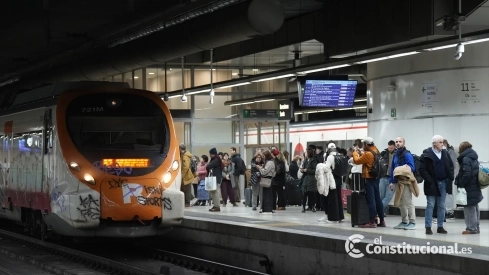
The president of the Generalitat, Salvador Illa, has officially activated the project for the future orbital railway line that will connect different municipalities of the Barcelona metropolitan area without the need to pass through the Catalan capital. The announcement was made in Sant Sadurní d’Anoia alongside the leader of ERC, Oriol Junqueras.
The new infrastructure will link Mataró with Vilafranca del Penedès and Vilanova i la Geltrú through a large metropolitan railway ring. The project contemplates 120 kilometers of track, of which 68 will be new construction, and a total of 40 stations, 23 of them completely new.
The Govern estimates that the future line could move more than 30 million passengers per year and become a key piece to improve mobility between regions such as Maresme, Vallès, Baix Llobregat, and Penedès without depending on radial routes towards Barcelona.
The planned investment amounts to 5.2 billion euros and construction will be carried out in phases until 2041. Part of the route will utilize existing infrastructures, such as lines R4 and R8 of Rodalies de Catalunya.
The first action will arrive in 2027 with an initial phase that will reinforce line R8 between Granollers and Martorell, in addition to new interchanges in Rubí and Sant Cugat del Vallès.
The first major new construction section will be the one connecting Santa Perpètua de Mogoda with Sabadell, planned for 2034 and with five new stations. This phase between Granollers and Terrassa is, for now, the only one that has guaranteed funding through the Rodalies Plan.
Subsequently, the connection between Mataró and Granollers will arrive, planned for 2037, with 23 kilometers of new tracks and six additional stations. The third phase will link Terrassa with Vilafranca del Penedès in 2040, while the last action will definitively close the railway ring between Vilafranca del Penedès and Vilanova i la Geltrú in 2041.
During the presentation event, Salvador Illa thanked Oriol Junqueras for his “sense of country” and “political courage” in promoting the agreement. For his part, Junqueras defended that the project “is much more than a train line” and assured that it represents “a new model of country and mobility.”
Add ElConstitucional.es as a preferred Google source for free.
Stay informed about all the latest breaking news with the best information. Against disinformation, for democracy and social rights.
