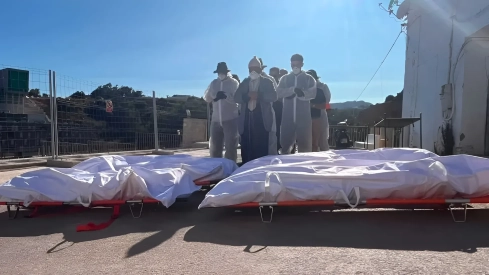
The Muslim cemetery of Sidi Embarek, in Ceuta, hosted this Friday the first burials of the victims of the migratory tragedy of July 30. Eighteen people have been buried without it being possible to know their names. On each grave, a white stone marked only with a number has been left.
The bodies arrived in groups of four from the improvised morgue in the old Military Hospital. Workers equipped with protective suits transferred them to the stretchers and, after a collective prayer led by an imam, deposited them in the spaces prepared in the expanded part of the cemetery.
The burial followed the Islamic rite, which establishes that the body remains in contact with the earth. Volunteers and operators closed the graves with bricks before covering them completely. Fingerprints, DNA samples, and the number assigned to each deceased are preserved in case their families manage to identify them later.
An identity still pending
The burials show the most painful dimension of the massive entry recorded on July 30 and 31. The Civil Guard recovered 82 bodies on the coast of Ceuta, a figure that overwhelmed the seven cold storage chambers and the three forensic doctors available at the Institute of Legal Medicine. The City had to set up a provisional morgue and received reinforcements from the Peninsula to complete the autopsies.
So far, only six of the victims have been identified. For each body, judicial proceedings have been opened, and fingerprints and biological samples have been collected to allow their identity to be cross-referenced with family members. Morocco's refusal to admit the bodies has prevented repatriations, even in cases where names and surnames are already known.
The burials will continue over the next few days due to the deterioration of the bodies and the impossibility of keeping them in the morgue for longer. If a family manages to identify any of these people, the registered code will allow their grave to be located and the exhumation and repatriation procedure to begin.
