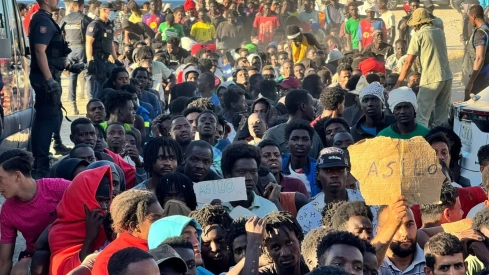
Ceuta is once again looking towards its border with August 15 marked as a new risk date. The autonomous Government has transferred to the competent authorities the messages disseminated from Moroccan accounts and groups that call for organizing another massive entry into the city from Castillejos.
The warning comes just days after the crisis that overwhelmed Ceuta's response capacity and left dozens dead. The spokesman for the Ceuta Executive, Alejandro Ramírez, has acknowledged that the call causes evident concern after what happened during July 30 and 31.
"Obviously, after what has happened, it is worrying that there is such rumor-mongering on social media," he explained after the meeting of the Governing Council. Ramírez confirmed that the messages are already in the hands of the bodies responsible for border security. "Let's hope that's not the case," he added.
The publications circulate on WhatsApp, Facebook, Instagram, and TikTok. Several invite people to join groups created to prepare for the crossing, set the date of August 15, and point to Castillejos, the Moroccan town of Fnideq located next to the Tarajal border, as the meeting point.
The groups exist and the mobilization remains to be measured
The call has gone beyond the realm of a simple isolated poster. An investigation by 'Maldita.es' has located groups and publications where there is open talk of crossing on the 15th and even of bringing forward the attempt. Ten general groups related to migration from Morocco gather more than 422,000 members, although this figure includes users who have been in them for some time and does not equate to the number of people willing to participate.
'El País' has also accessed five Facebook groups with nearly 400,000 members and nine WhatsApp chats. In them appear messages of enthusiasm, questions about routes and transport, and advice on how to cross the fence or arrive by sea. Warnings, taunts, and doubts about the authenticity and viability of the call are also abundant.
One of the channels uses the name 'haraga mrc', in allusion to the term harraga, used in North Africa to refer to those who try to emigrate irregularly. "We have created a group. Whoever wants to join, welcome," says one of the publications next to the date "15/08/2026". Other messages call for meeting in Castillejos and directly ask what plan will be followed to reach Ceuta.
Security forces have detected this movement and continue to evaluate its scope. Police sources cited by 'Antena 3' consider that the call currently has little viability because Spain and Morocco know the date in advance and can prepare their devices. This prudent assessment coexists with the alert from the Ceuta Government, determined to prevent a repeat of the lack of foresight at the end of July.
The closest precedent dates back to September 2024. A similar call led hundreds of people to the vicinity of the Moroccan border perimeter. Police coordination between both countries then prevented the call from ending in a massive entry, although during the previous month, days with more than 700 crossings by swimming and over the fence were registered.
A barrier in Tarajal and the request for more police
The central Government has installed a 500-meter pneumatic barrier next to the Tarajal breakwater, reinforced with Navy buoys and a submerged skirt. The device seeks to hinder swimming crossings and facilitate surveillance at one of the points used during the last massive entry.
The Interior Ministers of the European Union have also agreed to reinforce the protection of external borders, improve early warning systems, and increase cooperation against human trafficking networks and disinformation. Brussels has offered technical, financial, and operational assistance, including a possible reinforcement of Frontex, still pending Spain's request or acceptance of an extraordinary deployment.
Ceuta considers the current response insufficient to return to normality. Alejandro Ramírez has demanded from the Government of Pedro Sánchez more National Police officers to reinforce security in neighborhoods and public spaces, as well as resources to address the pressure the city continues to endure.
The autonomous executive also wants European institutions to assume greater responsibility for Ceuta and Melilla as external borders of the Union in North Africa. The call for August 15 is already in the hands of security officials, and the City demands that reinforcements arrive before that date.
Add ElConstitucional.es as a preferred Google source for free.
Stay informed about all the latest breaking news with the best information. Against disinformation, for democracy and social rights.
