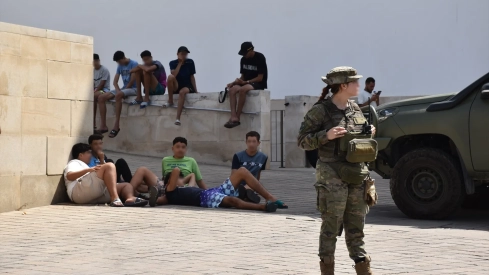
The Government has reinforced its message against the hoaxes circulating on social media in the face of the calls for a new massive entry into Ceuta and Melilla next August 15. The warning comes as Morocco multiplies controls on roads and towns near both autonomous cities.
The Spanish Embassy in Morocco has disseminated a message this Tuesday addressed to those contemplating traveling to the border. "Entering Ceuta or Melilla irregularly does not grant the right to remain in Spain or to access the rest of Europe," warned the diplomatic representation, which emphasizes that "any information to the contrary is FALSE".
Información verificada:
— Embajada de España en Marruecos (@EmbEspanaRabat) August 11, 2026
Entrar irregularmente en Ceuta o Melilla no da derecho a permanecer en España ni a acceder al resto de Europa.
Toda información en sentido contrario es FALSA.
The publication seeks to stop the spread of messages that present irregular entry into the autonomous cities as a way to reach the Peninsula or other European countries. The calls to attempt it next Saturday continue to spread on Moroccan social media.
Morocco multiplies controls near the border
The Moroccan authorities have reinforced the presence of the Police and Gendarmerie at the accesses to Fnideq, located next to Ceuta, and in the province of Nador, bordering Melilla, according to EFE. Agents search vehicles, check the identity of travelers, and daily intercept potential migrants on the roads leading to the border.
Journalist Ahmed Biyuzan, a resident of Fnideq and specialized in migration issues, explained that intercepted people are returned by bus to their cities of origin. In Nador, police checkpoints have also been installed at the main accesses, and transfers outside the province continue.
The Moroccan Association for Human Rights has denounced the existence of illegal places used to concentrate young people before sending them to cities like Casablanca or Beni Melal. Its head in Nador, Said Haddad, maintains that some transfers end several kilometers from urban centers "with the aim of exhausting" migrants.
The deployment comes less than two weeks after the massive entry on July 30 and 31. Tens of thousands of people crossed irregularly from Morocco and more than 70,000 subsequently returned to the country, while several thousand still remain in Ceuta. The crisis left dozens dead and temporarily overwhelmed the city's assistance resources.
Minister Albares asks that no one risk their life
The Embassy's message coincides with the warning issued this Tuesday by José Manuel Albares from Ceuta. After meeting with the president of the autonomous city, Juan Jesús Vivas, the Minister of Foreign Affairs has asked those who receive these calls to "not risk their lives, their money and their future in an adventure doomed to failure".
Albares has assured that people who enter irregularly will be returned and that this route will also not allow them to reach the Peninsula or other European countries. "Every last person who has entered Spain irregularly will return to Morocco," he affirmed after the meeting.
The head of Foreign Affairs maintains daily contact with his Moroccan counterpart, Nasser Bourita, to accelerate returns and strengthen border surveillance. According to Albares, Rabat has shown its "total willingness" to collaborate with Spain and prevent a new massive entry into Ceuta or Melilla.
Add ElConstitucional.es as a preferred Google source for free.
Stay informed about all the latest breaking news with the best information. Against disinformation, for democracy and social rights.
