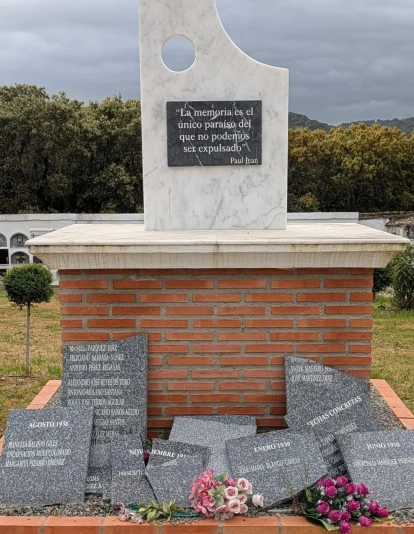
The memorialist associations of Extremadura have called for an act of homage and reparation next Saturday April 18 at 11:00 hours in the municipal cemetery of Cabeza la Vaca (Badajoz), after the vandalization of the memorial dedicated to the victims of the Francoist repression last April 4. The call, promoted by the local Agrupación de Familiares, the Asociación Comarcal Columna de los Ocho Mil and the Asociación para la Recuperación de la Memoria Histórica de Extremadura (ARMHEx), has the collaboration of the City Council of the municipality.
The attack consisted of the destruction of several gravestones with the names of neighbors repressed during Francoism. The memorial, located in the cemetery itself, collects the names of about 40 victims and stands over the place where the remains of at least 19 exhumed people from a mass grave were recovered after years of archaeological and historical investigation.
The convening entities consider that it is not a simple act of vandalism, but a serious aggression against democratic memory. According to their denunciation, the attack represents “an intolerable humiliation” for the families and an attempt to erase again those who were already victims of repression after the 1936 coup d'état. The memorial, built after interventions initiated in 2011, had become a space of recognition and reparation.
From a legal point of view, the facts could violate the Law of Democratic Memory, which obliges to protect these spaces, as well as fit within a hate crime. The complaint has already been transferred to the Prosecutor's Office of Democratic Memory of the province of Badajoz, while the Civil Guard keeps an investigation open.
Ángel Olmedo, historian of ARMHEx declares that “this is not breaking a lamppost, it is a serious crime”, and insists that the memorial “did not bother anyone” and fulfilled a basic function: allowing families to remember their loved ones. “There have been years of silence, without being able to bring flowers, without being able to pay tribute. And now that it is finally had, seeing the names broken is a humiliation”, he points out.
The reaction in the town has been, according to the organizers, of “indignation” and also of reaffirmation. “They are not allowed to rest even dead”, laments Olmedo, who warns that this type of attack seeks “to erase the names of those who were already murdered once”. Despite this, he insists that the objective now is to prevent these events from repeating and that “it does not go unpunished”.
In October 2025, the government of the Popular Party and Vox in the region reached an agreement for the repeal of the regional regulation of democratic memory, which, according to memorialist collectives, has generated a greater feeling of defenselessness of these spaces. In this regard, the associations warn that political decisions of this type can contribute to a climate that favors this type of attacks, although they insist that it is up to the investigation to determine the specific responsibilities.
The act of April 18 will include the public reading of the names of the victims, interventions by family members and associations, as well as a floral offering. It will be, as highlighted by the convening entities, a gesture of symbolic reparation and a reminder that democratic memory is a matter of human rights. “They forced us into silence for many years and we cannot return to that silence,” concludes historian Ángel Olmedo.
