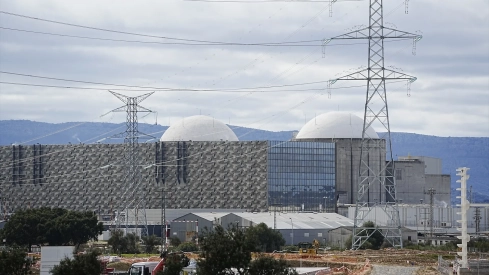
The Almaraz nuclear power plant has passed its main technical examination to continue operating until 2030. The plenary session of the Nuclear Safety Council has issued a favorable report, although subject to conditions, on the extension requested by Iberdrola, Endesa, and Naturgy for the two reactors of the Cáceres facility.
The opinion clears the obstacle related to the safety of the plant, but the final authorization corresponds to the Ministry for Ecological Transition. The department headed by Sara Aagesen will have approximately two months to study the documentation and decide whether to modify the calendar that currently sets the closure of Almaraz I in November 2027 and Almaraz II in October 2028.
The CSN report was mandatory within the procedure. A negative pronouncement would have prevented the extension, while the favorable endorsement allows the processing to continue without obliging the Government to authorize it. The safety conditions imposed by the regulator must be respected if the Executive allows the facility to continue operating.
More personnel to guarantee safety
The agreement was adopted with four votes in favor and the abstention of counselor Francisco Castejón. The evaluation is based on 29 documents prepared by 16 specialized areas of the Nuclear Safety Council, in addition to the continuous supervision that the body carries out on the plant.
The technicians have reviewed the aging of structures, safety systems and components, fire protection, environmental qualification of equipment, and compliance with improvement plans approved during the previous renewal.
The CSN proposes maintaining most of the current limits and conditions, updating the Official Operating Documents, and incorporating a specific requirement for the new period. The owners must guarantee sufficient staffing of workers in positions related to nuclear safety between 2028 and 2030.
The storage of spent fuel has also been analyzed. The regulator considers that the existing capacity, together with the project for the new Individualized Temporary Storage ATI-100, offers sufficient space to manage the waste generated until June 2030.
Almaraz I began operating in 1981 and the second reactor did so in 1983. Its owners formally requested the extension in October 2025 and provided the required documentation until February. The request contemplates that the two units can operate until June 8, 2030.
The Government will now study the entire file
Ecological Transition has announced that it will analyze the opinion and the rest of the file before making a decision. The Government had established three conditions to study any change in the nuclear calendar: safety accredited by the CSN, utility for the electricity system, and absence of additional costs for citizens.
The report released this Thursday responds to the first of these demands. The request submitted by the companies did not include the reduction of taxes or the fee intended to finance the management of radioactive waste that Iberdrola and Endesa had previously claimed.
The possible extension would modify the staggered closure schedule agreed in 2019 by the companies and the Executive. That plan begins with Almaraz and ends in 2035 with Trillo. The decision on the Extremaduran plant will be observed by the entire sector, as it may condition future debates on the rest of the nuclear park.
Extremadura increases pressure
The Junta de Extremadura has demanded that the Government approve the continuity of the plant. The Minister of Industry and Energy, Mercedes Morán, maintains that the Executive "no longer has any more excuses" after the regulator has confirmed that the plant can operate safely.
Also, the socialist president of the Provincial Council of Cáceres, Miguel Ángel Morales, has asked for the decision to arrive as soon as possible to offer certainty to workers, families, and businesses in Campo Arañuelo. The citizen platform 'Yes to Almaraz, Yes to the future' considers that the report "fills with hope" thousands of people economically and professionally linked to the plant.
The plant managers assure that Almaraz produces more than 7% of the electricity consumed in Spain and represents one of the main industrial engines of Extremadura. The company estimates that some 4,000 people work at the facility or in associated activities, to which about 1,200 employees are added during each refueling.
The Extremaduran PP considers that the decision is already in the Government's court, while the far-right Vox has used the technical opinion to accuse the Executive of "ecological fanaticism". The CSN's resolution, however, is limited to the scope of nuclear safety and leaves energy, economic, and environmental criteria in the hands of the Ministry.
Environmentalists demand to maintain the closure
Friends of the Earth, Ecologistas en Acción, Greenpeace, SEO/BirdLife, and WWF have asked the Government to reject the extension and respect the agreed calendar. The organizations recall that the technical endorsement of the CSN only analyzes nuclear and radiological safety, one of the conditions raised by the Executive.
Environmental groups warn of the consequences on renewable planning, waste management, and electricity costs. A study commissioned by Greenpeace and carried out by researchers from the Rey Juan Carlos University and the Universitat Politècnica de Catalunya calculates that prolonging Almaraz could generate an accumulated additional cost of about 3,800 million euros between 2026 and 2033. The owners and the nuclear sector question these forecasts and defend the stability that the plant brings to the system.
The Ministry must rule in the coming weeks, and the August break will not stop the deadline. If the Government does not expressly authorize the extension within the foreseen period, the electricity companies' request will be understood as rejected.
