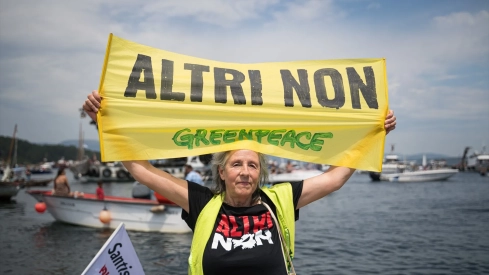
The Xunta de Galicia has informed Altri this Friday of the "definitive and firm" archiving of the project to build a large cellulose and textile fiber factory in Palas de Rei, in Lugo. The Government of Alfonso Rueda rejects the allegations presented by Greenfiber and concludes that the plant is unviable due to the lack of the electrical connection on which the file rested.
The decision puts an end to the administrative process opened for one of the most controversial industrial projects of recent years in Galicia. The Minister of Economy and Industry, María Jesús Lorenzana, has assured that the company's explanations are "inadequate and insufficient" and has practically declared the plan dead in its current configuration. "This project does not have many possibilities, not to say any, of going ahead," she acknowledged.
The initiative had been promoted during the last stage of Alberto Núñez Feijóo at the head of the Xunta and continued to advance with Rueda, whose Government even declared it a strategic industrial project. The plant also received a favorable environmental impact statement in March 2025, despite thousands of allegations and the opposition of residents, environmentalists, maritime sectors, and opposition parties.
The electrical connection finishes off an already weakened project
The Xunta initiated the archiving in February after the substation necessary to supply the factory was left out of the state electricity grid planning until 2030. The Ministry for Ecological Transition justified this exclusion due to the technical, economic, social, and environmental uncertainties surrounding the project and the risk of building a specific infrastructure that could end up unused.
Greenfiber, 75% owned by the Portuguese Altri and 25% by Smarttia, had three months to propose an alternative. The company rushed the deadline and argued that the installation could self-supply through cogeneration, in addition to pointing out other possible connection formulas. The Ministry of Economy has now ruled out these options because the file still depended on the initially planned substation.
The electrical setback was added to the lack of European funds that the promoters aspired to. The so-called Gama project contemplated an investment close to 1,000 million euros and promised about 500 direct jobs and around 2,000 indirect jobs. Its planned production included up to 200,000 tons per year of lyocell, a cellulosic fiber, in addition to a high production of soluble pulp.
The proposal that Feijóo initially presented as a commitment to sustainable textile fibers ended up revealing a much larger industrial dimension. Among the data that fueled the opposition was the request to capture up to 46 million liters of water daily, an amount that its detractors compared to the consumption of the entire province of Lugo. The volume of wood needed, the expansion of eucalyptus, and the discharges into the Ulla basin, which flows into the Arousa estuary, also caused concern.
From A Ulloa to the Arousa estuary
The filing comes after four years of sustained mobilizations in different parts of Galicia. The Ulloa Viva platform led an opposition that ended up incorporating groups from the regions of A Ulloa, Deza, Terra de Melide, and Arzúa, as well as environmental associations and organizations linked to fishing and shellfish gathering in Arousa.
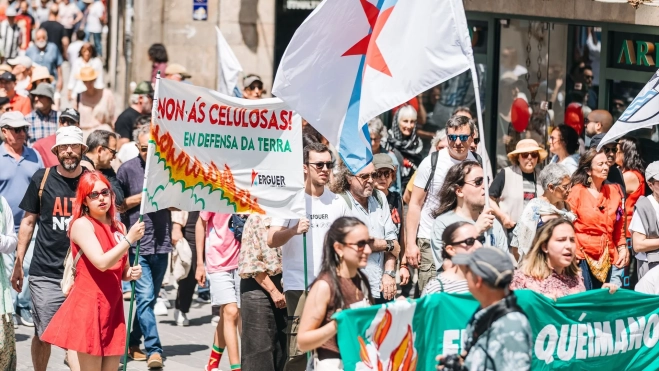
The protests brought thousands of people to the streets of Palas de Rei, Santiago de Compostela, and Pontevedra. There were also maritime mobilizations in the Arousa estuary, where the guilds warned of the possible consequences for one of Galicia's main shellfish areas. The rejection also reached the BNG and the PSdeG, who demanded the withdrawal of the project during its processing.
The planned location, next to Natura Network areas and near the Camino de Santiago, amplified concerns about an installation that would have operated for decades in the heart of Galicia. To the environmental objections was added a discussion about the economic and forestry model that a factory with high water and wood consumption would leave in its wake in a territory dominated by agricultural and livestock farms and small towns.
Ulloa Viva has received the news with satisfaction, although it remains cautious about a possible appeal from Greenfiber. The platform reproaches the Xunta for having closed the file due to lack of electricity after having defended its strategic nature for years, instead of addressing the reported effects on the territory. Greenpeace shares this criticism and celebrates the outcome as a victory for citizen mobilization. “Today, yes, and finally it was an ‘Altri non’”, said its spokesperson in Galicia, Manoel Santos.
Altri can still appeal
The archiving closes the current procedure, although the company retains the possibility of filing an administrative appeal. Altri remains silent for the moment and has not clarified whether it will go to court or if it will study a different proposal to remain in Palas de Rei.
Lorenzana assures that the Xunta also has no knowledge of a new project. The favorable environmental impact statement remains valid for four years and has already consumed more than one, but the Galician Executive considers that this document is of little use as long as there is no real solution for the electricity supply.
The company would have to get the courts to annul the file or start another process with a different technical approach. While it decides its next move, Ulloa Viva and environmental organizations will remain attentive to permits and authorizations related to water and the environment to prevent the project from being reactivated through another channel.
