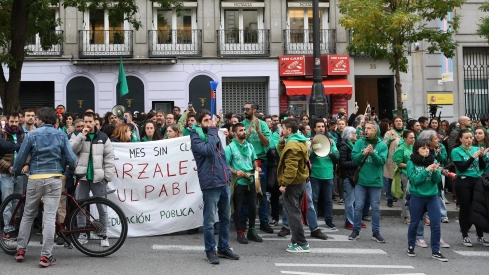
The Community of Madrid has prohibited public educational centers from using classrooms to promote the strike and, at the same time, has ordered to adapt the curricula for classes lost since October 14, with a control system that requires counting the sessions not taught in five school days.
The measure is included in two instructions signed this Thursday by the Deputy Minister of Educational Policy and Organization, José Carlos Fernández Borreguero, and addressed to non-university public centers, with the stated objective of guaranteeing institutional neutrality and activating reinforcements due to the interruption of teaching activity by the called strikes.
The document is emphatic: "the public teaching center belongs to everyone and must be neutral". It adds that its function is to educate, not indoctrinate, a formulation that the Ministry converts into a framework for action for teachers during the conflict.
Neutrality in the classroom and limits to union or political propaganda
The instructions prohibit teachers from transmitting their political, ideological, partisan, or union opinions to students in order to gain support, and also prevent using classes, tutorials, exams, or complementary activities to gain support for one of the parties in a conflict.
Nor will students be encouraged to participate in strikes, demonstrations, or signature collections, nor will comments or remarks be made to students or families about colleagues who join the strike or decide to work. The Ministry extends the restriction to the use of Raíces, Roble, EducaMadrid, and other institutional channels to disseminate manifestos or partisan positions on political, ideological, or union conflicts.
The prohibition also extends to facades, fences, and common areas, where elements that attribute institutional adherence to parties, organizations, or specific positions to the center may not be displayed. It is also forbidden to use the center's facilities or materials to place banners, posters, or distribute propaganda, except in the designated union spaces.
Now, the text introduces a limit to that restriction: the use of garments, badges, ribbons or other personal distinctive signs does not in itself constitute a breach, unless it is accompanied by prohibited actions directed at students. It also clarifies that teachers can answer questions from students with information "objective, brief and adapted to their age", without trying to convince them of any position.
Unions, for their part, may continue to use the enabled bulletin boards and corporate email for communications directed exclusively to staff, without involving students or families. And the document itself reminds that staff retain their full rights to strike, freedom of association, freedom of expression and academic freedom, in the terms of the Constitution and the laws.
A count in five days and mandatory adjustments in programming
In parallel, the Community has ordered the affected centers to quantify in five school days the sessions not taught since October 14, broken down by groups and subjects, based on schedules and data recorded in Raíces. This diagnosis must be updated monthly as long as the strike persists.
Based on this snapshot, the didactic departments and teaching teams must review the programming to identify the "essential learning" and reorganize the content in the remaining school time. Among the planned measures are individual monitoring plans, reinforcement of tutorial action, self-study materials, educational support and academic guidance.
If these actions are not enough, the management may request additional resources from its Territorial Area Directorate in a reasoned manner. In addition, centers will have to send a report to the DAT each month with the sessions not taught by group and subject, the measures adopted, the number of students with individual plans and the difficulties that may compromise evaluation, graduation or access to other studies.
Families, in addition, must receive information through Raíces and Roble about the sessions not taught and the educational measures applied. The reports will be prepared with aggregated data and without identifying the teachers who have exercised their right to strike. To supervise compliance, families, students, and staff may report possible non-compliance to the school administration or the Territorial Area Directorate (DAT), and the Educational Inspectorate will carry out an initial assessment within an indicative period of ten working days.
Priority for graduation courses and no obligation to make up hours
In courses that do not end a stage, learning that cannot be addressed this year will be transferred to the beginning of the next. In contrast, essential learning must be worked on during the current academic year in levels that lead to a degree or a change of stage. These include 6th grade of Primary, 4th grade of ESO, 2nd grade of Bachillerato, and the final courses of Vocational Training, including second year of Basic Grade. The Ministry adds that priority must also be given to students with specific educational support needs or in situations of social vulnerability.
In 2nd year of Bachillerato, schools will prioritize content with greater weight in the University Access Test, although without suppressing any of them. The instruction, however, does not alter the current regulations on evaluation, promotion, and graduation, although it allows adapting evaluation instruments and their temporary distribution to the difficulties arising from the interruption of classes.
The text also makes it clear that personnel who have exercised the right to strike will not be obliged to make up for untaught sessions, nor to work hours outside their schedule for that reason. Likewise, those who attend groups that are not their own during the strike will not be able to teach the striking teacher's subject or advance their curriculum; for these cases, schools must have review materials and autonomous work.
At the end of the academic year, the annual report will include an assessment of the actions carried out and the pending learning, which will be taken into account in the planning of the following academic year.
Contact