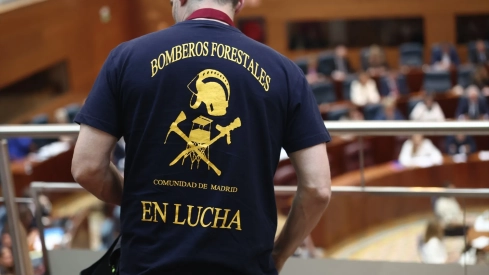
The Community of Madrid has resorted to the Military Emergency Unit while 61 public forest firefighters remain without vehicles, trucks, or tools to attend to fires. The workers assure that they requested their activation to intervene in the Almorox fire, which ended up reaching Madrid territory, but the General Directorate of Emergencies ignored their requests.
The complaint has gained strength amidst the national emergency due to the fires in Madrid and Ávila. While thousands of people were leaving their homes and the Government was mobilizing the UME, state media, and reinforcements from other communities, a part of Madrid's specialized personnel was working their shift at the Emergencies headquarters in Las Rozas.
"We are coming to our workplace to work, but we are not given the means to be able to travel to the fires," explained Alberto Ferreros, one of the affected firefighters. The personnel finish their shift at 10:00 PM and return home without having been mobilized, despite being uniformed and available.
The firefighters first requested their activation for Almorox on July 16. They did so by calling the Operational Coordination Center, the Fire Department headquarters, and through a written request registered with the Director General of Emergencies. They repeated the request the next day and still did not receive the necessary means to travel.
Los #BomberosForestalesCBCM queremos denunciar la no activación al #IFAlmorox deberíamos ser 62 fecetivos, pero la CM no contrata a todo el personal de extinción de incendios forestales.
— Bomberos Forestales CBCM (@bomberos_infoma) July 22, 2026
Estamos trabajando en nuestro centro de trabajo, pero no nos movilizan aunque lo solicitemos. pic.twitter.com/pmIb65C8Xv
The group has also reported that the Community should have 62 public personnel in service, but the firefighting staff remains incomplete. "We are working at our workplace, but they do not mobilize us even if we request it," they warn in the message disseminated from their official account.
The absence of these workers also does not mean that Madrid's forest firefighting system is completely stopped. Civil servant firefighters, teams contracted through Tragsa, forest agents, and state resources continue to intervene. The conflict affects forest firefighters directly contracted by the regional administration, a small staff whose presence allowed for the reinforcement of 19 stations during the high-risk campaign.
An available staff kept away from the stations
The 61 forest firefighters have been going to the General Directorate of Emergencies in Las Rozas since mid-May, the address listed as their workplace in their contracts. Previously, they were distributed among the region's stations and watchtowers, where they began and ended their shifts.
The protest formally maintains a strike, although the workers emphasize that they report to their posts and fulfill their schedules. Their lack of intervention during recent fires stems, they claim, from the absence of assigned vehicles and equipment. The established minimum services reach 80%, but even those personnel are not operating normally.
The situation has left an image difficult to explain during a week marked by fire. The duty chief requested around 20 additional civil servant firefighters to reinforce Aldea del Fresno, San Martín de Valdeiglesias, Villaviciosa de Odón, and Móstoles, while the public forest firefighters waited in Las Rozas for their activation.
Until this campaign, 19 stations had a unit consisting of a truck and two or three forest firefighters. This summer, they have lost that reinforcement. The Community has resorted to extraordinary shifts for civil servant firefighters, which are longer and more costly, while negotiations with the forest collective remain blocked.
The planned staff once had 124 positions. A total of 98 workers passed the stabilization process concluded in 2024, but only 61 remain active. The others are on leave after seeking other jobs with greater stability, according to the affected individuals themselves.
Their salary is around 1,826 gross euros per month and is close to 1,400 net euros. Contracts continue to identify some of them as drivers of cars, taxis and vans or building maintenance personnel. The professional category that appears on paper still does not correspond to the prevention and extinction work they carry out on the ground.
The forest firefighter law remains at the center of the conflict
The dispute worsened with the entry into force of Basic Law 5/2024 on forest firefighters. The norm recognizes this category for those who professionally perform prevention, surveillance, and extinction tasks, regardless of whether their relationship with the Administration is civil servant or labor.
The law also contemplates the negotiation of supplements linked to danger, physical effort, toxicity, arduousness, morbidity, and psychophysical risk. Workers demand the application of these concepts, the recognition of their category, and year-round contracts. The Community offered to group the six supplements into a 132-euro monthly increase, an amount that the committee considered insufficient.
Ayuso's Government maintains that it offered to reopen a negotiation table if the strike was suspended. Workers' representatives rejected that condition and accuse the Minister of Environment, Agriculture and Interior, Carlos Novillo, of attending the last meeting "without any proposal" and with warnings about the future of the corps.
Madrid has presented a budget of 187.9 million euros for 2026 for the 112 Security and Emergency Agency, 4.8% more than the previous year. The accounts reserve more than 31 million for work carried out by companies and for the new commission to Tragsa dedicated to prevention and support for extinction.
The budget documentation defends a change of model with 420 Tragsa workers throughout the year. The previous system had 550 people during the four months of greatest risk and around 300 during the rest of the year. The regional Executive assures that the new organization will allow reinforcing winter prevention and reducing seasonality.
Workers present a different balance. Jesús Molina, president of the Tragsa forest firefighters' works council, estimates a 50% reduction in preventive work carried out last winter. Clearing, opening firebreaks, maintaining tracks, and cleaning areas near municipalities condition the speed of the fire and the safety of those who have to fight it months later.
The Tragsa conflict runs separately from the one maintained by the 61 public workers. Their staff has been dragging an expired agreement since 2008, frozen salaries since 2010, and remunerations close to 1,300 euros. Around four out of ten personnel still depend on contracts limited to the summer campaign, a temporality that expels experienced professionals every year.
The indefinite strike of this second group has been suspended during the emergency to concentrate resources on extinction. Tragsa and labor representatives are preparing a pre-agreement on salaries, breaks, and protection against carcinogenic substances. Public forest firefighters, for their part, continue to demand vehicles and an activation order to join the fires.
The UME reinforces the emergency and prevention remains in autonomous hands
The arrival of the UME provides human capacity, heavy machinery, communications, and experience when a fire exceeds ordinary means. Madrid requested its intervention due to the advance of the fire from Almorox, and the Government has since expanded the deployment by declaring the emergency of national interest in the Community and in the province of Ávila.
The military works alongside autonomous and state devices under the National Civil Protection System. The Forest Firefighters Law itself excludes military personnel from that professional category. Their function begins with the great emergency, while territory surveillance, vegetation treatment, and mountain preparation correspond throughout the year to administrations and their civilian staff.
Madrid's INFOMA Plan foresees clearing, silvicultural treatments, maintenance of firebreaks, forest tracks, water points, and crew bases. For 2026, actions on 1,307 hectares were projected. The workers' alert points precisely to the discrepancy between that planning and the tasks that could be completed before summer.
The problem also reaches Castilla y León. Two days before the high-risk campaign began, around 200 workers demonstrated in Ávila, León, Palencia, and Segovia to denounce unfilled vacancies, lack of personnel in trucks and towers, and a professionalization still pending.
The Junta announced a deployment of 5,001 professionals and an investment of 160 million euros, 60 million more than the previous year. The campaign began, however, after a conflict that threatened to leave out nearly 950 workers from private companies due to safety conditions and contract adaptation. The agreement reached in June allowed these personnel to be recovered, although it left professional recognition and several labor changes pending.
Castilla y León also carried the blow of 2025, when nearly 171,900 hectares burned and five people died. The aerial means of the Ministry for Ecological Transition dedicated around 40% of all their support hours to that community. This summer, the Burgohondo fire has once again placed Ávila under state direction along with the Community of Madrid.
Madrid's forest firefighters returned this Friday to their workplace in Las Rozas. They continue to demand the vehicles, tools, and necessary positions to return to the parks. The UME, Tragsa teams, civil servant firefighters, and reinforcements displaced from other territories continue working against flames that they also asked to attend.
