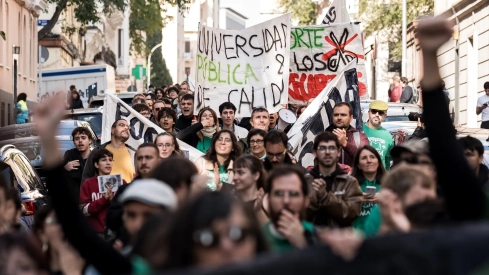
Three empty chairs marked the meeting called this Wednesday by the platforms for public education in Madrid. They were reserved for the counselor of the Ayuso Government, Mercedes Zarzalejo, and ministers Diana Morant and Milagros Tolón. Following their absence, the Platforms for Public University have warned that they will increase pressure to achieve a negotiation. “If Zarzalejo does not sit down to negotiate, there is no choice but to demand her immediate resignation,” concludes their statement, which this newspaper has had access to.
The meeting, scheduled for November 18 at 12:30 p.m. at the Complutense University, brought together the demands of different educational stages in a conflict that has accumulated more than a month of indefinite strike in non-university public education. The Labor Platform for Early Childhood Education Centers, the Fewer Teaching Hours Assembly, a member of the strike committee, and the university platforms participated.
“After the meeting to which we summoned the political leaders of education, today there was a chair prepared for counselor Mercedes Zarzalejo and two others for ministers Diana Morant and Milagros Tolón. Those chairs remain empty. And that absence says much more than any statement,” the platforms point out in the text released after the appointment.
The statement questions the regional Executive's presentation of its university budget as “historic.” According to the platforms' calculations, the regional plan would place public university spending at 0.39% of Madrid's GDP in 2031, compared to a national average they estimate at around 0.7% and the 1% target included in the LOSU.
The organizations argue that basic funding is insufficient to cover the ordinary operation of the centers. They denounce that this situation is causing cuts in teaching, research, infrastructure, and working conditions, in addition to compromising the quality of training.
“And this has no economic justification,” they affirm, contrasting these difficulties with the region's economic growth and wealth.
The platforms attribute the situation to a political decision. “We want to say it clearly: this is not incapacity or mismanagement, it is a model. First, the public is degraded, and then the private is offered as a solution,” the statement reads. As an example, they assure that 53 out of every 100 university staff hirings made in Madrid between 2016 and 2024 corresponded to private universities.
The Ministry, for its part, has defended the multi-year financing agreement signed with the rectors of the six public universities and has asked for time for it to take effect. Zarzalejo has described the demands as "totally unattainable".
The platforms denounce "silence and non-appearance"
The organizations recall that on October 26 they sent a letter to the Madrid Government to formally request a negotiation table. They assure that that request went unanswered and that Wednesday's meeting also did not allow for dialogue to open.
"Today we have summoned them here to open the door to the opening of this negotiation. The answer: silence and non-appearance", they reproach.
In the same section, they denounce what they consider a repressive response to the mobilizations. According to their account, on October 14, five people were arrested and six injured during a picket line at the Faculty of Chemistry of the Complutense University. They also recall the arrest of a teacher on November 5 in front of the Ministry and reject Ayuso's description of the strike as "devious".
"The Community of Madrid has an open conflict in all of Madrid's education and, therefore, in a very important part of Madrid society that opposes this destruction and dismantling of public services by the Popular Party", they maintain.
Responsibilities to the central Government
The criticism in the statement extends to the summoned ministries. The platforms consider that the distribution of powers also obliges the Government of Spain to act to guarantee university funding.
"The LOSU set a funding target of 1%, but without mechanisms to enforce it, it is dead letter", they state. They accuse the Ministry of Universities of knowing the situation in Madrid without having taken measures and describe its absence as "complicit in this situation".
A financing calendar and 362 million more in 2027
The platforms demand a budgetary path that allows reaching funding equivalent to 1% of the regional GDP for the public university system. For the Madrid budgets of 2027, they estimate that it would be necessary to incorporate an additional 362 million euros to what is planned.
They argue that this increase would allow them to combat contractual precariousness, reverse cuts, and substantially reduce tuition fees. They also demand "an end to the police repression of protest and the repeated insult to the university community" by regional authorities.
The text ends with a warning to the Ayuso Government. "If the Government of the Community of Madrid refuses to review its policies and negotiate, failing to comply with its public mandate, they leave us no other option but to escalate the conflict, and in the coming days we will do so. The ball is in their court."
Contact
We are listening. Get in touch.
