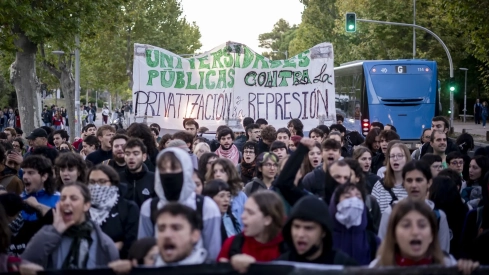
The indefinite strike for public education in Madrid begins this Wednesday, October 14, with the Government of Isabel Díaz Ayuso at the center of the criticism from its organizers, under the slogan: "Teachers and students united to defeat Ayuso in defense of public education." The spokesperson for the Student Union of Madrid, Gabriel Moya, denounces in an interview with 'ElConstitucional.es' the lack of resources and, therefore, the economic "suffocation" by the Community of Madrid.
The organization proposes a sustained mobilization through pickets, assemblies, and demonstrations. Its main demands include reversing cuts, increasing public investment, ending educational agreements, and expanding staff and available places. It also demands the renovation of centers and the strengthening of mental health care and the prevention of school bullying.
At the time of the interview, Moya denounced police charges against the informational picket line at Ciudad Universitaria. Regarding the reason for the strike, the spokesperson describes a situation of deterioration that, he maintains, affects both study conditions and the work of teachers.
Fewer resources for classrooms: Moya contrasts educational funding with Formula 1 and Ayuso's penthouse
Gabriel Moya denounces that the lack of funding is deteriorating study conditions at the Complutense and in public education as a whole. “The situation we are experiencing in all public education, including universities, is unsustainable; we are in a situation of economic suffocation due to underfunding,” states the spokesperson for the Student Union of Madrid.
As he explains, “there is less and less money for absolutely everything,” while “there are not enough teachers, there is no material in half of the classrooms.” He also criticizes the state of the infrastructure and classrooms, whose conditions he considers to be “in many cases deplorable.”
The precariousness extends, according to his account, to field trips and internships for degrees with laboratory hours. Moya holds the regional Executive responsible for the “indebtedness to which the Ayuso government is subjecting universities, especially the Complutense.”
His criticism points directly to the spending priorities he attributes to the regional president of Madrid: “But nevertheless we see that there is money for Formula 1 for the penthouses that Mrs. Ayuso buys with our public money but yes, to finance quality public education to guarantee that we can all access a public and quality university, well, she doesn't want to spend a penny.”
The union raises the same complaint in its call, where it contrasts the spending it attributes to the Community of Madrid on the penthouse and Formula 1 with the deficiencies of the institutes: deteriorated facilities, lack of air conditioning, overcrowded classrooms, and scarce investment in mental health and prevention of school bullying. Their demands include allocating at least 7% of GDP to public education and an investment plan of 3,000 million euros over four years to renovate, air-condition, and build centers.
Moya points to the elimination of afternoon shifts as one of the concrete consequences of the cuts: “We have suffered it in the cuts that have been made to many shifts, especially in the afternoon shift, where entire shifts have been removed.” “It is an attack that we, the most precarious and hardest-working youth, suffer, who have to combine our studies with work activity,” he stated.
The spokesperson has intensified his criticism against the regional president of Madrid: “We are not here to protest for public education in the abstract because we know that defending public education is attacking the Ayuso government and is defending ourselves from her government.” “These strikes are strikes against the Ayuso Government,” Moya reiterates.
More teachers and 100,000 new public vocational training places
The demands of the Student Union include reducing the number of students per classroom in Secondary to 15 and hiring the necessary teaching and non-teaching staff to cover all vacancies, with decent working conditions.
In Vocational Training, the organization proposes a shock plan to create 100,000 public places in Madrid. In addition, it demands the abolition of fees, guaranteed paid internships, and an end to vocational training agreements, incorporating these centers into the public network.
The withdrawal of subsidies to private education and the Catholic Church, along with the termination of all educational agreements, constitutes another of their demands. The union advocates that no student should be left without a place in public education.
Asked about contacts with the Ayuso Government before the call, Moya responds by reviewing the mobilizations of recent years, including those organized with Menos Lectivas and the university strike last November. According to the spokesperson, the regional Executive's response has been "silence" and "all refusal to negotiate". He also accuses it of continuing with privatizations and cuts while financing private and subsidized education.
Housing is also part of the protest
Regarding the incorporation of the right to housing into the demands, Moya maintains that difficulties in accessing accommodation directly affect education: "We believe that there cannot be public education if there is no housing."
The spokesperson explains that students and teachers need decent conditions outside the classrooms to be able to study and work. He links the problems of paying rent with job insecurity and with the impossibility of affording the cost of a private university.
In its call, the union also links the defense of public education with the situation of neighborhoods and access to housing. Its approach is to extend the mobilization to all young people and the working class.
