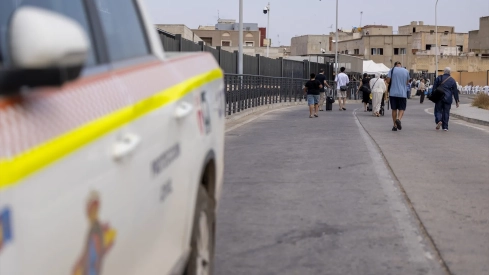
Melilla arrives at dawn on Saturday, August 15, with a reinforced security deployment and attention focused on Mount Gurugú, located on the other side of the border. Calls disseminated in recent weeks on social media and messaging groups have led security forces to prepare for a possible attempt at irregular entry, although its scope remains uncertain.
Concern has increased in recent hours due to information gathered in several police reports sent to officials at the Ministry of Interior. According to 'El Confidencial', groups of sub-Saharan migrants would have arrived from cities like Fez or Casablanca to the Beni Enzar station and would have subsequently moved towards Gurugú, from where a good part of Melilla's border perimeter is overlooked.
The Ministry of Interior has not provided an official figure on the people who might be in the area nor has it confirmed that there is an organized mobilization for this Saturday. The Government of Melilla stated last Tuesday that it lacked information about specific movements, although it acknowledged the existence of messages encouraging new crossings into Spanish territory.
Moroccan authorities have established controls on roads near Nador and Beni Enzar to detect movements of potential migrants. The deployment is less visible than that organized at other points on the border, a circumstance that has contributed to placing Melilla among the main concerns of Spanish services.
The analysis carried out by Golden Owl, a company linked to the Scientific Park of the University of Alicante, already warned this week that the closure of several Facebook groups used to promote irregular migration had reduced their visibility, but had kept their structure operational. The investigation pointed to Nador and Melilla as possible alternative routes after the reinforcement of surveillance at other points in northern Morocco.
The president of Melilla, Juan José Imbroda, has asked for calm and affirmed that the city is prepared to respond. "Nothing is happening here", he maintained this Friday, addressing especially students who are considering moving to the city to start their university course. The popular leader has admitted, however, that the alert could harm Melilla's external image and has announced a monitoring of hotel occupancy and tourist activity.
Reinforcements by land, sea and air
The deployment in Melilla includes three Civil Guard Reserve and Security Groups, made up of 18 agents each, and around 50 police officers from the Police Intervention Unit. These personnel are joined by a helicopter transferred from the Málaga air unit.
The Civil Guard has also sent to the city the offshore patrol boat 'Río Segura', flagship of its Maritime Service. The vessel has means to carry out surveillance, rescue and border control operations and will remain in the vicinity of Melilla while the special deployment is maintained.
One of the most monitored points will be the South Dike, next to the Moroccan port of Nador. The Interior Ministry has finished installing a temporary and provisional floating maritime barrier there and has completed the last 140 meters of the dike with construction fences, where until now there was only a breakwater.
The installation responds to Instruction 9/2026 of the Secretary of State for Security, approved after the last Supreme Court ruling on border rejections. The high court established that this procedure can be applied to those who try to enter by overcoming physical containment elements, including those placed in the sea. The Interior Ministry thus intends to provide legal coverage for the actions of the Civil Guard in the face of possible swimming accesses.
The Beni Enzar crossing, the only one of Melilla's four historic border posts that remains operational, will in principle remain open on Saturday. The border was closed for nearly 40 hours between July 30 and August 1, when clashes occurred between groups of young people and Moroccan riot police. Three police vehicles were set on fire and there were injuries on both sides, subsequently treated at the Hassani hospital in Nador.
During those incidents, 130 people managed to enter Melilla irregularly, mainly through the South Dike and the old Barrio Chino crossing. Among them were 84 minors who were placed under the guardianship of the Autonomous City. That precedent explains why this weekend's surveillance covers the land perimeter, the coast, and elevated areas from which movements on the other side of the border can be detected.
La Purísima expands its resources due to over-occupancy
The pressure of recent weeks is also evident in the 'La Purísima' minor protection center. The Melilla government has acknowledged a situation of over-occupancy caused by the continuous increase in arrivals during the summer and by the entries registered at the end of July and beginning of August.
The City has incorporated 100 beds and 100 fireproof mattresses acquired on the peninsula, in addition to 80 bed bases purchased in Melilla for immediate use. The assistance system has been reinforced with three social educators, six educational assistants, and two cleaning workers. Another 15 assistants are in the process of being hired.
The Department of Social Policies maintains that the center has enough food, clothing, hygiene products, and material to care for the sheltered minors. The presence of the Local Police in the surroundings has also been increased, and periodic reviews of the facilities are maintained. An agreement signed with the Superacció entity will allow specialized mental health care to be provided by a team of three professionals.
Civil Guard and National Police will maintain surveillance of the perimeter, the South Dike, the coast, and the Beni Enzar crossing throughout the night. The deployment may be modified depending on the movements detected in Nador and on the slopes of Gurugú.
