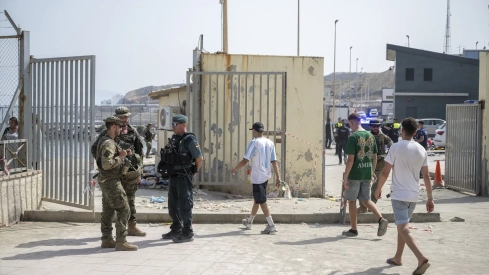
Morocco has reinforced access to Ceuta in response to calls disseminated on social media to attempt a new massive crossing this Saturday, August 15. Hundreds of police officers, gendarmes, members of the Auxiliary Forces, and military personnel have been sent to Fnideq, the border town of Castillejos, and to the roads connecting this area with Tangier and Tetouan.
The deployment also extends towards the border with Melilla, included in the messages detected by Moroccan authorities. The Interior Ministry assures that it maintains continuous surveillance over both crossings and has adopted "all necessary measures" to intercept those who try to approach the autonomous cities with the intention of crossing irregularly.
Castillejos, surrounded by land and sea
Controls begin tens of kilometers from Ceuta. Police and Gendarmerie are searching cars, buses, and taxis, while several patrols scour the forests and hills where groups of migrants usually hide before approaching the border. Dozens of buses remain prepared in Fnideq to transport intercepted individuals to central and southern Morocco.
The coastal road to Ceuta remains closed and access is restricted to authorized travelers and workers. Half of the urban beach closest to the Spanish city has also been closed. Morocco has installed new fences and concertina wire, maintains riot vehicles with water cannons, and has deployed two Royal Navy vessels off the coast.
The mobilization contrasts with what happened on July 30, when Moroccan forces avoided confronting the crowd and tens of thousands of people reached Ceuta by land and by swimming. Rabat justified that action by the risk of causing a tragedy among the crowd. The crossing left at least 141 dead, according to humanitarian organizations, and thousands of people subsequently returned to Morocco.
Arrests for social media calls
The spokesperson for the Interior Ministry, Rachid El Khalfi, has warned of the circulation of "suspicious and misleading" posts falsely announcing the opening of the border during the Spanish holiday. Authorities have arrested several people accused of spreading these messages and have announced legal proceedings against those who promote new entry attempts.
The authorship and the real scope of the call remain unclear. Some messages invite people to travel to Castillejos, while others propose shifting the attempt towards Melilla. Rabat has asked the population to ignore these publications due to the serious danger they pose, especially after the deaths recorded during the crossing at the end of July.
Add ElConstitucional.es as a preferred Google source for free.
Stay informed about all the latest breaking news with the best information. Against disinformation, for democracy and social rights.
