The President of the Senate, Pedro Rollán, has called this Friday from Ceuta for a new legal framework that allows for a quicker response to future massive entries across the border. After meeting with Juan Jesús Vivas in the Assembly Palace, the popular leader warned that the situation runs the risk of becoming a permanent anomaly.
"Normalcy does not have to be recovered tomorrow, it has to be recovered today," said Rollán, who called for maintaining state reinforcements and accelerating the returns of those who irregularly entered the city at the end of July. He also maintained that the Cortes Generales "have nothing better to do" than to start working on a "broad, complete, guaranteeing, solid, and solvent" regulation.
Rollán pide un marco normativo que garantice una respuesta inmediata en el caso de Ceuta https://t.co/B64xj2R5ne pic.twitter.com/ORwxjv16Bi
— Europa Press TV (@europapress_tv) August 14, 2026
Rollán has estimated that between 7,000 and 10,000 people who have not been identified still remain in Ceuta. The estimate differs from the balance offered on Thursday by the Minister of the Interior, Fernando Grande-Marlaska, who placed the figure around 5,000 people. There are also differences regarding the magnitude of the arrival. Vivas speaks of about 80,000 entries, while the Interior Ministry handles about 72,000.
The President of the Senate has argued that all people who crossed without following legal channels must return to their place of origin, although he has acknowledged that current legislation requires individual processing of files. His proposal seeks to accelerate these procedures in the face of episodes that overwhelm the ordinary capacity of administrations.
A reform still without text or calendar
Rollán and Vivas have agreed on the need to review what went wrong during the massive entry on July 30 and to reinforce border infrastructures. Neither has yet specified which laws should be modified, who would formally promote the initiative, or what deadlines the Cortes would handle to approve it.
Vivas has proposed that Ceuta receive exceptional treatment due to its status as a European land border in Africa. The regional president has called for a greater state presence, investments in infrastructure and housing, support for the productive sector, and a strengthening of the city's anchoring in the European Union.
He has also again rejected that Ceuta can become a gateway to asylum or subsequent transfer to the Peninsula. Vivas believes that this possibility would increase pressure on a city of 84,000 inhabitants that, according to his data, currently attends to some 1,300 unaccompanied migrant minors.
The visit has taken place on the eve of August 15, a date for which new calls for entry from Morocco have circulated on social media. Spain and the neighboring country have reinforced surveillance, and the Spanish deployment now has 880 national police officers and 714 civil guards, almost 500 more personnel than on July 30. The Interior Ministry has also announced the incorporation of another 45 agents from the Prevention and Reaction Unit. The reinforcements remain deployed on both sides of the border.
Morocco is listed as a safe country, but asylum maintains guarantees
Vivas has based part of his proposal on the fact that Morocco has appeared on the European list of safe countries of origin since June. The statement is correct, although this consideration has a more limited scope than that proposed by the president of Ceuta. The regulation approved by the European Union allows for faster processing of applications from Moroccan citizens, but maintains individual examination and the possibility of proving personal risks.
The classification affects Moroccan nationals and does not automatically eliminate the right to asylum for people from other countries who have crossed from Moroccan territory. Spanish international protection law also establishes that the submission of an application suspends any return, readmission, or expulsion until it is inadmissible or resolved.
The Constitutional Court endorsed the special regime of rejection at the border of Ceuta and Melilla for those intercepted when trying to cross it, but conditioned its application on respect for human rights, international protection, and specific attention to minors and vulnerable people. This border mechanism also does not equate to a collective return of those who have been within Spanish territory for days.
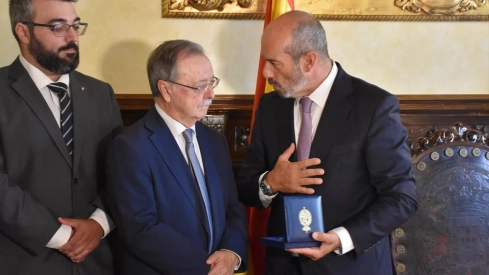
Rollán has presented Vivas with a Senate medal as a sign of institutional support and has defined Ceuta and Melilla as "kilometer zero" of the national territory. His request to change the legislation now awaits the government or a parliamentary group to turn it into a concrete initiative.
Add ElConstitucional.es as a preferred Google source for free.
Stay informed about all the latest breaking news with the best information. Against disinformation, for democracy and social rights.
