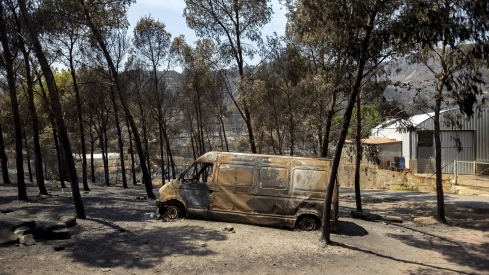
The forest fire in Vall d'Uixó has been stabilized this Friday after seven active days and 9,568 hectares burned in the province of Castellón. The progress of the work has allowed the emergency to be downgraded to situation 1 and authorized the return of residents of Artana and Eslida, the last two municipalities that remained evacuated.
Stabilization means that the fire is evolving within the lines established by the extinction teams and its surface has stopped growing. There are still hot spots with the capacity to cause some flare-up, so the fire remains pending to be declared controlled and subsequently extinguished.
The perimeter reaches 89 kilometers and keeps firefighters working on an extensive and difficult-to-access area. Artana has been the most affected municipality, with 3,160 hectares affected, of which 2,705 correspond to forest land. The flames have reached around 12% of the Sierra de Espadán Natural Park.
(18:10 h) L'#IFLaVallDUixo està estabilitzat, segons informa @BombersDipcas pic.twitter.com/U4BoZhPTrE
— Emergències 112CV (@GVA112) July 31, 2026
Teams concentrate on hot spots
The operation is now focusing its efforts on cooling the terrain and securing the perimeter around Artana, Eslida, Tales, and part of Vall d'Uixó. Four units of the Generalitat's Forest Firefighters will remain overnight reviewing the area, while aerial means will rejoin early Saturday.
The technical director of the Advanced Command Post, Fernando Pérez, explained that the evolution will be studied day by day before taking the next step. High temperatures, dry storms, lightning, and wind forecast for the coming days keep the device prepared for possible reproductions.
Emergencies has asked citizens to avoid traveling on the roads and paths of the affected municipalities. Falling trees, sinkholes opened by heavy machinery, and the presence of extinction vehicles continue to make transit through the burned area dangerous. Health also maintains controls on water quality in Artana and Eslida.
The improvement has allowed for the progressive withdrawal of personnel deployed from other communities. Teams from Aragon and Barcelona have left the area during the morning, while personnel from Murcia and the Military Emergency Unit conclude their participation after a week of work on the ground.
The Civil Guard continues to investigate the origin of the flames. Agents have located two distinct foci in time and space, both close to the urban area of La Vall d'Uixó and the first evacuated neighborhoods. The Valencian government believes that the evidence points to an intentional act, although the investigation has not yet identified any responsible party.
Aid for those affected and other active fires
The Consell has approved this Friday a plan of 67 million euros to address the damages caused by the fire. The package reserves 12 million for direct aid, five million for town councils and irrigation communities, and another 50 million for subsidized loans aimed at companies and industries.
Applications can be submitted starting August 10, and the deadline will remain open for three months. Compensations will cover homes, belongings, vehicles, agricultural and livestock farms, businesses, self-employed individuals, and workers affected by temporary employment files. Aid for the destruction of a habitual residence can reach 20,000 euros, and each municipality will receive an initial advance of 200,000 euros to repair urgent infrastructures.
The Generalitat will also incorporate 118 rangers and finance more than 35,000 overtime hours for forest prevention. The plan is completed with the future reforestation of the Sierra de Espadán and the recovery of damaged soils, biodiversity, and water resources.
Outside of Castellón, the Fermoselle fire remains at level 2 after burning around 11,000 hectares in Zamora. The improved situation has allowed for the lifting of confinements and the authorization of return to almost all evacuated villages, although residents of Pinilla de Fermoselle and Mámoles still remain out of their homes. The main active foci are in the most inaccessible areas of the Arribes del Duero.
The Sierra Oeste de Madrid fire remains stabilized, but a flare-up near the San Juan reservoir forces its access points to remain closed. Seven urbanizations in Pelayos de la Presa and San Martín de Valdeiglesias are still awaiting the return of their residents while teams finish off hot spots.
Attention also remains on Veguellina, in León, where the fire remains at level 2 and around 200 residents from three towns continue to be evacuated. Extinction teams have concentrated their work this afternoon on the northern flank to secure the perimeter in anticipation of changing winds.
Add ElConstitucional.es as a preferred Google source for free.
Stay informed about all the latest breaking news with the best information. Against disinformation, for democracy and social rights.
