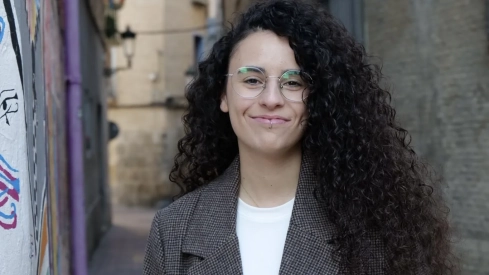
"I myself don't have a home". Marina Rodríguez, candidate for Chunta Aragonesista-Frente Amplio Aragón to Congress for Zaragoza, places the housing emergency at the center of her priorities for the general elections on November 29. In this interview with Clara Cerrada, deputy director, and Jaime Barrionuevo, assistant to the director, for 'Noticias de Verdad', the podcast of 'ElConstitucional.es', she defends indefinite rental contracts and the expansion of the public housing stock, and confirms that housing will be a red line for pacts with the PSOE. She assures that she will support a progressive government if her vote is decisive, although she warns that this support "is not a blank check".
Rodríguez directs her harshest criticisms at the Popular Party and its agreements with Vox, especially when talking about the protection of women against sexist violence. She accuses the mayor of Zaragoza, Natalia Chueca, of having sacrificed the purple points at the Pilar festivities to approve the municipal budgets and maintains that, for the PP, "everything is a bargaining chip". "They would sell their mother to approve the budgets of any institution," she states. She also demands solidarity from the Aragonese president, Jorge Azcón, in welcoming migrants and reproaches him for his response to arrivals in Ceuta.
The candidate also questions the image of a youth devoted to the far right. "We have bought into the idea that youth is fascist and it's not true," she maintains, championing those who participate in mobilizations for housing, education, and healthcare. This defense of opportunities for young people links with her demands regarding the future of Aragon, from infrastructure and the rejection of the Ebro transfer to the model for implementing data centers. "If Aragon generates wealth, that wealth must stay here," she demands.
How are you facing this campaign on November 29 and how is Chunta Aragonesista facing it?
Very excited. I think we are all very excited. Last February 8, the Aragonese people granted us the responsibility of leading this unity of the lefts in Aragon. At the same time, the citizenry asked us for a single left-wing ballot that would be able to convey these Aragonese demands to Congress. We are working on that.
There is always an undecided electorate. What would you say to a left-wing voter who wants to stop the PP and Vox about the useful vote in Aragon?
We can view the useful vote from two perspectives, one numerical and the other, let's say, moral. In the constituency of Zaragoza, we combine both visions.
Firstly, because there is nothing more useful than voting in your favor, in favor of your neighbor. That is Chunta Aragonesista-Frente Amplio Aragón.
Secondly, because that seat that Zaragoza distributes is the one at stake, the one we are disputing between the far right and Chunta Aragonesista-Frente Amplio Aragón. By voting for us, you would add a progressive seat and subtract a seat from the far right.
Do you defend any specific commitment or measure that makes a difference?
Our history is the guarantor that we do not make promises we cannot keep. We commit to working by putting the citizen at the center and responding only to the interests of Aragon. That is what we can promise, the work we know how to do well, the one Jorge Pueyo did before, the one Chesús Yuste did before, and the one José Antonio Labordeta did before. That is what we know how to do in Chunta Aragonesista, defend Aragon.
Chunta Aragonesista has reached an agreement with Izquierda Unida, Movimiento Sumar, and other progressive forces to run together in these elections, but Podemos was left out. What happened in the negotiations? Why was it not possible to present a single candidacy in Aragon, after the three alternative left ballots in the regional elections in February?
We cannot get into the decisions of other parties. We can answer for our own decisions and for the responsibility we have with the citizens, with the Aragonese men and women. I believe that those of us who wanted to be here are here.
Despite the noise, we are very clear about who our enemy is. The outstretched hand will always be there, and we have many more things in common with these forces that unite us than those that separate us. In Chunta Aragonesista, we are very clear about it. The question is whether it is equally clear in other forces. I think so.
Did Chunta Aragonesista also try to reach an agreement with Podemos?
Yes, of course. The result of this is that today we have a candidacy that includes Chunta Aragonesista, Movimiento Sumar de Aragón, Izquierda Unida de Aragón, the Green Party, and Recortes Cero.
In the pre-campaign, Chunta Aragonesista and Izquierda Unida clashed over the decision not to run in Teruel. IU called it "nonsense" and criticized CHA for adopting the discourse of the useful vote for the PSOE. Do you believe that in Teruel the only useful progressive vote is the PSOE?
No, not at all. The process that led us to make the decision not to run in Teruel was much simpler than it may seem and, at the same time, I understand it to be very complex for other parties. It was about listening to the territory. It was our militants in Teruel who asked us, please, not to run. They understood that, mathematically, it was very difficult to form an opposition or have any possibility of not fragmenting too much. What we did was listen to the territory.
Furthermore, the voter in Teruel is not abandoned. In these elections, we are focusing on the Congress of Deputies, but we cannot forget that we are also running for the Senate. Voters in Teruel will have a ballot where they can mark a representative of Chunta Aragonesista for the Upper House, which is the territorial chamber.
The deputy from Chunta Aragonesista has never been a deputy from Zaragoza; they have been the deputy for all of Aragon. That is what we know how to do, defend Aragon. Good proof of this is the work that Jorge Pueyo did in this last legislature. He even became the deputy who presented the most initiatives on depopulation and has brought many initiatives for Teruel and for the development of the southern regions of Aragon. We must remember that. Teruel will under no circumstances be abandoned. Teruel is our priority.
You mentioned the Senate, where Frente Amplio runs, with some exceptions, in 'Senado de Progreso' together with the PSOE. If a progressive government could be re-established after November 29, would Chunta Aragonesista be willing to support another investiture of Pedro Sánchez? What would be your conditions and what measures do you consider essential?
Chunta Aragonesista will always vote in favor of progress. If it is in our hands to decide on a progressive government, citizens can rest assured, we will vote in favor. One hundred percent, let there be no doubt.
Our vote is not a blank check and good proof of this is the previous legislature. Our priority is Aragon, our program is Aragon and our red lines are Aragon. Everything we can do to benefit Aragon, we will do. It will be a priority and a condition to reach any agreement with any political force. With anyone.
Pablo Bustinduy, campaign spokesperson for Frente Amplio, has said that these elections are a referendum on housing. We have experienced the general strike of 11N and the tragic eviction of Mari Carmen. For years we have been hearing that housing is a priority for the Government, which even spoke of "the housing legislature," but many young people still cannot emancipate themselves and rents are unaffordable, also in Zaragoza. Some forces of your candidacy have held government responsibilities this legislature. What has failed? What guarantees can you give that housing will be a red line before the PSOE and not another broken promise? What are your initiatives?
Housing right now is not just a problem. We are facing an emergency. In Chunta Aragonesista, we are fully aware of the level and degree of emergency we are subjected to. I myself do not have a home. This is what has led young people to take to the squares and take steps that are more than necessary, they are imperative.
Right now there is not a single party that is not talking about housing. The problem is not that we talk about housing in the campaign; it would not be strategic if we didn't. The problem is what political parties are going to do on November 30. I am clear about it. If Chunta Aragonesista-Frente Amplio Aragón has any kind of responsibility or is part of a progressive Government, housing is our priority.
There is no single solution. Housing must be very well adapted to the territory. Here in Aragon, we know well what we are talking about. It is essential to talk about rural housing and public services in rural areas, because, otherwise, housing remains empty.
We are talking about indefinite rental contracts, expanding the public housing stock, and measures like those conveyed by spokesperson Bustinduy. There is no single solution. That is what we are trying to do in Aragon.
But will it be a red line for an agreement with the Socialist Party?
Of course. That's what we've been saying for weeks. We are going to build an Aragon where we can live. And to live, housing.
Another campaign issue is immigration. Faced with far-right discourses that say migrants come to take our jobs or describe what happened in Ceuta as an "invasion," and given the arrivals in the Canary Islands, what is your position and what should change in the country's migration policy?
If the question is how we in Chunta Aragonesista-Frente Amplio Aragón value the hate speeches to which we are subjected daily in the media, on social networks, on the street, and in any corner of our country, we are squarely against them.
In Aragon, we know very well that, if it weren't for migration, half of our towns would be dead, empty.
Do you advocate for reception, then?
Yes. Furthermore, we understand that part of these hate speeches stems from the fact that the far-right, I'm starting to have my doubts that they hate the migrant. I believe they hate the poor. They hate the poor Spaniard, the poor Aragonese, the poor Senegalese, and the poor Moroccan. They don't care where they come from. What they hate is the poor.
The migratory flow is leading to a distribution among autonomous communities. What role should Aragon play in the reception of migrants?
Whatever the State needs. The question is what role Aragon should have played while the Popular Party was wringing its hands over what they have called an "invasion" in Ceuta. Jorge Azcón only wrung his hands and at no point offered collaboration to the president of Ceuta.
Why are we at no point talking about solidarity, cooperation, working together? That is the problem. We are always focusing on migration from the negative side. We never talk about the solidarity and cooperation we need between peoples and that is also necessary between institutions.
I would like the Popular Party, when talking about immigration, instead of it being basically something that Vox can incite in institutions that they cannot say in the media, to also have a certain sense of state and responsibility. In this case, Jorge Azcón has left much to be desired as president of the Government of Aragon.
You are the Secretary of Feminisms and Labor for Chunta Aragonesista. What is your priority regarding feminism?
Feminists will forgive me for speaking negatively, but right now it is essential that we talk about the 44 women who have been murdered this year. Forty-four official, which then become 88, I think they are.
It is essential to talk about safety, about supporting victims of gender violence and their children. It is essential to implement real programs that bring real solutions to the situations these women face.
What is failing in the response to sexist violence?
What is failing is that in Spain, the Socialist Party has been saying for months that the wolf is coming. In Aragon, the wolf is our Vice President of the Government and was our Vice President of the Cortes de Aragón. Here we know what it's like for the wolf to govern.
We have seen how our mayor of Zaragoza, Natalia Chueca, managed to approve the City Council's budgets last year by eliminating the purple points in our Pilar festivities. That is the problem. For the Popular Party, anything goes, everything is a bargaining chip. They don't care about women's safety, they don't care about homophobia. They would sell their mother to approve the budgets of any institution.
What is failing is that our mayor is designating parishes as safe points in Zaragoza, that we don't have purple points, and that there isn't proper support. What is failing is that we are not complying with the law and we don't have reception and prevention points open 24 hours a day.
Of course, it's failing. There is a security problem concerning women and gender violence in our country. In Aragon, we know it very well. These people can reach the central government, and in Aragon, we know perfectly well what they are capable of.
Another aspect that affects women is the wage gap, of 15.7% according to the Annual Salary Structure Survey and the analyses published in 2026. What does CHA-Frente Amplio Aragón propose to improve their working conditions?
The first thing is to understand where this gender gap in the workplace comes from. It comes from the fact that it is the woman who requests reduced working hours, who takes those leaves of absence for childcare; it is never the man. What we have to do is rethink care.
The other day Ada Colau talked about it with the new initiative on the chosen family. Care must be put at the center and distributed equitably, because that is our social contract, that is the welfare state. It cannot be that care always falls on the same people.
Polls point to a greater inclination of young people towards the far right and that they adopt discourses against women, immigration, and LGTBI rights. Does this worry you? Is it important to educate in classrooms about these issues?
I'm going to answer you in two parts. I'll start with the end. Yes. All the education in respect, solidarity, and coexistence that we can convey will be little, because that is also our social contract.
As for the first part, I don't believe that youth is far-right. I think we have bought into that framework. We have bought into the idea that youth is fascist, and it's not true. They take an 87-year-old woman out of her home on a stretcher, and it's the organized youth who are at her door trying to stop it.
Here we see how young people lead mobilizations in education and healthcare. In each and every one of the demonstrations in our cities and our country, young people are at the forefront. With the housing issue, it took an 87-year-old woman being taken out of her home on a stretcher for attention to be paid to what young people had been saying for so long.
Aragonese youth gave us six seats in the last regional elections. Youth is not far-right. Young women are proving to be a bulwark against the new fascism we currently have on our streets. We have to say this.
There are far-right young people who make a lot of noise, encouraged by fanatics like Vito Quiles. Of course there are. But there are so many supportive young people who are where they need to be, fighting in the streets and supporting just causes, and we have to give them that recognition.
Earlier you mentioned CHA-Frente Amplio Aragón's priorities in housing. What would you say to a young person who currently cannot move out?
Welcome to the club. An entire generation is in the same situation. This is desperate. We have been seeing for a long time how politics serves more to tell young people that "this responsibility is not mine, this is the other's fault." The answer is that the system has failed. When you have an entire youth looking at their future with uncertainty, the system has failed.
To these young people, we have to tell them that their place is here, Chunta Aragonesista-Frente Amplio Aragón, because we are the only ones who are putting on the table the solutions needed in housing matters. We are the only ones who are trying to build an Aragon where one can live.
The question I generally ask is whether we really believe that the Popular Party wants to solve the housing problem. I don't think so. The Popular Party holds the three mayoralties of Aragon, Huesca, Zaragoza, and Teruel, and the Government of Aragon. Here we are the same as everywhere else.
For me, the question is simple. Does the Popular Party want to solve the housing problem? The answer does not seem clear to me. Chunta Aragonesista wants to solve it, because we understand that this is a housing emergency and that we must put our foot down now.
You have denounced that Aragon runs the risk of becoming an "energy colony" due to large data centers, which consume enormous amounts of energy and water. Azcón and his Government present them as an investment and employment opportunity. How can a balance be found? What laws or conditions would you promote to ensure that companies leave wealth and quality employment in the territory?
That is the key. I don't think Jorge Azcón has asked himself that question. Now we have municipal elections in May and I'm sure we're seeing it in our cities. When you have elections at the door, what you want is to cut ribbons and take pretty pictures.
I think that's what Jorge Azcón has tried to do these last two years with data centers. Take the picture, say that an investment of I don't know how many millions of euros is coming to Aragon, project about thirty data centers that then translate into, I think they are, 82 buildings. It's an outrage.
For us, the solution is as simple as putting the citizen at the center and seeing how we can improve their life. In Aragon, we have been providing our water, our electricity, our energy, our wind, our landscapes for decades.
Would you say then that Chunta Aragonesista is in favor of these data centers, but in a different way?
This is like the issue of renewables. We are not against digitalization, of course not. We could talk about digital sovereignty and spend hours talking about data centers.
We want to make the Government of Aragon understand that it cannot be done this way. If Aragon generates wealth, the wealth must stay here, to be able to build those future projects in our towns and cities.
You cannot look a young person in the face and tell them that there is no work here, that there is no housing, that there is no future or opportunities, that they cannot stay in their town, that they cannot move on the road, that they have no train. Hey, but your autonomous community is making a fortune.
Marina, another historical demand of Aragon is to improve its railway connections. CHA has just proposed a grand pact for the railway, with commitments on Zaragoza commuter trains, Canfranc, and the Cantabrian-Mediterranean corridor. What would you demand from the next Government of Spain for these infrastructures to advance? Let's also remember the tragic accident in Urda and the insecurity it has generated among those who travel by train.
We ask for everything, because what Aragon has with Madrid in terms of infrastructure is a historical debt.
We ask for the A-21, the A-23, the A-25, the A-68, the A-40, the reopening of Canfranc and the Cantabrian-Mediterranean corridor. We ask for the high-performance electrified double track through Teruel, the expansion of commuter trains and the expansion of the tram.
The problem is that in Aragon we are the last. The best example is the Zaragoza tram. There should be co-payment between the Government of Aragon, the Zaragoza City Council and the state Government. The Seville metro cost the State 650 million euros. Do you know how much the Zaragoza tram cost the central Government? Zero.
It is a good example of how mobility infrastructures work in Aragon. We ask for them, we pay for them and we fight for them. The parties here demand them loudly and, when they arrive in Madrid, they vote what Pedro Sánchez and Alberto Núñez Feijóo say.
Another issue present in this campaign and in the regional elections in February is the possible Ebro transfer, after the right has revived the debate on a new National Hydrological Plan. You have been critical of the PP's position, both in Aragon and nationally. What would you say to Alberto Núñez Feijóo and Santiago Abascal, who could govern after November 29? What initiatives or measures would CHA demand in Congress to guarantee that the Ebro is not transferred?
The Ebro is where it is and there it will remain. I am very clear about that. This is a demand that the people of Aragon have been making for 25 years. We are asking Aragonese people to vote for their dignity, for that of their people. It's incredible. Twenty-five years with the ghost of the transfer running through our streets.
The problem is that the Popular Party has lost all capacity to set its own ideological agenda. Vox arrives, presents its electoral program, and the last measure it includes is the interconnection of river basins. We know perfectly well what it is. The question is whether Feijóo knows.
Finally, Marina, what would be your last plea to your voters for the November 29 elections?
On November 29, we are playing for our rights. We are playing for living in a country with rights, in a country with dignity. There is nothing more useful than voting in your favor, in favor of Aragon.
We are trying to build something as simple and as immensely great as an Aragon where we can live. For that, we need all Aragonese women, because either we do this together or it won't happen.
Contact
We are listening. Get in touch.

