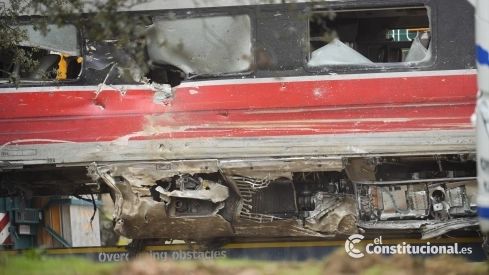
The train tragedy that occurred last Sunday in Adamuz (Córdoba) has opened up multiple questions, not only about the causes of the accident but also about possible legal responsibilities and victims' rights. In a context marked by social shock and the still incipient progress of the judicial investigation, ElConstitucional.es analyzes the legal keys to the case with Alejandro Vega, lawyer and managing partner of the Criminal Law department at the firm Criado del Rey Abogados, who breaks down the possible scenarios of civil, administrative, and criminal liability arising from one of the most serious railway accidents in recent years.
Question, Luis Corpas, ElConstitucional.es: Good afternoon. To understand the legal keys to the tragedy that occurred last Sunday in Adamuz, Córdoba, to which we send all our support to the victims and their families, we have with us the lawyer Alejandro Vega, managing partner of the Criminal Law department at Criado del Rey Abogados Law Firm. Good afternoon, Alejandro. In the current state of the investigation, which is still incipient, what profiles or actors could potentially assume legal responsibility, considering the different hypotheses being considered?
Response, Alejandro Vega. Well, in principle, it seems evident that we can speak of two possible responsible parties. On the one hand, there would be Iryo, as the owner of the train, of the carriage, which basically derailed and which was what caused, without a doubt, its derailment was what caused the impact with the other train and the collision and therefore... causation of the accident, that on the one hand, or on the other hand, it would be the owner of the infrastructure, in this case Adif, which is the one responsible for the maintenance and care of this infrastructure. I can't think of other possibilities a priori, unless the investigation determined something that seems highly improbable, which would be, for example, sabotage or an act by a third party that had caused the train to derail. But that, a priori, I repeat, with all the prudence that such an early moment as this deserves, does not seem to be a real possibility. This is what we readers of the press have learned so far.
Q. In legal terms, how could the victims be compensated and what mechanisms does the legal system provide for this in a case of this nature?
R. Well, there are two avenues for compensation here. One is **economic compensation**, which is perhaps the most obvious and is almost certain to happen. I'll add a nuance to this later, but it's almost certain to happen, which is basically the compensation of the victims, the injured, themselves, as those affected by an accident, by injuries. The deceased, obviously, their families will also be entitled to very significant compensation. The law provides, in this case, a... a set of possible beneficiaries of these compensations, such as parents, wives, children, depending on whether they lived together, etc. **Separate, very substantial compensation, fixed by specific law,** both the road safety traffic legislation that regulates the scale of injuries in Spain, and in its case, the railway and railway liability legislation that also specifically regulates who are possible beneficiaries of these compensations. But this would be an economic matter that it is true that it is where the insurance companies. **Earlier you also asked me who the possible responsible parties would be. Obviously, in addition to Iryo and Adif, it would be** **the respective insurers of those two companies or those two entities themselves,** who are also the ones who ultimately assume the economic responsibility we are talking about, because... certainly, both Adif and Iryo have insurers who are directly liable to the injured parties and they are the ones who ultimately bear the economic cost of this situation. As I mentioned, **this economic part is tedious, it is laborious, because it first requires the recovery of the injured to determine the amount of their respective injuries.** There must be a recovery process to be able to quantify, once the sequelae have stabilized, the compensation for days of absence, sequelae, etc. And **in the case of the deceased, unfortunately, it is much simpler because in any case a lump sum will be set for the death of the beneficiaries, in this case the respective family members** I mentioned earlier. That would be the economic compensation. **And then there would be, in its case, possible compensation, let's call it criminal, in the event that it is finally determined that there has been some kind of negligence in this accident.** **I insist, with the due caution that we must continue to maintain at this time because everything points to an unfortunate accident.** Everything points to it. If that were the case, it seems unlikely to talk about criminal liability. I insist, this is very, very nuanced with the progress the investigation may have. In this case, if evidence is finally found that could show that a specific natural person has somehow omitted a duty of care... or for example, imagine, which, by the way, cannot be ruled out, I will qualify again the answer I gave you to the first question about who could be responsible. **Imagine that Adif ends up saying that the company that did the infrastructure or the renovation that was done in this area, by the way, I think with many hundreds of millions of euros, committed negligence when doing the welds and that poorly made weld is what caused the accident. Again, this would put a third possible responsible party in the equation** and perhaps even then, if there has been any negligence, I insist, not simply an accident, one could even talk about possible criminal liability. So, well, a little more...P. The next question was also going in that direction. I mean, if you want to... I mean, last night it's true that **recordings of an audio between the Iryo train driver and the Atocha control center were leaked**. Likewise, Minister **Oscar Puente has pointed out that several trains had previously traveled through the same spot, and showed marks compatible with a possible track rupture**, I mean, trains that had passed through that exact same spot. **So, in what way do you consider that this new information could affect the course of the accident investigation? And in the event of what we are talking about, of negligence being detected on the part of the Atocha control center, government leaders, or any other involved party, through what mechanisms could the corresponding responsibility be claimed?**
R. Of course, you see, here we must always distinguish between two very clearly defined areas, sometimes not so much in practice, but in theory: civil or administrative liability, which will obviously exist, okay? There would only be no such administrative or civil liability in the event that total fortuitous event or force majeure could be proven. That would be the only scenario in which no one would be held liable, neither financially nor civilly, if a tragic accident suddenly occurred where a track broke due to force majeure or a fortuitous event and a disaster was caused. Having said that, to reassure everyone, this is absolutely improbable because it will be very difficult and, moreover, jurisprudence is extremely restrictive in considering that in the case of a railway accident or an accident on a public road, there was a fortuitous event that was impossible to foresee and that therefore exonerates everyone from civil liability, I insist. That would be, if you allow me, there would be like three areas. That case of total absence of liability in the event of a fortuitous event, which I insist, will not happen in my opinion. The next area is that of civil or administrative financial liability. It could even be, if it is a private operator, as would be the case with Iryo, it would be a civil liability and a civil claim procedure; if it were a public entity, it would be a procedure for liability due to abnormal functioning of the Administration of Justice or for patrimonial liability, that issue which, in the end, to avoid confusing the audience a bit, the consequence is the same, it is purely financial. And the third area, which is perhaps the most serious, without a doubt, is criminal liability. But here, again, we must be very cautious. You see, if we compare this accident with the Angrois one, as a case where it was evident that there had been a combination of causes that led to that tragic accident, which part of the Galician people still have, as in Spain, right? We Galicians have it deeply rooted in our most mournful memory, in the end only two people were convicted: the driver and a person responsible who was deemed to have omitted all types of care, despite the more than striking and repeated calls to order: "listen, the automatic braking system of the train must be rectified, etc., etc., etc." right? And two people are convicted, but one who was the driver or who committed an absolute negligence by not paying attention to the train when entering an area well above the appropriate speed, which is a recklessness that does have criminal liability, because there is serious recklessness that is punished through article 147 and following as reckless homicide or reckless injury that has criminal consequences. And in that case, Adif's. In the case we are discussing here, the information you are giving me puts us in a very cautious scenario. Because, of course, I don't know when, we will have to see, and it can be studied, and it will certainly be studied, and in fact there is already a criminal proceeding open in the court, I don't know which investigating court number it is, well, the nomenclature has changed now, the court of first instance, investigating and first instance section of the town where this is being investigated, which is a criminal proceeding. In this proceeding, all of this that you are telling me will be investigated. And if in the end it could be, I'm speaking hypothetically, discovered that there was a safety manager to whom, with sufficient time, various incidents were presented, such as: "listen, we have suffered damage, we notice something strange on the track" and nothing is done for hours and finally this happens, that person will have to explain many things. That's for sure. Even, if you push me, and I see this as very, very difficult. The one who built the infrastructure may have to respond criminally because that infrastructure fails and finally collapses, breaks, and causes that disaster. I also see this as highly complicated. Although also, imagine that tomorrow there is an expert report that proves that there was absolute negligence in the way the installation was done, okay?, and that all the due care standards typical of the sector in which we operate were omitted. Well, in this case of... railway infrastructure and that a safety plan was not made, it was not cross-checked, it was not verified in the end if the track was operational, then, what I am telling you, would start to change a lot. And I am sure that successive authorities and successive company managers would start to parade to explain in the criminal sphere whether it was done correctly or not. But, I repeat, be very cautious with what I am saying because we have no idea about this yet.
Q. And any other key point or something you can consider regarding what citizens are even denouncing on social media or the uproar surrounding the issue? If you could give some kind of…
R. Look, as a criminal lawyer, I find myself, well, not in tragedies of this magnitude, nor am I a specialist in the criminal field of collective airplane accidents. I have colleagues who specialize in collective accidents, like the Spanair one, like the Alvia one, and they've handled them wonderfully. **But as a lawyer and a criminal lawyer in particular, I would first ask for... all respect for the victims, all care for the victims, and all the delicacy that can be shown in this matter.** I can't even imagine what the families of these people must be suffering, and from here, as I said at the beginning, my absolute support, and that the media, **especially us, you, we have a responsibility also when communicating things, that we do it with all the fairness and as we are doing.** Next question, **patience**. First, **those who are going to compensate, don't doubt that they will do it as soon as possible, because not doing it as soon as possible generates brutal interest for them, and therefore, it's very likely that victims will soon be compensated, financially.** And then **in the criminal sphere, patience, because unfortunately in Spain, and even more so when there are many victims as in this case, criminal proceedings are necessarily prolonged**, and even more so when you know, with all due respect to the judicial bodies, that small judicial circumstances, like the court where these events were heard, can sometimes be overwhelmed by the magnitude of the problem because suddenly a court that is used to normal, everyday cases, is suddenly faced with a proceeding in which there are 150 family members, three parties as injured and victims who have to be dealt with, so... **In summary, prudence, patience, and above all, that justice is ultimately served, I am convinced of it.** **Fortunately, we have a justice system that usually works well in these matters, and let's trust it so that those responsible, whether civil or criminal, if they exist, are finally found, and of course, the victims are compensated, which is always the main objective of all proceedings of this nature in our country.**
Q. Well, thank you very much, Alejandro, for providing a bit of information on the matter, and we at El Constitucional also await justice to determine what it needs to determine, and for journalism to be exclusively in charge of informing, and nothing more.
R. Exactly. Well, it was a pleasure.
P. Thank you very much. Goodbye.
R. Goodbye