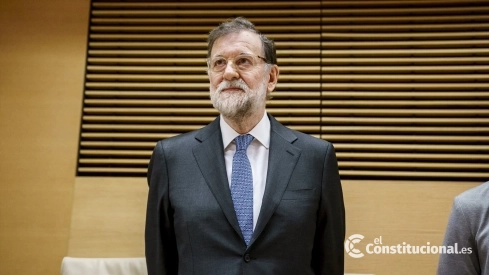
These days, news sections open with the well-known Kitchen case, which, although it was especially mediatic years ago due to the possible participation of the leadership of the Ministry of Interior during the Government of Mariano Rajoy, now it has returned to the media spotlight due to the celebration of the oral trial sessions.
Many wonder why, despite the famous note “M. Rajoy” discovered by the investigators, Mariano Rajoy is not charged in the present case.
The truth is that it is not only about discussing what meaning should be attributed to said annotation, as has sometimes been disseminated, but about remembering that, for a person to be charged with a crime and come to sit in the dock, it is necessary that sufficient evidence of criminality against her emerges from the investigation phase.
Specifically, for a person to be accused, a mere suspicion is not enough. There must be rational indications or objective data that allow the possible commission of a crime and the eventual participation of a specific person to be considered sufficiently justified.
In this regard, the Supreme Court has said that something more than a simple verisimilitude or suspicion is required, although the certainty typical of a conviction is not required, since precisely for that purpose is the oral trial. However, there must be a reasonable probability that justifies moving towards the intermediate phase.
In the present case, the only indications that, apparently, exist regarding Mariano Rajoy would be, on the one hand, the statement by Luis Bárcenas, who affirmed that “this operation is initiated by those responsible for the party at that time, and then it is transferred, if that is proven, to the representatives of the Ministry of the Interior, but it starts in the party”. It is true that Bárcenas has testified in this procedure as a witness and not as an accused, so he has an obligation to tell the truth. However, it is also true that, when there is a manifest enmity, a factor of subjective incredibility is introduced that prevents a statement from being given full incriminating effect if it is not corroborated by objective, external, and independent elements.
As a possible objective element, the handwritten annotation “M. Rajoy” could be cited. However, said annotation could have been made when the existence of the investigation was already known, so, in any case, it would constitute an indication too vague and insufficient by itself.
Now, however, if during the celebration of the oral trial the eventual participation of some other person not investigated until now were to be proven, the Chamber could deduce testimony for those facts to be investigated. For now, however, it does not seem that there are sufficient elements to sustain such a scenario.
Add ElConstitucional.es as a preferred Google source for free.
Stay informed about all the latest breaking news with the best information. Against disinformation, for democracy and social rights.
