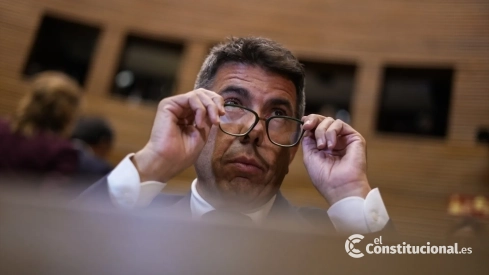
First, although Mazón submitted his resignation last November 3, 2025, as president of the Generalitat Valenciana, he continues to hold the status of regional deputy. Despite repeated public statements demanding his resignation, he maintains his seat in Les Corts, which implies that any criminal action against him must be processed according to the special procedure provided for those with parliamentary immunity.
In this regard, Organic Law 5/1982, of July 1, on the Statute of Autonomy of the Comunitat Valenciana, is applicable. Its article 23.3 provides that the members of Les Corts, during their mandate, may not be arrested or detained for criminal acts committed in the territory of the Comunitat Valenciana, except in cases of flagrant crime. Likewise, it establishes that it is up to the Tribunal Superior de Justicia de la Comunitat Valenciana to decide on their indictment, imprisonment, prosecution and, where appropriate, trial. If the acts had taken place outside the autonomous territory, jurisdiction would fall to the Sala de lo Penal del Tribunal Supremo.
Therefore, even if the investigating magistrate considers that there is sufficient evidence of the alleged commission of the aforementioned crimes —as stated in her request—, the final decision on the appropriateness of the indictment rests exclusively with the High Court of Justice of the Valencian Community. If this body did not find such evidence, the criminal proceedings could not be directed against Mazón.
Otherwise, if the TSJ of the Valencian Community assumed the existence of evidence and agreed to open the investigation, the jurisdiction to continue the case would pass to said court.
Do you want us to continue investigating the topics that others silence? We want to be free and independent, but we need your help. Any contribution helps us to move forward. Thank you very much for being there.
The reasoning of the judge of the Dana
According to what was published, the magistrate bases her request for indictment, among other aspects, on the following facts:
-
The delays in the convocation of Cecopi and in the activation of the ES-Alert system.
-
The alleged public and illogical minimization of the seriousness of the emergency.
-
The apparent disconnection regarding the situation, evidenced by his prolonged meal at El Ventorro.
-
His alleged passivity in crisis management.
These elements are invoked in order to support the existence of indications of the criminal commission.
Reckless homicide: what does the Penal Code say?
Involuntary manslaughter is regulated in article 142 of the Penal Code, while negligent injuries are contemplated in article 152 of the same legal text. In both cases, the penalties can be aggravated when the number of victims is especially high.
-
For liability due to imprudence to arise, three essential requirements must be proven:
-
The existence of an objective duty of care on the part of the active subject. In this case, Mazón, as the highest institutional authority, held a guarantor position regarding emergency management.
-
The performance of reckless conduct, either by action or by omission. The instructor focuses her analysis on a possible commission by omission.
-
The existence of a causal link between said conduct and the result produced (deaths and injuries). It will be necessary to demonstrate that, had action been taken differently, the outcome could have been avoided or significantly mitigated.
Ultimately, the TSJ of the Comunitat Valenciana will have to assess whether, in light of the proceedings carried out to date, there are sufficient indications to direct the procedure against Mazón. However, even in the event that the imputation were agreed upon, this does not imply that he is guilty. The eventual criminal liability could only be determined after the carrying out of new proceedings and, where appropriate, the holding of the corresponding trial.
Add ElConstitucional.es as a preferred Google source for free.
Stay informed about all the latest breaking news with the best information. Against disinformation, for democracy and social rights.
