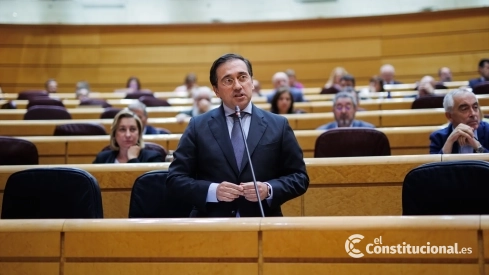
The Minister of Foreign Affairs, European Union and Cooperation, José Manuel Albares, makes this Thursday 26 and Friday 27 of March his first official visit to Algeria, a trip with which the Spanish Government wants to “strengthen the bilateral relationship” and consider a diplomatic crisis that continues to have a fundamental anomaly as channeled: the Treaty of Friendship, Good Neighborliness and Cooperation signed in 2002 continues suspended by decision of the Algerian president, Abdelmayid Tebune, since June 2022. On the agenda are a meeting with his counterpart, Ahmed Attaf, another with the Minister of Hydrocarbons and Mines, Mohamed Arkab, a meeting with Spanish businessmen and the inauguration of the new Cervantes Institute of Oran.
The key to everything lies in the turn of Spain on Western Sahara. The crisis erupted after, in March 2022, the letter in which Pedro Sánchez conveyed to Mohamed VI that Spain considered the Moroccan autonomy proposal of 2007 as “the most serious, credible, and realistic basis” to resolve the conflict was made public. From there, Algeria called its ambassador in Madrid for consultations on March 19, 2022 and, a few months later, on June 8, 2022, announced the “immediate” suspension of the treaty with Spain, denouncing the “unjustifiable” Spanish support for the Moroccan plan.
The background of the clash is especially sensitive because Algeria has been one of the main diplomatic supporters of the Polisario Front, while Morocco defends its autonomy plan over a territory whose status remains pending resolution at the UN. In fact, the United Nations Mission for the Referendum in Western Sahara (MINURSO) was created by the Security Council in 1991, with the aim of preparing a consultation in which the Sahrawi population could choose between independence and integration into Morocco. That international framework explains why the change in the Spanish position was interpreted in Algiers as a rupture of historical balances on an extremely delicate issue for the region.
Despite the political freeze, the energy relationship never broke. Algeria was the main supplier of natural gas to Spain in 2025, with almost 35% of the total, ahead of the United States and Russia, although below 39.5% in 2024. That dependence gives special importance to Albares' meeting with minister Mohamed Arkab, even more so at a time of tension in the markets due to the conflict with Iran and the blockade of the Strait of Hormuz. Furthermore, the CEO of Naturgy, Francisco Reynés, stated this same week that the relationship with the Algerian state-owned company Sonatrach will go “even more into the future”; both companies operate Medgaz, today the only gas pipeline through which Spain receives Algerian gas after the closure, in November 2021, of the Maghreb-Europe (GME) which passed through Morocco.
Where the rupture was strongly felt was in trade. The Professional Association of Banks and Financial Institutions (ABEF) froze in June 2022 bank direct debits for foreign trade operations with Spain, a restriction that remained until November 2024. The blow was severe: Spanish exports to Algeria went from 1,888 million euros in 2021 to 1,021 million in 2022 and plummeted to 331.8 million in 2023. Afterwards came the recovery: 794 million in 2024 and 2,133.5 million in 2025, even above the pre-crisis level. Albares himself boasted this week about that rebound by stating: “In 2025 we tripled exports compared to the previous year, the best result of our exports since 2019”.
The visit also has political value because it seeks to prepare a new High-Level Meeting (HLM), which would be the first between both countries since 2018. It is not a minor gesture: Albares' trip scheduled for February 2024 was canceled at the last minute due to disagreements over the agenda, apparently due to Spain's refusal to address the situation in Western Sahara, and it has not been until now that the minister has been able to finalize his official trip. In the meantime, Albares and Attaf have met four times since February 2025, including the meeting held in Madrid last February on the former Spanish colony with the participation also of Morocco, the Polisario and Mauritania.
The trip will conclude in Oran with the inauguration of a second Instituto Cervantes in Algeria, after the one in the capital. Foreign Affairs stresses that interest in Spanish continues to grow in the Maghreb country, with some 40,000 students studying it in primary and secondary education and another 3,500 at university. Albares will also participate in an act of democratic memory before the monolith of the Stanbrook, the British merchant ship that sailed from Alicante with Republican refugees a few days before the end of the Civil War.
Add ElConstitucional.es as a preferred Google source for free.
Stay informed about all the latest breaking news with the best information. Against disinformation, for democracy and social rights.
