Madrid hosts this Wednesday, November 4, and Thursday, November 5, the XXX Ibero-American Summit, an international meeting that brings together representatives from Spain, Portugal, Andorra, and Latin American countries to address common problems and strengthen cooperation between both sides of the Atlantic.
The event, presided over by Felipe VI, comes at a complicated time for political relations between several of the participating countries. Although all 22 States will be represented, only ten will attend with their top leaders. Among the most notable absences are those of Brazil's president, Luiz Inácio Lula da Silva; Mexico's president, Claudia Sheinbaum, and Venezuelan leader, Delcy Rodríguez. On the contrary, Madrid will receive some of the most prominent leaders of the Latin American right, such as Argentine president, Javier Milei, and Chilean José Antonio Kast. Their presence coincides with that of Pedro Sánchez, with whom Milei has had several public confrontations in recent months.
The meeting also has an added challenge: to recover the importance of a summit that in its last edition, held in Cuenca (Ecuador) in 2024, barely managed to gather the main leaders and ended without an official joint declaration. Spain now seeks for the meeting to allow agreements to be reached and dialogue to be maintained between countries with very different political positions.
Albares defends strengthening ties between Spain and Latin America
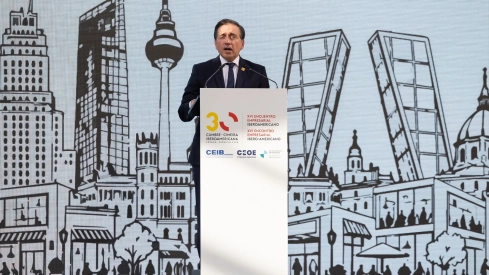
During the inauguration of the XVI Ibero-American Business Meeting, held this Tuesday in Madrid as a prelude to the summit, José Manuel Albares defended that Spain should act as a "stable and reliable partner" for the 22 countries that form the Ibero-American community. The minister called for moving "from diagnosis to decisions" and taking advantage of the meeting to turn political cooperation into concrete agreements that benefit businesses and citizens. Among his priorities, he highlighted facilitating the international expansion of small and medium-sized enterprises, improving infrastructure, energy, and knowledge connections, and increasing productive investment to create quality employment.
Albares has also warned that Ibero-America should not limit itself to depending on other countries for resources or technology. In his opinion, the region needs to participate in all phases of production, from research and design to manufacturing and commercialization, to gain economic autonomy and decision-making capacity. "We don't have to substitute one dependency for another," he stated, arguing that the response to the current international context must involve diversifying relationships, expanding alliances, and strengthening integration among Ibero-American countries. The business meeting, organized by the CEOE, the Ibero-American Business Council, and the Ibero-American General Secretariat, aims precisely to boost investment, connect markets, and convey the private sector's proposals to political leaders.
The business meeting, organized by the Spanish Confederation of Business Organizations (CEOE), the Ibero-American Business Council (CEIB), and the Ibero-American General Secretariat (SEGIB), aims to bring the private sector's proposals closer to governments. Among its objectives are to promote economic integration, strengthen legal certainty for investments, and open stable channels of dialogue between companies and public administrations. Albares has argued that this collaboration is necessary so that the summit agreements do not remain mere institutional declarations, but can be translated into concrete projects and new economic opportunities for the participating countries.
Lula, Sheinbaum, and Delcy Rodríguez, among the main absences
The absence of Claudia Sheinbaum and Lula da Silva represents one of the main setbacks for the organization. Both represent two of the largest economies in Latin America and two left-wing governments in the region.
In Mexico's case, the Spanish Government explains that Sheinbaum usually makes few international trips. The president was already in Barcelona last April to participate in a meeting of progressive leaders and plans to travel to China soon to attend a summit of Asia-Pacific countries. Her absence is particularly striking because, after several years of diplomatic estrangement between Spain and Mexico, Felipe VI met with her in June at the Mexican National Palace to improve relations between both countries. For his part, Lula's absence comes after particularly intense elections in Brazil. According to sources from the Spanish Executive, the wear and tear of the campaign and accumulated fatigue influenced his decision not to travel to Madrid.
Venezuelan Delcy Rodríguez will also not be present. Her absence is related to Venezuela's internal situation and to the European Union's sanctions, which required managing an exemption to facilitate her travel. Finally, the country will be represented by its Minister of Foreign Affairs. In contrast to these absences, ten countries will attend with their top leaders: Spain, Argentina, Bolivia, Chile, Costa Rica, Guatemala, Honduras, Portugal, Dominican Republic, and Andorra. Among the attendees will be Pedro Sánchez, Javier Milei, and José Antonio Kast. Colombia, Ecuador, and El Salvador will send their vice presidents, while the other nine countries will be represented by their foreign ministers.
The tension between Sánchez and Milei and the agreements the summit seeks
One of the focuses of attention will be on the meeting between Pedro Sánchez and Javier Milei. The Argentine president has publicly criticized the head of the Spanish Executive and, during his last visit to Madrid just two weeks ago, even called him an "unpresentable dictator," "corrupt," and "authoritarian". Although both will coincide at the international meeting, the Spanish Government has ruled out that Sánchez plans to hold a bilateral meeting with the Argentine president. A possible meeting between Milei and Felipe VI is also pending confirmation, after the Argentine president requested an audience with the monarch through the Ministry of Foreign Affairs.
Beyond possible political confrontations, the summit aims to reach agreements on issues affecting citizens of the 22 countries. Under the motto "Ibero-America. Together we build our Community. Together we project it towards the future and towards the world", leaders will address issues such as artificial intelligence, digital transformation, the protection of minors on the internet, and the reduction of technological inequalities. Cooperation in the face of natural disasters and climate change, the improvement of civil protection systems, the recognition of university studies and degrees to facilitate youth mobility, and the improvement of public policies related to care and attention for dependent people will also be on the table.
The organization also aims to strengthen cooperation between countries starting in 2027 and convert political commitments into concrete measures. To this end, meetings and working sessions will be held, culminating in Thursday's plenary session, where representatives from the 22 countries will speak. The official inauguration will take place this Wednesday at the Teatro Real, followed by a dinner offered by the Kings at the Palacio Real. On Thursday, Felipe VI will preside over the plenary session at the Galería de las Colecciones Reales.
The meeting therefore arrives with the challenge of demonstrating that Ibero-American countries can maintain spaces for dialogue and reach common agreements despite their political differences. The low attendance of some of the main leaders and the tension between Sánchez and Milei will be two of the elements that will mark this edition.
