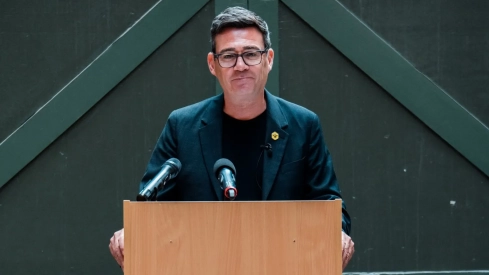
Andy Burnham has chosen Manchester to showcase the first major piece of his project for the United Kingdom. The favorite to succeed Keir Starmer at the head of the Labour Party and Downing Street has advocated for the creation of a ‘Northern Number 10’, an extension of the prime minister's office outside London that should coordinate a new stage of political, economic, and administrative decentralization. The message is clear for a country exhausted by Brexit, the decline in living standards, and the feeling of abandonment in many medium-sized and coastal cities: less Whitehall and more local power.
The days of Whitehall fighting devolution are over. pic.twitter.com/5hno4Ai7dr
— Andy Burnham (@andyburnham) June 29, 2026
Burnham, former Mayor of Greater Manchester and recently returned to Westminster, wants to turn his municipal experience into a national program. He speaks of “Manchesterism,” a formula that combines public intervention, housing, transport, urban regeneration, and collaboration with businesses. His idea involves transferring powers and decision-making capacity to local authorities so that regions can design their own growth, build public housing, reform business rates, and strengthen technical education in the face of an economy too concentrated in London and the Southeast.
The proposal touches one of the most sensitive nerves in British politics. The United Kingdom has been promising territorial rebalancing for years, but the state machinery remains highly concentrated in London. Scotland, Wales, and Northern Ireland have their own institutions, while England operates with a mosaic of regional mayoralties, under-resourced local councils, and a strong dependence on Whitehall. Burnham tries to occupy a broad political space there: speaking to the industrial north, to Labour's working-class belts, and to voters who look to Nigel Farage and Reform UK out of weariness with Westminster.
The speech also sought to calm the markets. Burnham has promised to respect the fiscal rules inherited from the Labour government, with a balance between revenue and current expenditure and a reduction of public debt to GDP. This point matters because his plan sounds ambitious, but still leaves questions about funding, local taxes, and the actual distribution of powers. He wants more state in basic services and more local power, but without opening an immediate war with the Treasury or the City.
The right has already smelled an avenue of attack. Conservatives accuse Burnham of selling more regulation, more spending, and more public control, while the far-right Reform UK tries to present him as another Labour leader who reaches Downing Street without going through a general election. Within Labour, however, the shift in tone is evident. Burnham moves better in street language than Starmer, connects with regional pride, and promises a politics less confined to Westminster.
The timeline is short. Candidacies for the Labour leadership will be presented between July 9 and 16. If no viable rival appears, Burnham will be proclaimed leader on July 17 and could enter Downing Street on July 20. Before that, he will have to put numbers and names to a project that, for now, has opened the most uncomfortable debate for the old British power: who really rules the United Kingdom and from where its future is decided.
