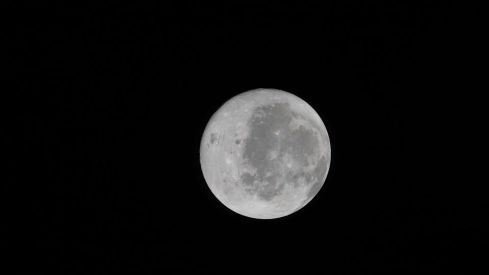
More than five decades after the last human journey to the Moon, NASA's Artemis II mission has returned humanity to lunar orbit, marking a before and after in space exploration. The Orion spacecraft, with four astronauts on board, took off on April 1 from Cape Canaveral (Florida) and has successfully completed one of the most ambitious phases of the Artemis program, the successor to the historic Apollo program.
The crew, formed by Reid Wiseman, Victor Glover and Christina Koch, of NASA, along with Canadian Jeremy Hansen, has protagonized several simultaneous milestones. Koch has become the first woman to reach lunar orbit, Glover the first astronaut of color to do so, and Hansen the first non-American to participate in a lunar mission of the agency. This combination makes Artemis II the most diverse mission ever sent towards the Moon.
One of the most notable moments of the journey occurred when the spacecraft exceeded 406,000 kilometers of distance from Earth, establishing a new historical record and surpassing the Apollo 13 mark in 1970. “They have now traveled farther from Earth than any other human in history,” celebrated the NASA administrator, Jared Isaacman, in a public message.
During their passage on the far side of the Moon, the astronauts were incommunicado with Earth for about 40 minutes, a foreseen phenomenon due to the interference of the satellite itself. It was precisely during that segment when the crew carried out one of the most relevant observations of the mission, studying a region that is never visible from our planet.
The lunar observation phase, which developed during about seven hours, allowed the astronauts to analyze the surface at a minimum distance of about 6,500 kilometers. Through photographs and direct observation, they detected color variations, brown and bluish tones, which help to better understand the mineral composition and the age of the Moon.
Additionally, the mission coincided with an exceptional phenomenon: a 53-minute total solar eclipse visible only from its position around the Moon. This event allowed for the study of the solar corona under unique conditions, as well as the observation of possible meteorite impacts and suspended dust on the lunar horizon.
The experience on the far side left deep impressions on the crew. “We saw things no human being had seen before, not even in the Apollo program”, affirmed Commander Reid Wiseman. For his part, Victor Glover recounted that, despite the tension of the moment without communications, “I said a small prayer, but then I kept recording.”
The mission also included a conv
ersation live with the president of the United States, Donald Trump, who thanked the “bravery” of the astronauts and reaffirmed the goal of establishing a permanent presence on the Moon. “We will return to leave not only footprints, but a lasting mission,” he stated.
Despite some minor setbacks, such as a toilet malfunction and the presence of uncomfortable odors in the capsule, the mission has progressed without critical problems. Artemis II now faces its return to Earth, scheduled for April 10 with a landing off the coast of San Diego, thus closing a ten-day expedition that opens a new era in lunar exploration.
Add ElConstitucional.es as a preferred Google source for free.
Stay informed about all the latest breaking news with the best information. Against disinformation, for democracy and social rights.
