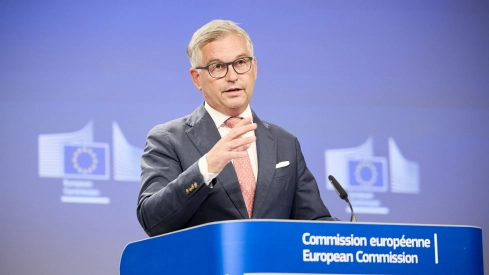
The European Commission has taken a first concrete step this Friday to strengthen its response to the Ceuta crisis. A community technical mission will travel next week to the autonomous city to learn about the situation on the ground and specify what European means Spain needs after the irregular entry of more than 70,000 people from Morocco at the end of July.
The trip has been agreed upon after a conversation between the Minister of Interior, Fernando Grande-Marlaska, and the European Commissioner for Home Affairs and Migration, Magnus Brunner. The Interior Ministry has assured that the community official has received information on the evolution of the crisis, the pace of triage, the processing of asylum applications, and the planned measures to return those who do not have the right to remain in Spain.
"I had a good phone call with Minister Grande-Marlaska on the evolving situation in Ceuta," Brunner explained. The commissioner also highlighted Spanish efforts to improve security and confirmed "important progress" in the request for financial and operational assistance submitted to Brussels.
I had a good phone call with Minister Grande-Marlaska on the evolving situation in Ceuta. He updated me on Spain’s response and the next steps concerning the return of those who remain illegally, as well as efforts to improve security on the ground.
— Magnus Brunner (@magnusbrunner) September 4, 2026
A mission to specify European aid
The delegation will allow community experts to verify Ceuta's needs and define the possible reinforcement of the European Border and Coast Guard Agency (Frontex), the European Union Agency for Law Enforcement Cooperation (Europol), and the European Union Agency for Asylum. Emergency funding continues to be evaluated and will require a subsequent decision from the Commission.
The announcement comes after Brussels acknowledged this Thursday that it still had "important open questions" about the Spanish requests. The European spokesperson for Home Affairs and Migration, Markus Lammert, avoided specifying these doubts and linked them to how the requested economic and operational resources would be deployed on the ground.
The call between Grande-Marlaska and Brunner has brought positions closer, although there are still aspects to be finalized. The Commission keeps the file among its priorities and the mission will serve precisely to convert general requests into identified needs, deployment locations, and concrete actions.
The Ministry of Interior has requested 32 million euros to finance 14 measures related to emergency management. The package includes resources for triage and file processing, Asylum Agency personnel to conduct interviews and interpretation tasks, and more community support in border management.
Frontex is already working in the port of Ceuta. The Government wants to expand this intervention with a permanent presence both in the port and at the border breakwater, a possibility that will now have to be analyzed with the agency itself. Sánchez has also asked Europol for a specific mission to monitor irregular migratory movements and combat human trafficking networks.
The European response will also have to cover return procedures. Brussels has insisted on the return of those who remain in an irregular situation, once their files have been resolved and the guarantees provided for those seeking international protection have been respected. According to data presented by the President of the Government, Pedro Sánchez, more than 90% of those who crossed during the first hours returned to Morocco in the following three days.
The political leap towards greater integration
The operational deployment constitutes the immediate part of the negotiation. The Executive has simultaneously opened a longer-term debate for Ceuta and Melilla to gain weight within the community architecture. Sánchez announced this Thursday that Spain will request its entry into the customs union, a stable representation in the European Committee of the Regions, and recognition as outermost regions.
The European Union currently has nine territories under this statute, including the Canary Islands, Madeira, the Azores, and six French regions. Their geographical uniqueness allows for the adaptation of community rules on taxation, customs, public aid, agriculture, or fishing, in addition to facilitating specific allocations from European funds.
The recognition would provide Ceuta and Melilla with more stable economic and institutional support, but it requires complex negotiation. The change requires altering their fit within the Treaty on the Functioning of the European Union, consulting the European Parliament, and obtaining the unanimity of the Twenty-Seven. The Government must also convince its partners that the geographical and economic position of both cities justifies incorporating them into a regime reserved for territories with permanent structural conditions.
Integration into the customs union has a foreseen path since Spain's accession to the European communities. It also needs a proposal from the Commission and the unanimous support of the Member States. In the Committee of the Regions, Spain has 21 representatives and can reorganize its delegation to allow the autonomous cities to enter, with subsequent formal approval from the Council.
The technical mission will coincide with the visit of the president of Ceuta, Juan Jesús Vivas, to Brussels next Tuesday. The Ceuta leader will meet with Brunner and with the European Commissioner for the Mediterranean, Dubravka Šuica, and will go to the European Parliament to address the city's situation together with the president of the Committee on Civil Liberties, Justice and Home Affairs, Javier Zarzalejos.
