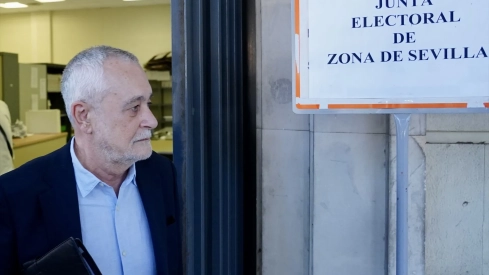
The European Commission has taken a key step in the judicial process of the ERE case by arguing that the Court of Justice of the European Union (CJEU) is “manifestly incompetent” to rule on the annulment of convictions issued by the Constitutional Court of Spain. In its submissions, Brussels requests that the preliminary question raised by the Provincial Court of Seville be declared inadmissible.
The origin of the conflict dates back to July 2025, when the Audiencia sevillana decided to raise a query to the TJUE after the Constitutional Court's rulings that annulled the convictions of several former high-ranking officials of the Junta de Andalucía for the aid system of the employment regulation files (ERE). Among those benefited by these resolutions are the former Andalusian presidents of the PSOE Manuel Chaves and José Antonio Griñán.
In its written submission, the European Commission argues that the issues raised do not fit within Union law, since the funds involved come from the regional budget and not from the community budget. Therefore, it considers that Article 325 of the Treaty on the Functioning of the EU, which protects European financial interests, is not applicable, and underlines that the CJEU cannot rule on matters outside its scope of competence.
Brussels goes further and states that the requested interpretation “has no relation with reality or with the object of the main litigation”. In this regard, it emphasizes that in none of the previous resolutions, neither of the Audiencia de Sevilla, nor of the Tribunal Supremo de España, nor of the Constitutional Court itself, is European funding linked to the investigated program mentioned.
The Audiencia de Sevilla had argued that, although the funds were national, there could be an indirect impact on the financial interests of the European Union. However, the Commission rejects this approach and deems it insufficient, pointing out that without a direct link to the community budget, the issues raised are “purely hypothetical”.
The background of the case lies in the judgments issued in 2024 by the Constitutional Court, which concluded that both the Audiencia and the Supremo incurred in an “extravagant and unpredictable” interpretation of the crimes of prevarication and embezzlement, violating the fundamental right to criminal legality enshrined in the Constitution. These resolutions obliged to issue new judgments adjusted to that doctrine.
Given this situation, the Seville Court decided to suspend the drafting of the new rulings and resort to the TJUE to avoid, as it argued, a possible “systemic risk of future impunity” and guarantee the fight against corruption. However, the position of the European Commission considerably reduces the possibility that the European court will assess the merits of the case, returning the focus of the ERE case to the strictly national sphere.
Add ElConstitucional.es as a preferred Google source for free.
Stay informed about all the latest breaking news with the best information. Against disinformation, for democracy and social rights.
