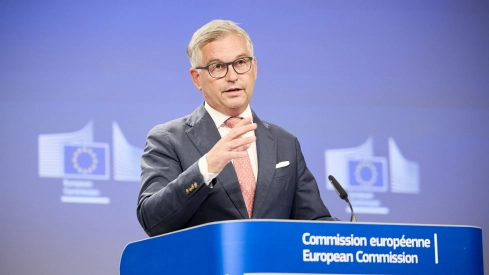
Brussels has turned the Ceuta crisis into a warning for the entire European Union. The Commission has closed ranks with Spain, is studying granting it additional financial aid, and calls for strengthening Europe's capacity to protect its borders without being exposed to the decisions of neighboring countries like Morocco.
The Community Executive received this Wednesday a first assessment of the needs sent by the Spanish authorities. Its services are now analyzing what equipment, border services, and humanitarian or medical resources can be financed. Spain will then have to submit a formal request and the amount will be set when that examination is completed.
The possible support will be added to the more than 1,000 million euros allocated to Spain through the Home Affairs Funds for the period 2021-2027. The country has also received 114 million in emergency assistance and other European actions, of which about 28 million have been allocated to Ceuta. Frontex maintains more than 30 agents on the ground, while Europol and the European Union Agency for Asylum are prepared to expand their intervention.
What happened in Ceuta was a test of our resilience and the security of our external borders.
— Magnus Brunner (@magnusbrunner) August 5, 2026
We restored control because we acted together. Now, we must draw the right conclusions and strengthen our response.
Full press conference:https://t.co/31fssshJrh pic.twitter.com/YApYJ9n8aq
A border dependent on Morocco
The European Commissioner for Home Affairs and Migration, Magnus Brunner, has argued before the European Parliament that the events in Ceuta have left a conclusion difficult to ignore. "As long as control depends on the goodwill of a neighboring state, we will remain vulnerable," he warned during his appearance before the Committee on Civil Liberties, Justice and Home Affairs.
Brunner acknowledged that the actions of the Spanish authorities, collaboration with Morocco, and community support allowed the situation to be contained. Almost all of the people who returned to Moroccan territory did so in the following days, no one passed from Ceuta to the Peninsula, and the Schengen area maintained its integrity. The joint response regained control, but Brussels believes that this capacity for reaction must now be accompanied by prevention and European autonomy.
The Commission has wanted to place the crisis within a migratory trend that had been improving. Irregular crossings of the EU's external borders have decreased by 55% over the last two years and by nearly another 40% so far in 2026. The just over 49,000 entries registered this year across the Union are roughly equivalent to those received by the Greek islands during a single week in October 2015.
Ceuta has, however, altered the perception of that progress. "Dramatic images outweigh the best statistics," Brunner acknowledged. More than 70,000 people crossed in a matter of hours, encouraged, according to the Commission, by criminal networks and messages spread on digital platforms. The crisis also left 75 dead and subjected the external border to exceptional pressure.
The response proposed by Brussels combines the full application of the Pact on Migration and Asylum, faster border procedures, agile returns, and a strengthening of Frontex. It also includes early warning systems capable of detecting disinformation campaigns and coordinated movements through social media.
The Commission wants to use trade, visa, and development cooperation policies more effectively to ensure the collaboration of countries of origin and transit. Migration precisely occupies a central place in the strategic partnership that the European Union is negotiating with Morocco, an agreement on which Ceuta has placed new demands.
The directive against mafias is still pending
Brunner has also taken advantage of the crisis to urge the European Parliament to unblock the European directive against migrant smuggling. The Commission presented the proposal in November 2023 and the Council set its negotiating position in December 2024, but the European Parliament still needs to adopt its mandate to open negotiations between the institutions.
The norm aims to harmonize crimes and penalties within the Union, expand jurisdiction over organizations operating from third countries, and ensure specialized police and judicial units. The initial proposal contemplates higher sentences when networks act with violence, endanger vulnerable people, or cause deaths.
The delay also responds to the discussion about its guarantees. The rapporteur for the European Parliament, German social democrat Birgit Sippel, has proposed expressly defining humanitarian assistance to prevent it from being prosecuted and eliminating some overly broad concepts from the original proposal. The Parliament must still close the balance between the prosecution of criminal organizations and the protection of those who provide legitimate aid to migrants.
Brunner demands that this discussion end as soon as possible. He also calls for expanding cooperation with digital platforms to remove content used by traffickers and approving a global sanctions regime against those who organize these movements. "The impact of criminal migrant smuggling networks on our security is simply unacceptable," he stated.
The Commission has set October as the first horizon to advance on the five priorities raised after Ceuta. Interior ministers will re-examine them at the next Justice and Home Affairs Council before they reach the European Council. The first decision now rests with the European Parliament and its position on the directive against mafias.
Add ElConstitucional.es as a preferred Google source for free.
Stay informed about all the latest breaking news with the best information. Against disinformation, for democracy and social rights.
