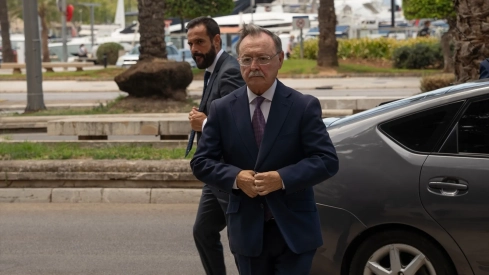
The president of Ceuta, Juan Jesús Vivas, brought the city's migratory crisis to the European Parliament this Thursday. The popular leader has demanded the immediate expulsion of Moroccan citizens who entered irregularly and still remain in Spanish territory, as well as a European reinforcement of the border with more personnel, material resources, and infrastructure.
Vivas spoke via videoconference before the Committee on Civil Liberties, Justice and Home Affairs of the European Parliament. The extraordinary session was promoted by the Popular Party and included the participation of the European Commissioner for Home Affairs and Migration, Magnus Brunner. Ministers Fernando Grande-Marlaska and Elma Saiz had been invited, although they ultimately did not participate in the meeting.
Expulsions, European agencies, and more resources
Most of the nearly 80,000 people who crossed the border on July 30 and 31 have already returned to Morocco. Vivas has estimated that between 3,000 and 5,000 migrants remain in Ceuta, while the reception centers for adults and minors remain collapsed and the city faces a large-scale humanitarian emergency.
The Ceuta president acknowledged that the authorities still lack an exact figure and attributed this situation to the "precariousness of resources" deployed to identify those who remain in the city. The occupation of resources for minors reaches a level equivalent to 2,600% of its usual capacity, well above the threshold that legislation considers critical.
Vivas also conveyed the mood of the population after a week marked by tension. "Our population feels sad, helpless, uneasy, fearful, and worried," he stated before warning that the crisis has exposed the dependence on border cooperation with Rabat. "It has become evident that we are extraordinarily vulnerable, that our security and integrity are in the hands of Morocco, which does not recognize our sovereignty," he pointed out.
🔴Juan Jesús Vivas, presidente de Ceuta, sobre la crisis migratoria en la ciudad autónoma: "Se ha puesto en evidencia que somos extraordinariamente vulnerables, que nuestra seguridad e integridad están en manos de Marruecos, que no reconoce nuestra soberanía". #Canal24Horas pic.twitter.com/XWMWjddmAG
— RTVE Noticias (@rtvenoticias) August 6, 2026
The popular leader has resorted to the term "invasion" to describe the massive entry and has linked it to the second meaning collected by the Royal Spanish Academy, referring to the anomalous or irregular occupation of a place. Based on that diagnosis, he has asked the European Parliament that what happened not be reduced to just another migratory crisis and receive a political and structural response.
His proposal includes reinforcing the State Security Forces and Corps, carrying out the necessary works at the border, and enabling new facilities to care for adults and minors. Vivas has also requested the "explicit and unequivocal" support of community institutions and the active presence in Ceuta of Frontex, Europol, and the European Asylum Agency.
The expulsion request is directed at Moroccan citizens who entered irregularly and remain in the city. During the question period, Vivas himself recalled that minors are protected by the principle of the best interests of the child and cannot be subject to collective returns. Each possible return requires checking their family circumstances and all legal guarantees.
The president of Ceuta has also expressed his concern about messages spread on social media that point to next August 15 as the date for a possible new entry attempt. Vivas has admitted that it is unknown if it will occur, but believes that its circulation shows the anguish with which Ceuta faces the vulnerability of its border.
Brunner has agreed that depending on the will of a single neighboring country keeps the entire European Union exposed. The commissioner has argued that Brussels should use the instruments at its disposal, including trade and visa policies, to guarantee Morocco's cooperation on migration. Vivas was even more emphatic in stating that Rabat "is not a reliable country".
Meetings with Prohens and King Felipe VI
Before his European intervention, Vivas met for more than an hour with the president of the Balearic Islands, Marga Prohens, at the Consolat de Mar. The president of Ceuta conveyed to her the "serious situation" the city is going through and the need to restore normality with lasting solutions, border protection, and support for the local productive fabric.
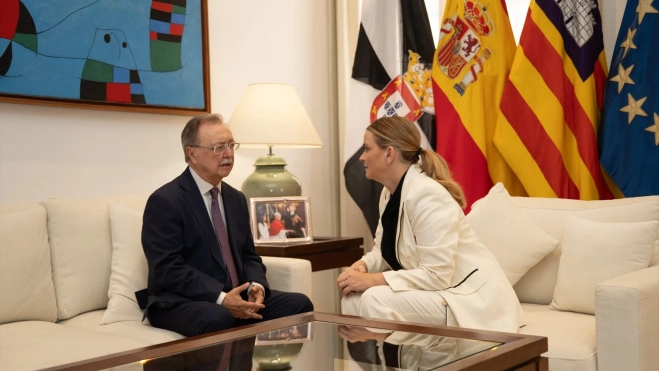
Prohens has expressed her concern about circumstances of "extraordinary complexity" and has acknowledged the response offered by Ceuta's institutions and society. Vivas thanked her for her "support and solidarity" during a meeting held during his institutional visit to Palma.
Vivas will complete his agenda this Thursday at 5:30 p.m., when he will be received by Felipe VI at the Marivent Palace to address the Ceuta crisis.
Add ElConstitucional.es as a preferred Google source for free.
Stay informed about all the latest breaking news with the best information. Against disinformation, for democracy and social rights.
