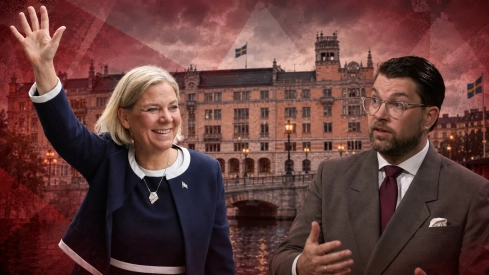
Barely 28,000 votes separate the two blocs in Sweden that aspire to govern for the next four years. With nearly 95% counted, the opposition led by Social Democrat Magdalena Andersson provisionally gathers 176 deputies, one more than needed to reach an absolute majority, while Ulf Kristersson's right-wing remains at 173.
The result of the elections held this Sunday, September 13, remains open. Around 200,000 ballots still need to be incorporated into the count, including early votes that did not reach their polling stations in time and votes sent from abroad. The small distance between both blocs allows for the distribution of one or more seats to change over the next few days.
The Swedish Election Authority explains that these ballots will be grouped into 314 special districts and will begin to be counted on Wednesday, although the process may extend until Thursday. After that will come the definitive scrutiny, carried out by the provincial administrations, which review all votes cast. The official result is usually finalized approximately one week after the elections.
The caution also responds to the most recent precedent. In 2022, the right-wing ended up winning by 176 seats to 173, exactly the same difference that now favors the opposition. The first polls that night had pointed in the opposite direction, and the pending vote ended up confirming Kristersson's victory.
The significance of a few ballots goes far beyond deciding who occupies the prime minister's office. A victory for the right-wing could allow the far-right Sweden Democrats to enter the Government for the first time, after four years of supporting the conservative executive from outside and conditioning a large part of its policies on immigration, security, and social benefits.
Magdalena Andersson has avoided declaring herself the winner. "If this result holds, Sweden will have a new Government," she stated to her followers. Kristersson has also not conceded defeat and is waiting for the overseas vote before making any decision. The provisional results released by Swedish public television leave a majority that is too narrow to anticipate the outcome.
The Social Democrats continue to be the leading force with 28.1% and 100 deputies, although they lose more than two points and seven seats. Kristersson's Moderates rise to 19.9% and reach 70 representatives. Sweden Democrats fall to 17.5%, lose eleven deputies and are left with 62, while the Left Party grows to 8.3% and achieves 29.
The Centre Party obtains 7.1% and 25 seats, the Greens reach 6.1% and 22 representatives, the Christian Democrats also get 22 deputies with 6.2% and the Liberals survive with 5.4% which allows them to retain 19 seats. The eight parties that were already part of Parliament once again exceed the national barrier of 4%.
The setback of the far-right Sweden Democrats keeps their threat alive
The Sweden Democrats have suffered their first fall in a general election since they burst into Parliament in 2010. Jimmie Åkesson's party loses three points, ceases to be the second force and even retreats in territories of Scania that for years functioned as its main strongholds.
The blow gains relevance in a Europe where the far-right has continued to expand its institutional presence. It also represents a punishment for a party that aspired to convert its external support into ministries, budgetary power and direct capacity to manage migration policy. Kristersson had left open during the campaign the possibility of giving them responsibilities within the Executive.
However, more than 1.1 million Swedes have once again chosen Åkesson's ballot. Their 17.5% keeps the Sweden Democrats as the third force and ensures that they will continue to have considerable influence over the right. It is also warned that a part of their fall may come from strategic voting and internal movements within the conservative bloc itself.
The Liberals reached the final stretch threatened with disappearing from Parliament if they fell below 4%. Numerous moderate and Sweden Democrat voters may have lent them their ballot to save the entire bloc. According to the electoral study by public television 'SVT', 64% of those who finally voted for the Liberal Party decided their option during the last week.
That transfer helped the liberals reach 5.4% and prevented dozens of right-wing seats from being unrepresented. Åkesson's setback contains a part of rejection of his party, but also an operation of electoral survival among parties that share four years of government and parliamentary agreements.
The influence of the Sweden Democrats can be better measured in the policies implemented since 2022. The conservative government eliminated permanent residence permits for refugees, tightened access to certain aid, and accelerated expulsions. Asylum applications have fallen to their lowest level in four decades and Sweden has abandoned much of the reception model that characterized the country during the 2015 refugee crisis.
Åkesson took that agenda even further during the campaign. His party proposed increasing deportations, ending multiculturalism, and banning certain Islamic garments in public spaces. The reaction gathered by 'Reuters' in neighborhoods with a high migrant population shows the extent to which these proposals mobilized voters who feared a new turn of the screw. In Rinkeby, the entire opposition reached almost 94% of the votes.
The Left Party has grown especially in some of these popular neighborhoods, where it has managed to present itself as the clearest answer to the far-right. This mobilization explains part of its increase of five deputies and also the setback of social democrats who in recent years have accepted a much more restrictive migratory framework.
The problem of integration will continue to occupy a central position in Swedish politics. Around a fifth of the population was born abroad and unemployment among immigrants reaches 16.4%, compared to 6.2% registered among those born in the country. At the same time, public services increasingly depend on these workers.
The contradiction will accompany the next government. Sweden needs to correct the labor, educational, and residential inequalities that fuel segregation, while its population ages and numerous municipalities lack professionals. Turning all immigration into a threat can provide votes to the far-right, but it also exacerbates the staff shortage already suffered by healthcare and care services.
Kristersson's provisional defeat also does not mean that the tightening of migration policies will disappear. The Social Democrats have adopted part of these policies, and Andersson has ruled out returning to the model of the last decade. Political scientist Niklas Bohlin, from Mid Sweden University, believes that the general shift towards a more restrictive policy is here to stay.
Government's wear and tear opens a difficult majority for Andersson
The possible victory of the opposition bloc contains a serious warning for the Social Democrats. 28.1% represents their worst result since 1908, although the party is once again the most voted, a position it has held uninterruptedly since 1917. Andersson loses more than two points compared to 2022 and registers some of its most significant setbacks in the north of the country.
The bloc advances thanks to the growth of its potential allies. The Left Party gains five seats and the Greens add four, while the Centre Party improves slightly. The change in majority comes from an internal redistribution of the opposition vote and the decline of the Sweden Democrats, far from a Social Democratic recovery.
The shift to the left is partly a response to discontent with the cost of living, precariousness, and the deterioration of public services. The economy has begun to recover, and the gross domestic product grew by 1.6% during the second quarter, but the most recent data also show a drop in activity in July. Unemployment remains at 8.7%, according to the Swedish statistical office, a high figure for a country that has made employment one of the pillars of its social model.
Households have endured the effects of inflation, high interest rates, and loss of purchasing power during the legislature. The pressure also reached municipalities and regions, responsible for education, healthcare, and a large part of care services. In 2024, several hospitals announced thousands of job cuts while regional deficits soared, a crisis that led many professionals to denounce the erosion of the welfare state.
The Executive tried to reach the elections with an expansive budget of 80 billion kronor. The largest item was allocated to tax cuts, the VAT on food was temporarily reduced, and military spending increased considerably. Along with these measures, the Government tightened social benefits and established cuts that could exceed 8,000 kronor per month for a family with five children.
The economic recovery of recent months came too late to erase the accumulated wear and tear. Andersson has promised to strengthen healthcare, education, and care, review the tax system, and demand a greater contribution from banks and higher incomes. The advance of the Left Party and the Greens increases the pressure for these promises to become the focus of the next legislature.
Parliamentary arithmetic will complicate that program. Andersson needs the support of the Left Party, the Greens, and the Centre Party to maintain the 176 seats that the count now attributes to the opposition. The Centre rejects sharing government with the Left Party, while this party demands to enter the Council of Ministers and insists that large fortunes finance a larger part of public spending.
Sweden operates under a system of negative parliamentarism. A candidate can be invested as long as 175 deputies do not expressly vote against them. This formula facilitates minority governments, although it forces negotiations on abstentions, budgets, and legislative agreements with very different parties.
The Speaker of Parliament, Andreas Norlén, has already warned that the formation of the Government can become a complicated process. After the 2022 elections, 37 days were needed to close the right-wing agreement, and in 2018, talks lasted 134 days.
Before these negotiations, the decisive moment of the recount will arrive. On Wednesday, late-arriving early ballots and votes from abroad will be incorporated, with sufficient capacity to modify the last seat allocation. Afterwards, provincial administrations will complete the definitive review, and Norlén will formally begin consultations to check if Andersson can convert her 28,000-vote advantage into a Government.
Add ElConstitucional.es as a preferred Google source for free.
Stay informed about all the latest breaking news with the best information. Against disinformation, for democracy and social rights.
