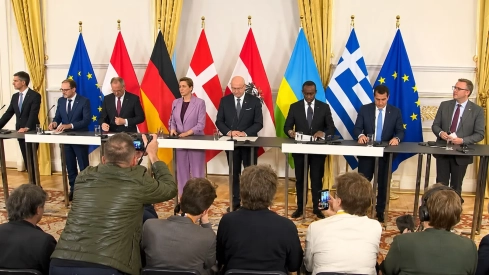
Five European Union countries have closed an agreement with Rwanda to establish a return center outside community territory, a maneuver that aims to accelerate expulsions that are not currently carried out and that has already caused an open clash with Pedro Sánchez and Emmanuel Macron.
Denmark, Germany, the Netherlands, Greece, and Austria announced this Monday, in Vienna, the start of negotiations with the Rwandan authorities. The plan aims to launch the project in 2027 and, for now, foresees a facility for about a hundred people.
The objective is to transfer adults whose asylum applications have been rejected and who, in addition, have exhausted all avenues of appeal and have an enforceable expulsion order, but cannot be returned to their countries of origin. The promoting governments present the initiative as a way to close the gap between issued orders and returns that finally materialize. According to Eurostat, in 2025, Member States issued 491,950 return orders for non-EU citizens, but only 135,460 deportations were carried out, around 28%. This difference is what the promoters want to reduce with a model that, for now, still lacks details on its funding, supervision, and control mechanisms.
Unlike previous migration agreements, the center would not be conceived as a detention facility. Transferred individuals could remain in Rwanda, integrate into its society, and access the labor market or voluntarily request to return to their countries of origin, although details on operation, funding, and supervision are still pending.
Sánchez and Macron reject a model that promoters sell as a deterrent
Pedro Sánchez distanced himself from the plan with a resounding message. "I see no future or humanity in that. It is not the solution," he said this Monday in an interview with Telecinco. Emmanuel Macron had already expressed a similar rejection of return centers in third countries in June. The French president considered them "neither effective nor in line with our values" and warned of legal, technical, operational, and moral obstacles.
Faced with these criticisms, the governments pushing the agreement maintain that the center will serve to reinforce migration control and discourage irregular entry into the European Union. Danish Prime Minister Mette Frederiksen defined it as "a game changer," while Austrian Chancellor Christian Stocker spoke of a "historic paradigm shift."
German Interior Minister Alexander Dobrindt also defended that the plan will be applied in accordance with European and German legislation and with respect for human rights. This political promise, however, still does not clarify how the mechanism will operate or who will assume surveillance on the ground.
DIRECTO #Canal24Horas | El modelo de deportación a Ruanda
— RTVE Noticias (@rtvenoticias) November 17, 2026
🗣️Cecilia Estrada, RRII en U. Comillas y experta en migraciones: "Ningún país europeo debe desentenderse de esta obligación" pic.twitter.com/FeCWDGFtT2
Legal guarantees remain open as pressure grows in Brussels
The debate has already reached the European Parliament. Swedish MEP Charlie Weimers, from the European Conservatives and Reformists, supported the initiative and highlighted its possible deterrent effect, while Renew Europe MEP Abir Al-Sahlani questioned why Rwanda could execute returns that European countries themselves cannot manage to close.
From The Greens, French MEP Mélissa Camara called the agreement a "disgrace" and accused the governments involved of making a deal with an authoritarian regime without sufficient guarantees for the transferred individuals. NGOs have also raised objections. Human Rights Watch argues that the agreement does not meet European protection requirements and warns of Rwanda's history of political repression, arbitrary detentions, and ill-treatment attributed to Rwandan authorities.
The organization calls for concrete guarantees regarding the supervision of facilities and the right of affected individuals to appeal transfers. Judith Sunderland, associate director for Europe and Central Asia, has also questioned why monitoring mechanisms and access for international observers remain unclear.
Amnesty International has made similar criticisms. Its expert on asylum and migration in Austria, Aimée Stuflesser, believes that the plan repeats errors from previous outsourcing attempts and warns of the risk that transferred individuals may fall outside public scrutiny.
UNHCR, for its part, reminds that any such agreement must respect international law and the principle of non-refoulement, which prevents transferring a person to a place where they may suffer persecution or ill-treatment. The project is based on the new EU Returns Regulation, but its implementation still depends on specific agreements with Rwanda and legal guarantees that, for now, remain unresolved.
Negotiations continue and the timeline points to 2027, but before then, the conditions of transfer, facility supervision, and appeal routes for those affected must be defined.
Contact