The German government formally accused Russia this Tuesday of organizing the failed drone attack with explosives against Leipzig/Halle airport on August 4. The main target of the operation was several Ukrainian transport aircraft located in one of Germany's most important logistics facilities.
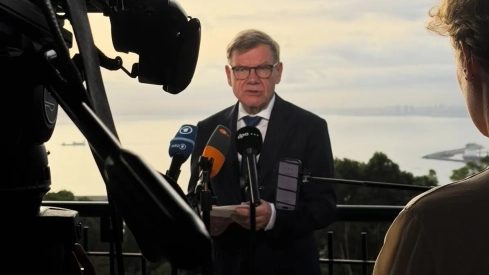
Interior Minister Alexander Dobrindt and Foreign Minister Johann Wadephul appeared together in Berlin to present the conclusions of the investigation. Friedrich Merz's executive maintains that police investigations, the pattern followed by the perpetrators, and information collected by intelligence services accredit Russian responsibility.
Investigators have found a configuration of drones, explosives, and detonation systems already identified in other hybrid operations attributed to Moscow. Dobrindt also assured that there are indications about individuals who acted on behalf of Russian state bodies. The planning required advanced technical knowledge, although the execution would have been left to low-level agents recruited for a specific mission.
Three Drones Loaded with Explosives
At least three devices participated in the attack. One was found in the airport's security zone, a few meters from the Antonov planes used by Ukraine to transport material. The drone carried explosives and a detonator that suffered a technical failure, which prevented the charge from exploding.
A second device crashed that same night into a DHL cargo plane that was performing a takeoff maneuver. The aircraft suffered minor damage and ended up diverting to Hannover airport. The third drone appeared on August 14 in a field near the facilities, also equipped with explosives.
Leipzig/Halle airport houses part of the Ukrainian commercial fleet since the country's airspace was closed due to the Russian invasion. It also plays a prominent role in the transport of military supplies and in the logistical operations of the North Atlantic Treaty Organization (NATO). The German federal prosecutor's office is investigating the events as a serious attack against the country's air and logistical infrastructure.
Dobrindt has placed what happened within a broader campaign of sabotage, espionage, cyberattacks, and actions against critical infrastructure. "Germany is a daily target of hybrid warfare," the minister warned, considering it likely that Russia will try to promote new operations on German territory.
Berlin hardens its response against Moscow
The German government has summoned the Russian ambassador and announced the closure of the Russian Consulate General in Bonn starting September 18. It will also rescind the agreement that allows the Russian House in Berlin to operate, a cultural center dependent on the Embassy that has been under suspicion for years of serving as a cover for intelligence activities.
The response includes more demanding controls for Russian citizens entering Germany, new sanction proposals within the European Union, and greater pressure on the so-called Russian shadow fleet, used to transport oil and other resources circumventing Western restrictions. Berlin will also maintain its civil and military support for Ukraine.
Moscow had already rejected any involvement when the investigation began. The Russian Embassy then called the incident a "fabricated provocation" and accused German authorities of fueling a new wave of "anti-Russian hysteria."
The accusation has coincided with the discovery of several explosive and incendiary devices in an electrical substation in Brandenburg, near the Jänschwalde thermal power plant. The devices were homemade projectiles similar to New Year's Eve rockets, and some caused damage and a brief interruption in several lines.
The general supply network continued to operate, and the affected lines have resumed service. The Police keep the investigation open and have not yet attributed this second attack to Russia. The President of Brandenburg, Dietmar Woidke, has called for stronger protection of critical infrastructure given the frequency of these episodes.
