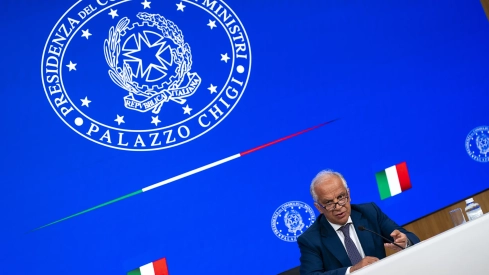
The ultraconservative Government of Giorgia Meloni will maintain controls on travelers from Spain and will prolong the diplomatic clash opened between both countries after the massive entry of people into Ceuta. The Italian Minister of Interior, Matteo Piantedosi, assured this Thursday that Rome will not review its decision before August 15.
Piantedosi has conditioned any change on the "complete exclusion" of risks to Italy's security. The measure affects air and sea connections from Spain and focuses on citizens of third countries, although the checks have ended up altering the free movement between two European Union partners in the middle of the tourist season.
The Italian position comes while Spain has already identified 3,115 passengers arriving from Italy. National Police controls have reached travelers on 273 flights and have mobilized 446 agents since they began during the early hours of Saturday, according to the latest data provided by the Ministry of Interior.
Rome maintains its suspicions about Ceuta
Meloni's Government justifies its actions by the fear of possible secondary movements from Ceuta and by the calls disseminated on social networks to attempt another massive entry on August 15. Piantedosi has added the risk that these mobilizations could be used for jihadist recruitment, although his appearance has not provided public evidence of displacements from Ceuta to Italy.
The reality on the ground has changed considerably since July 30. The vast majority of people who crossed from Morocco returned during the first days and the Ceuta authorities estimate that around 10,000 still remain in the city. More than 600 have voluntarily left Ceuta during the last 48 hours due to the impossibility of continuing their journey to the peninsula.
Ceuta also has a special regime within the Schengen area. Those who enter the city irregularly lack automatic access to the peninsula and the rest of European territory, one of the main arguments used by the Spanish Government to question the threat that Rome presents as the basis for its controls.
Piantedosi has reported to the Italian Parliament three arrests and the rejection of 21 third-country nationals since the beginning of the verifications, six of them Moroccans. The minister has also not detailed that these people had entered through Ceuta nor has he established a direct relationship with the Spanish migratory crisis, according to information published by the Italian agency 'ANSA'.
Rome defends that its decision fully complies with community law and recalls that other countries have temporarily reinstated internal controls. The European Commission allows the use of this tool in the face of a serious threat, but establishes that it must be used as a last resort, for the essential time and respecting the principles of necessity and proportionality.
The notification sent by Italy to Brussels maintains controls between August 1 and September 1. Spain has communicated its own from August 8 to September 7. The registration of both measures by the Commission certifies that they were notified, but does not in itself constitute a definitive endorsement of their necessity or proportionality, which remain subject to European supervision.
More than 3,000 identifications in Spain
Piantedosi has accused Madrid of following a "substantially retaliatory logic", despite the fact that the origin of the confrontation lies in the unilateral decision previously adopted by Rome. The minister has tried to downplay the diplomatic scope of his words by assuring that Italy maintains historical ties of "friendship and brotherhood" with Spain.
The last formal position released by Moncloa described the Italian measure as "unjust, contrary to the interests of the EU and discriminatory". The Executive recalled that almost all of those who entered Ceuta had returned to Morocco, questioned the alleged consequences for Italy and accused Meloni of promoting the conflict for internal electoral motivations. The official statement also reproached Rome for adopting its decision without prior notice.
In the last 24 hours, 430 passengers have passed through Spanish controls. Madrid-Barajas concentrated 175 identifications on five flights and Barcelona-El Prat another 106 on seven connections. Checks were also carried out in Valencia, Bilbao, Malaga and various airports in the Balearic and Canary Islands.
Spanish checks are random and are also aimed at citizens from countries outside the European Union. Community passengers retain their right to free movement, although the re-establishment of controls requires the deployment of police and subjects arrivals from Italy to checks that had disappeared between both countries.
Rome will maintain its measures at least until Saturday, August 15. Spain maintains its order until September 7 and conditions the return to normality on the Meloni Government first withdrawing the controls that opened the conflict.
Add ElConstitucional.es as a preferred Google source for free.
Stay informed about all the latest breaking news with the best information. Against disinformation, for democracy and social rights.
