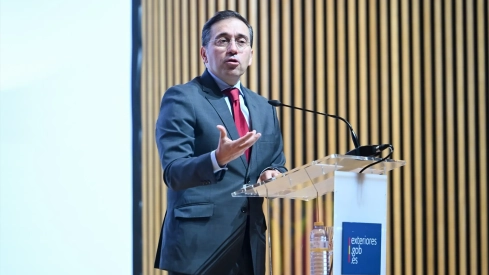
The Ministry's headquarters has been the scene of a new warning from the Minister of Foreign Affairs, European Union and Cooperation, José Manuel Albares, against the Taliban regime in Afghanistan, which he has accused of committing a "gender apartheid" and of subjecting women and girls to a system of discrimination, segregation, and constant violence.
The minister inaugurated for the fourth consecutive year at the Foreign Ministry's headquarters the HearUs summit, organized together with the entity Women for Afghanistan, an event that this edition is held under the motto "Afghan Women's Leadership to Achieve Justice and Peace Through Accountability". During his speech, José Manuel Albares stressed that the Taliban cannot aspire to international legitimacy as long as they continue to violate the fundamental rights of the female population.
"Afghanistan has become the most evident place of the violation of women's rights," said the minister, who recalled that, after the Taliban came to power five years ago, women have been excluded from education, employment, and deprived of their freedom of movement and expression. "A system of discrimination, segregation, constant violence against women and girls," he summarized.
Albares insisted that this is a crime that must be named with precision, because, he said, "it goes beyond mere segregation." In this regard, he defended that Spain supports the recognition and criminalization of gender apartheid in International Law, and announced that the Spanish Government will work to incorporate this figure in the upcoming negotiations of the Convention on Crimes Against Humanity.
"We will promote a stronger legal response to forced marriage, sexual and reproductive violence, and persecution on gender grounds," said the minister, who also stressed that the international community has a responsibility to investigate these crimes, identify those responsible, and activate mechanisms for accountability.
Spain supports investigation and accountability mechanisms
The Minister of Foreign Affairs has assured that Spain supports international initiatives aimed at documenting human rights violations in Afghanistan and has highlighted the Government's financial contribution to the launch of the new independent investigation mechanism, with the aim that it can begin its work and contribute effectively to accountability in the Asian country.
“Their actions will not be forgotten, and we will not tolerate them going unpunished,” said José Manuel Albares, before insisting that Spain will “never accept these systematic violations of Human Rights against women and girls.” “No power can aspire to be legitimate while systematically denying the mere dignity of women,” he added.
The minister also promised Afghan women that their tragedy will not disappear from the international agenda and reiterated that the Taliban regime will not be recognized as long as it continues to trample on women's rights. “The future of Afghanistan is yours. And without you, there is no future for Afghanistan,” he concluded before the summit participants.
Pramila Patten warns of the seriousness of the crimes
Also speaking at the meeting was the Special Representative of the United Nations Secretary-General on Sexual Violence in Conflict, Pramila Patten, who denounced that “no other country has imposed such exhaustive and systematic restrictions on half of the population, based solely on gender” as Afghanistan.
Patten argued that the international community should recognize the seriousness of these acts, which, in her opinion, can be considered crimes against humanity. “Accountability is not revenge,” she stated, “but refusing to accept that there are people who are above the law.” The UN official called for data, evidence, and a mechanism to advance in the search for accountability.
“We have to tell survivors that what happened to them matters,” she stressed, while warning that the challenge is to ensure that the existing mechanism can come to fruition. To do this, she called for “political will, sustained support, and the necessary resources,” and urged not to leave Afghan women without protection or funding.
Fawzia Koofi warns of the political exclusion of 43 million people
The president of Women for Afghanistan, Fawzia Koofi, has thanked Spain for its support of Afghan women and has denounced the persecution and discrimination they suffer in their country, supposedly "in the name of Islam," when, she affirmed, that interpretation contradicts what that religion truly promulgates.
Koofi described the situation in Afghanistan not only as a human rights crisis or a humanitarian crisis, but also as a political crisis, in which a minority, the Taliban, controls power and the rest of the population, "about 43 million people," is completely excluded and without the capacity to express an opinion on the future of the country.
The leader considered that Spain, having experienced a dictatorship 50 years ago, understands the pain of those who cannot decide their own destiny. She also insisted that Afghan women are knocking on "all doors" to demand justice and warned that, if action is not taken, the consequences of this situation could extend beyond Afghan borders and reach Europe.
Contact