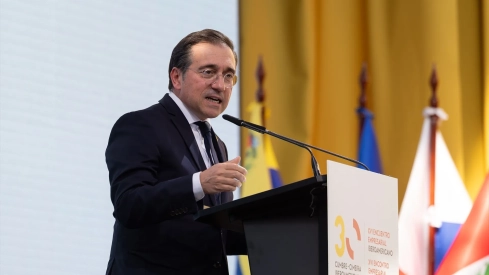
The Minister of Foreign Affairs, European Union and Cooperation, José Manuel Albares, regretted this Monday that, in his opinion, there are “too many actors” in the so-called “European team” that will participate in the peace talks on Ukraine, a format made up of representatives from five countries and European institutions.
Upon his arrival at the Foreign Affairs Council (FAC) held in Brussels, Albares pointed out that this configuration could lead to “a cacophony” and warned that “that is not the most effective way for Europe to work,” while insisting that “some fundamental institutional actors” are missing.
At the FAC, the minister will also participate in a review of the decision adopted by the leaders of the Twenty-Seven last week in Dublin.
Defense of Kaja Kallas's role
The Foreign Minister defended the High Representative of the European Union for Foreign Policy, Kaja Kallas, chosen by the Twenty-Seven to be “the voice of Europe” abroad, and stressed that, in his opinion, she “undoubtedly should be” in the talks.
For now, the European group will be represented by Germany, France, the United Kingdom, Italy, and Poland, in addition to high-ranking officials from the European Commission and the European Council. Albares recalled that the agreed format is, for now, a format at the level of national security advisors, although he maintained that “at some point” the foreign ministers of the European Union will have to get involved in the process.
Spain demands a seat at the table
In his statements, José Manuel Albares also stressed the importance of Spain having representation in these peace talks, stating that “nothing will be decided” in relation to European security and with Europe and Ukraine “without Spain being seated at that table and Spain being able to decide.”
“There is no doubt about that,” said the minister, who linked this position to the role that member states must play in a debate that directly affects the future of continental security.
The Dublin agreement and European representation
Albares' statements come after European leaders agreed last Friday, during the informal summit held in Dublin, that Germany, France, Italy, Poland, and the United Kingdom, along with representatives from the European Commission and the European Council, would form the European team that will participate in the peace talks sponsored by the United States.
That agreement came after Kaja Kallas asserted her role as a European interlocutor in the negotiations, by virtue of her responsibilities as High Representative for Foreign Policy, although ultimately the leaders opted for broader representation, without designating a single person to speak on behalf of the bloc.
Contact