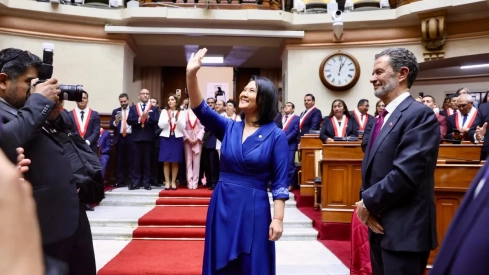
Keiko Fujimori has been sworn in this Tuesday as president of Peru and has returned Fujimorism to power 26 years later. The leader of Fuerza Popular has received the presidential sash before Congress to begin a mandate that will extend until 2031, almost three decades after her father, Alberto Fujimori, resigned by fax from Japan while his government was sinking due to a huge corruption scandal.
At 51 years old, Fujimori becomes the first woman elected by popular vote to govern Peru. Dina Boluarte had already served as President between 2022 and 2025, although she came to office by constitutional succession after the impeachment of Pedro Castillo.
The new president finally reaches power after losing the second rounds of 2011, 2016, and 2021. On this occasion, she defeated leftist Roberto Sánchez by less than 50,000 votes and thanks to decisive support received from abroad, after her rival won within Peruvian territory.
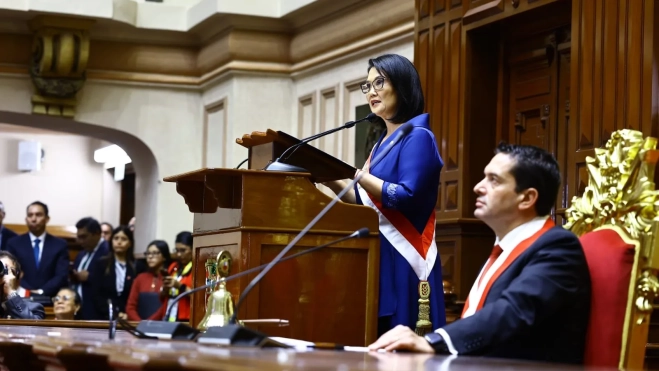
Fujimori has sworn to preserve "national sovereignty, freedom, and democracy" and has promised to work for a country that is "safe, prosperous, and united." She has also publicly limited her mandate to "the next five years, not one day more," a precision aimed at containing fears about any attempt to prolong her stay in power as her father did.
Army, mega-prisons, and anonymous judges
Citizen security will be at the center of the new stage. Fujimori has announced that the Armed Forces will temporarily assume internal control during states of emergency and will act alongside the Police against organized crime, with special attention to extortion and drug trafficking.
The president also arrives with a campaign built around "iron fist". Among her commitments are the construction of mega-prisons inspired by Nayib Bukele's model in El Salvador and the recovery of faceless judges for certain processes against criminal organizations. This last formula was already used during Alberto Fujimori's government and received strong criticism for the lack of judicial guarantees.
Fujimori has also promised to prepare the country for a new episode of the El Niño phenomenon and to request legislative powers to accelerate prevention measures. In economic matters, her government is committed to reducing state spending, attracting private investment, and maintaining the autonomy of the Central Bank, with economist Elmer Cuba at the head of the Ministry of Economy.
The ultraconservative turn also appears in her defense of the role of religion. During the oath, Fujimori assured that she would recognize "the importance of the Catholic Church in the cultural and moral formation of Peru," a statement that connects with the religious sectors that have supported Fuerza Popular.
The return of the surname that still divides Peru
The inauguration brings back one of the most controversial surnames in the country's recent history. Alberto Fujimori governed between 1990 and 2000, carried out the self-coup of 1992, and was eventually sentenced to 25 years in prison for crimes against humanity, in addition to receiving other convictions linked to different corruption cases.
Keiko Fujimori was his first lady from the age of 19, after her mother, Susana Higuchi, separated from the then-president after denouncing corruption and mistreatment. Since then, the new president has consistently defended her father's political legacy and has built Fuerza Popular around that inheritance.
"Dad, today Peru remembers you and millions carry you in their hearts," Fujimori wrote a few hours before taking office. The message has reopened the wounds of the relatives of the victims of La Cantuta and Barrios Altos, two of the massacres for which the former president was convicted.
Human rights collectives, students, and victims' relatives have called for mobilizations under the slogan "Keiko does not represent me. For justice, memory, and truth." The new president thus begins her mandate with one part of the country celebrating the promise of stability and another warning about the return of a project linked to authoritarianism, corruption, and human rights violations.
Felipe VI has led the official Spanish delegation and attended the ceremony in Congress. The monarch met with Fujimori on Monday at the Torre Tagle Palace, where both reaffirmed the ties between Spain and Peru and addressed political and economic cooperation and the fight against organized crime.
🇵🇪 On the eve of the Supreme Command Transmission ceremony, the King holds a meeting with the elected president of the Republic of Peru, Keiko Fujimori, at Torre Tagle Palace.
— Casa de S.M. el Rey (@CasaReal) July 27, 2026
➡️https://t.co/xqdg7qYpJi pic.twitter.com/V8bJEWJVnG
Milei, Kast and Feijóo embrace her arrival
The ceremony has gathered in Lima several leaders of the Latin American right and far-right. Among the attendees were Javier Milei, José Antonio Kast, Daniel Noboa, Santiago Peña, Nasry Asfura and José Raúl Mulino, while Lula da Silva and Claudia Sheinbaum avoided attending the event.
Fujimori met with the ultra Milei before the inauguration and agreed to strengthen cooperation between Peru and Argentina in economy, security, science and technology. She also held meetings with Kast and Noboa to advance in the fight against organized crime. The new president seeks to integrate into the ultraconservative bloc that has spread across the region and bring Peru closer to the Donald Trump Administration.
The elected president, Keiko Fujimori, held a meeting with the president of Argentina, Javier Milei, to promote greater integration and reaffirm the commitment of both countries to an agenda of growth and development. pic.twitter.com/FkLiQgfhxK
— Oficina de la Presidenta Electa (@ope_peru) July 28, 2026
To this map will soon be added the far-right Abelardo de la Espriella, elected president of Colombia. His vice president, José Manuel Restrepo, has represented the new Colombian Administration in Lima and has agreed with Fujimori to fully restore diplomatic relations by sending ambassadors.
Alberto Núñez Feijóo has also traveled to Peru to accompany the inauguration, after having expressly asked for the vote for Fujimori from Peruvians residing in Spain. The president of the PP already presented her victory as "great news" for Hispanic America and spoke of the beginning of a "time of hope."
Lima gathers these days the main Ibero-American leaders.
— Alberto Núñez Feijóo (@NunezFeijoo) July 28, 2026
Peru is a strategic ally for Spain that deserves prosperity and stability. @KeikoFujimori will work for this to be so. And I will do so for my country to be a bridge between the European Union and Ibero-America.
Today… pic.twitter.com/F65Q2P6krS
Feijóo met bilaterally with the president and took advantage of his stay in Lima to hold meetings with Kast and Noboa. He was accompanied by Ana Pastor, Dolors Montserrat, and other popular leaders. The PP has thus turned the investiture into another photograph of its rapprochement with the most conservative governments in Ibero-America.
Fujimori will now complete the appointment of his first Council of Ministers. Luis Galarreta will serve as prime minister, Elmer Cuba will head Economy, and journalist Carlos Espá will assume Foreign Affairs. The return of Fujimorism begins with the Army as a response to insecurity, a liberal economic agenda, and the backing of the new Latin American ultraconservative bloc.
