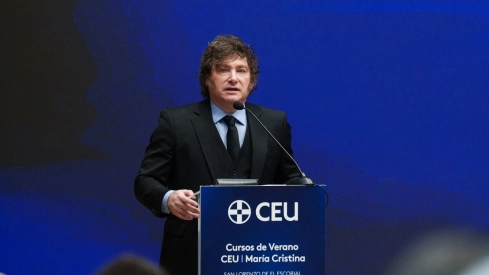
The president of Argentina, Javier Milei, has returned to Madrid to do what best fits his international agenda: receive a distinction, lash out against the left, and be embraced by the Spanish right. In his sixth visit to Spain since arriving at the Casa Rosada, the ultraliberal leader is not scheduled to meet with the President of the Government, Pedro Sánchez, nor with King Felipe VI, but he has found time to strengthen his rapport with Santiago Abascal.
Milei received the Medal of Honor from CEU San Pablo University this Friday during the inauguration of the CEU-María Cristina Summer Courses. Under the guise of a conference on economics and political morality, the Argentine president deployed his usual repertoire against the State, taxes, social justice, Europe, and everything he identifies with the left. “Evil comes wrapped in the best intentions, but they are always red,” he even said to an enthusiastic audience.
His speech also included a strong defense of the State of Israel, increasingly questioned for the offensive in Gaza and its attacks in the region. Milei presented it as “the bastion of the West” and linked the left with terrorists for sharing, according to his discourse, a supposed common enemy: free-enterprise capitalism.
The Argentine president also did not miss the opportunity to meddle in Spanish politics. Without directly naming Sánchez, he alluded to the judicial cases surrounding the PSOE, spoke of politicians with “porous hands” and mentioned “one and a half million in jewelry” and “the leaks about the wife.” Milei already caused a diplomatic crisis in 2024 by calling Begoña Gómez, the wife of the President of the Government, “corrupt.” This time he was not so direct, but he has once again used Madrid as a stage to attack his ideological adversaries.
The speech also comes at a time when the Argentine government itself faces internal problems due to investigations and scandals affecting figures in its inner circle. Milei, who usually presents himself as a scourge of the “caste,” has avoided applying the same level of demand to his closest collaborators. In Spain, he preferred to look towards Ferraz, Zapatero, or Sánchez rather than dwell on the shadows of his own Executive.
Abascal, Vox, and the mirror sought by the Spanish far-right
The visit has also had its political photo. Milei met this Thursday with Santiago Abascal, leader of the far-right Vox, a relationship that has become one of the preferred international axes of the Spanish far-right. Abascal's party has been showcasing the Argentine for years as a reference for cultural battle, cuts, deregulation, and a frontal clash against the left.
It is always an honor to welcome my good friend @JMilei, president of the Argentine Republic, to Spain. pic.twitter.com/esV3Nz9SfW
— Santiago Abascal 🇪🇸 (@Santi_ABASCAL) June 25, 2026
The link is not just personal. Vox has built part of its recent economic discourse around the idea of the "chainsaw" and deregulation, precisely the ground where Milei boasts of having eliminated thousands of regulations in Argentina. The presence of Vox leaders at the CEU event, along with officials from the Popular Party such as the mayor of Madrid, José Luis Martínez-Almeida, has once again left an uncomfortable image for the Spanish right: Milei does not come to Spain to do institutional diplomacy, but to feed a political network of allies.
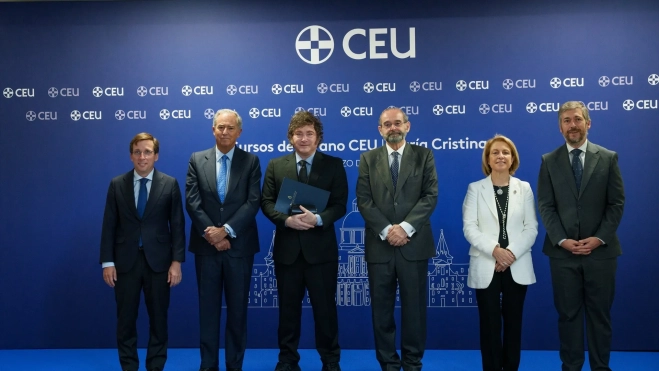
Almeida also joined the friendly photo with the Argentine president and highlighted the ties between Spain and Argentina. The problem is not in remembering these historical ties, but in overlooking that Milei uses each visit to Madrid to strain the relationship with the Spanish Government, attack the left, and strengthen Vox in its attempt to present itself as part of an international far-right wave. The visit will continue this Saturday with business meetings to sell Argentina as an investment destination.
