The clash between Spain and Italy over free movement within the Schengen area will last at least two more weeks. The Government of Giorgia Meloni decided this Tuesday to maintain border controls for travelers from Spain for 15 more days, a measure initially adopted after the massive entry of migrants into Ceuta at the end of July.
Madrid responded hours later with an identical extension. The Ministry of Interior has informed the European Union that controls at ports and airports with direct connections from Italy will continue until October 8, although the deadline could be shortened if circumstances change.
The Italian decision was adopted by the Minister of Interior, Matteo Piantedosi, after meeting with the Committee for the Analysis of Immigration and Border Security. Rome maintains that "high risks to internal security" and a "potential threat" of terrorist infiltrations persist, according to information released by the Italian Ministry of Interior.
The Italian statement maintains this warning in general terms and does not provide specific cases linking the entry of migrants into Ceuta with terrorist organizations. Nor does it explain how many of the people intercepted during the first weeks of controls actually came from the autonomous city.
Albares accuses Meloni of undermining Schengen
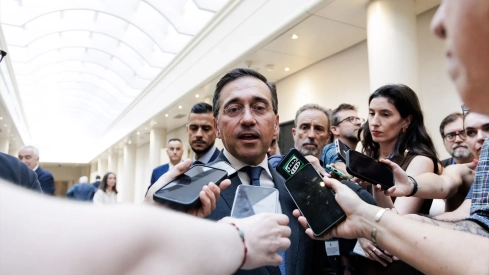
The Minister of Foreign Affairs, José Manuel Albares, reacted with particular harshness from the Senate. "It is absurd, it is useless and it is a shame because it is undermining the spirit and philosophy of what it means to be European partners," he assured.
Albares believes that the Italian Executive, led by the far-right, is using the Ceuta crisis to fuel its internal agenda. He also accused Meloni and the Italian Minister of Foreign Affairs, Antonio Tajani, of acting below the responsibility expected of two European leaders.
"It is a direct attack on the dignity of Spaniards and on the unity and solidarity of Europeans," the minister insisted. In his opinion, the decision is especially difficult to justify when Italy currently receives twice as many irregular entries as Spain.
The head of Foreign Affairs recalled that Madrid avoided imposing controls on Italian travelers during the 2023 Lampedusa migratory crisis. Spain then offered its collaboration to Rome and agreed to transfer part of the people who arrived on the island to Spanish territory.
Albares has also directed his criticism at the PP and Vox. He has asked the popular party to intervene with Forza Italia, Tajani's party and PP's partner in the European People's Party, and Santiago Abascal's formation to convey to its allies on the Italian radical right that the measure is "absurd and ridiculous".
The Schengen Borders Code allows for the temporary reintroduction of internal controls in the face of a serious threat to public order or security. The European Commission reminds, however, that it must be an exceptional measure, limited to the indispensable minimum and subject to the principles of necessity and proportionality.
More than 180,000 identified and only 31 rejections
The results provided so far by Rome show a considerable distance between the alarm used to justify the measure and its concrete effects. During August, Italian authorities consulted passenger lists of nearly half a million people and directly identified more than 180,000 travelers arriving from Spain.
Of all of them, Italy rejected the entry of 31 people, among whom were eight Moroccan citizens, and made six arrests. The rejections represent less than 0.02% of the identified travelers, according to data from the Italian Ministry of Interior itself.
The figures released by Rome also do not detail how many of these actions were related to the Ceuta crisis. The Italian Executive has defended that the controls are mainly aimed at citizens of third countries and that Spanish, Italian and other European Union travelers can travel normally carrying their documentation.
The Italian opposition already accused Meloni when the restrictions began of resorting to migratory propaganda to divert attention from her internal problems. The left-wing leader Nicola Fratoianni demanded the withdrawal of a measure that, he denounced, was causing an unnecessary diplomatic conflict with Spain.
Italy reintroduced controls at its air and sea borders with Spain on August 1. The Spanish Government demanded their withdrawal and responded on the 8th by applying random checks to travelers coming from Italy. Since then, successive extensions have kept open a political struggle affecting two European Union partners and partially suspending free movement between both countries.
Add ElConstitucional.es as a preferred Google source for free.
Stay informed about all the latest breaking news with the best information. Against disinformation, for democracy and social rights.
